Advertised GLP-1 telehealth plans start around $149 to $199 per month, but the true long-term cost for maintenance doses ranges from $299 to over $1,300 monthly, depending on the drug, formulation, and insurance stability. The cheapest advertised price is usually an entry point, not a reliable estimate of what treatment will cost after dose escalation.
That distinction changes the entire answer to GLP-1 weight loss cost. A consumer comparing only month-one prices may overlook higher maintenance doses, provider fees, shipping, laboratory work, deductibles, and the possibility that an insurer removes coverage during treatment. The financially useful question isn't “What does this plan cost?” It's “What will I pay at the dose I'm likely to use, under the coverage rules I can realistically keep?”
The Starting Dose Pricing Trap
The lowest advertised GLP-1 price often describes the shortest part of treatment. Comparing that figure with another introductory offer can produce a neat answer to GLP-1 weight loss cost, but it can also conceal the bill that follows dose escalation.
Treatment commonly starts at a lower dose, then increases under clinical supervision. Cash prices reported in 2026 ranged from about $149 per month for a low-dose oral GLP-1 to $199 to $399 per month for some injectable starting doses. These are entry prices, not dependable forecasts of later spending. CNBC's breakdown of GLP-1 cash pricing illustrates why a dose-specific offer can look affordable before the prescribed dose changes.
Why month one is a weak comparison
The starting dose has a clinical purpose. It gives the prescriber time to assess tolerability and adjust treatment rather than beginning with a higher dose immediately. The financial implication is direct: the dose that attracts a buyer may not be the dose that determines the long-term budget.
CNBC's 2026 cash-price reporting put injectable maintenance doses at roughly $299 to $699 per month or more. Manufacturer list prices for branded Wegovy and Zepbound were around $900 to $1,300 or more per month, according to their published pricing information. Those figures make a month-one comparison incomplete unless the buyer also confirms the charge at each planned dose.
Practical rule: Treat the advertised starting price as an enrollment price. Ask for the maintenance-dose price before authorizing recurring charges.
The dose-specific math
A useful comparison needs a price schedule rather than a banner figure. Request the monthly cost for the starting dose, every escalation stage, and the expected maintenance dose. Separate consultation, medication, shipping, and laboratory charges when the provider does not bundle them.
For a six- to twelve-month budget, calculate each treatment phase instead of assigning one price to every month:
- Introductory phase: Record the exact dose and monthly charge.
- Escalation phase: List each possible increase and its corresponding price.
- Maintenance phase: Use the charge for the dose the prescriber expects to continue, not the cheapest available option.
- Treatment interruptions: Confirm whether a missed shipment, paused subscription, or restart requires another consultation or a lower-dose reintroduction.
The same method clarifies comparisons between oral and injectable products. Formulation, dose, pharmacy arrangement, and prescribing model can all change the bill. A low-priced pill and a higher-priced injectable should be compared across the full treatment pathway and the period each price covers, not by their first monthly charges alone.
Retail Pharmacy vs Telehealth Pricing Models
Retail pharmacy and telehealth offer more than just different places to collect the same prescription. They often use different billing models, which changes how predictable the patient's total cost will be.
A retail buyer may encounter a branded list price, insurance deductible, copay tier, prior authorization requirement, specialty-pharmacy rules, or a manufacturer savings condition. A telehealth buyer may instead receive one recurring charge that combines clinical evaluation, medication fulfillment, follow-up access, and delivery. Neither model eliminates the need to verify clinical suitability or pharmacy legitimacy, but the budget behaves differently.
Two models, different financial risks
| Cost Factor | Retail Brand-Name, Wegovy or Zepbound | Telehealth Compounded, Weight Method |
|---|---|---|
| Medication price | May be covered by insurance, subject to plan rules, or billed at a high cash price | May be included in a published monthly program price |
| Provider evaluation | Often handled through an existing clinician, with separate visit billing possible | Typically incorporated into the program structure |
| Dose management | Prescriber and pharmacy processes can vary | Should be verified as part of the recurring service |
| Shipping | May involve pharmacy pickup or separate delivery arrangements | May be bundled, but confirm the exact policy |
| Insurance friction | Can involve prior authorization, deductibles, and formulary restrictions | Cash-pay structure can avoid insurance authorization, but doesn't create insurance coverage |
| Price stability | Depends on plan design, pharmacy terms, and product pricing | Depends on the provider's published dose and subscription terms |
| Questions to ask | What will I owe at the pharmacy after approval? | What is included at my maintenance dose? |
Weight Method is one example of a telehealth model that combines provider care, medication, dose management, messaging, and home delivery into a recurring program. Its published pricing and inclusions should still be checked directly, especially because the telehealth cost breakdown may differ by medication and dose.
What “all-inclusive” must mean
“All-inclusive” has value only when the provider defines it. Ask whether the quoted price includes the medication itself, licensed-provider evaluation, follow-up consultations, dose adjustments, shipping, replacement shipments, and required laboratory work. Also ask whether the price changes when the dose increases.
Retail pharmacy pricing can be cheaper for a patient with stable insurance and a favorable formulary. It can also become difficult to forecast when the patient faces a deductible or a coverage denial. Telehealth can make recurring cash expenses easier to model, but it doesn't guarantee that a particular compounded product is appropriate, available, or clinically equivalent for every patient. A licensed clinician must assess the treatment and explain the pharmacy and formulation being used.
The right comparison is therefore not retail versus telehealth in the abstract. Compare your verified retail out-of-pocket cost at the intended dose with the telehealth price for the same treatment period and all included services.
Navigating Insurance Coverage and Benefit Churn
Insurance coverage creates a dangerous illusion of permanence. A patient may receive approval today, begin treatment, and then discover that an employer plan, state program, or formulary has narrowed eligibility before the next renewal cycle.
Recent 2026 reporting found that only about one-third of employers covered GLP-1s for obesity, while several state programs tightened eligibility or ended coverage. One Massachusetts report identified 112,000 fewer residents covered for GLP-1 weight-loss drugs in a single year. Marketplace's reporting on employer and public-program coverage illustrates why coverage status alone isn't enough. The relevant question is whether the benefit is durable.
Benefit churn changes the household budget
A coverage loss can transform a manageable copay into a large cash obligation. The patient may not have changed medication, dose, or prescriber, but the payer's rules can change around them. That creates benefit churn, the financial risk that access continues only while a particular plan design, employer policy, or public-program rule remains in place.
Ask your benefits administrator these questions before starting:
- Eligibility: Does the plan cover obesity treatment, diabetes treatment, or both?
- Authorization: What clinical criteria must be met, and how often is authorization renewed?
- Continuity: If the plan removes coverage, will current patients receive transition protection?
- Dose limits: Does the plan apply separate rules to introductory and maintenance doses?
- Formulary changes: Can the plan substitute another GLP-1 or exclude the current product?
- Appeals: What documentation is required if coverage is denied?
Consumers in Ohio who are also reviewing broader behavioral-health and medical insurance access may find it useful to examine resources such as psychiatry insurance accepted Columbus Ohio. That kind of provider-directory information doesn't establish GLP-1 eligibility, but it can help clarify which clinicians and insurance arrangements are available locally.
Medicare policy also shows how segmented access can become. A new Medicare Part D bridge program began allowing some beneficiaries access to certain weight-loss medications for $50 per month from July 2026 through December 2027, according to Medicare Rights Center's program explanation. The program is temporary and eligibility-based, so it shouldn't be treated as a permanent solution.
For a broader explanation of authorization questions and plan rules, review this guide to GLP-1 insurance coverage. The financially prudent move is to calculate a fallback cash price before treatment begins. If coverage disappears, you'll know whether continuing is feasible rather than discovering the answer at the pharmacy counter.
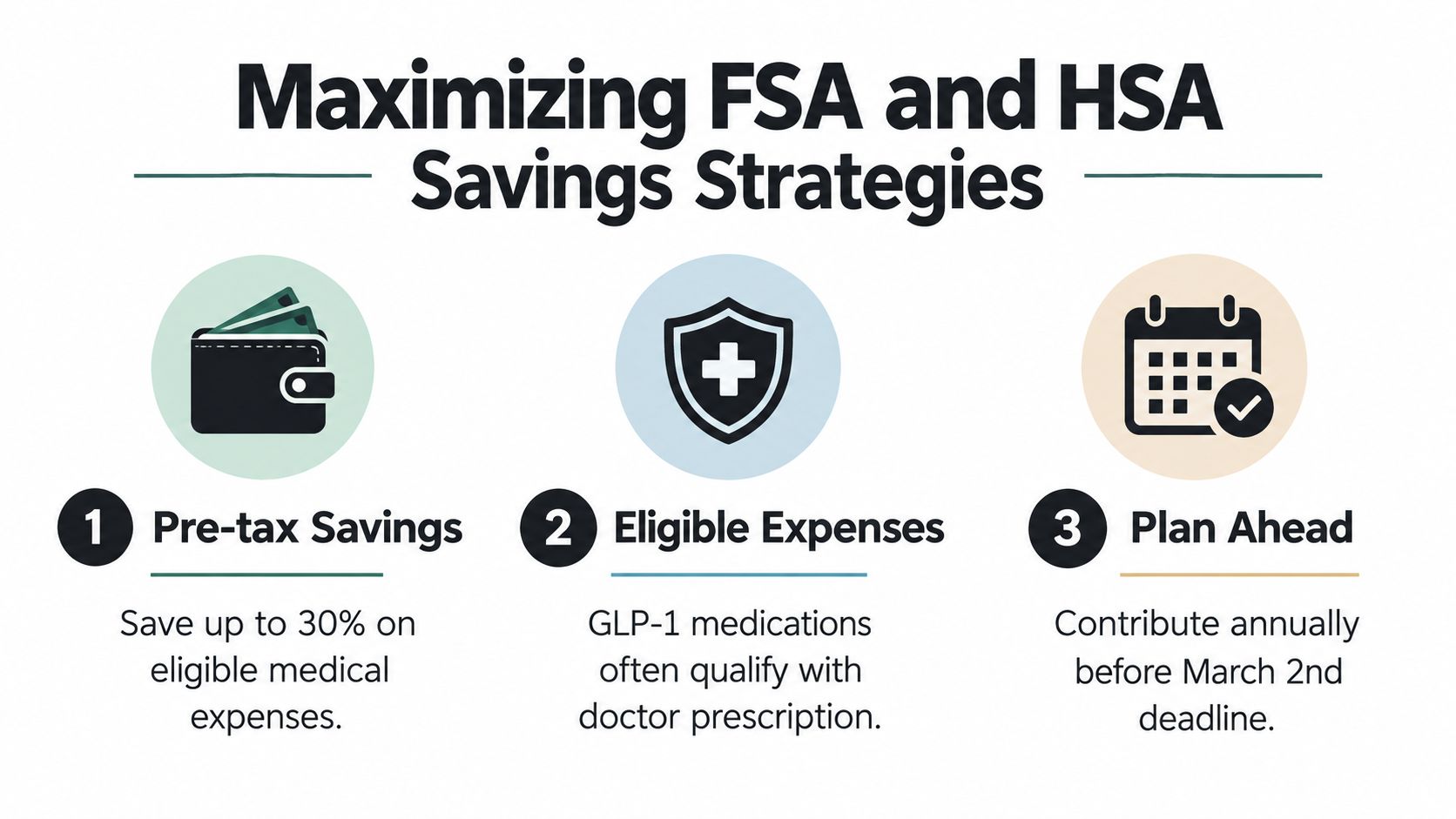
Maximizing FSA and HSA Savings Strategies
Tax-advantaged accounts can reduce the effective cost of eligible medical expenses, but they don't make every GLP-1 charge automatically eligible. The central requirement is documentation. A prescription, itemized receipt, provider statement, and explanation of the medical purpose can help support a claim, but account administrators and tax rules determine what qualifies.
Build an evidence file before paying
Start with the provider. Ask whether the consultation, prescribed medication, laboratory work, and follow-up services generate separate itemized receipts. If a telehealth program bundles multiple services into one monthly charge, request an explanation of the medical components and retain the full statement.
Use this checklist:
- Confirm eligibility: Ask the FSA or HSA administrator whether the prescribed GLP-1, consultation, and related laboratory work qualify under your plan.
- Keep prescriptions: Save the prescription or clinical documentation supporting medical treatment.
- Store itemized receipts: Retain dates, service descriptions, amounts, and payment records.
- Separate personal charges: Don't combine supplements, convenience products, or nonmedical services with eligible treatment expenses.
- Check deadlines: Reimbursement and carryover rules vary by account, so verify them before contributing or submitting a claim.
A resource on managing healthcare costs with Fintrack can help consumers think through account strategy, but it doesn't replace guidance from the account administrator or a tax professional. Eligibility can depend on the precise service, prescription status, and plan documentation.
Use promotions as risk control, not proof of affordability
Introductory discounts, first-month promotions, and money-back policies can reduce the cost of testing a program. They don't answer the more important question of what the maintenance dose will cost. Read the cancellation rules, refund conditions, shipping policy, and requirements for claiming a guarantee before paying.
Weight Method's explanation of FSA and HSA reimbursement can serve as a starting point for organizing receipts and asking account-specific questions. The safe sequence is simple: verify eligibility, document the expense, then submit it through the account's approved process.
The Economics of Clinical Effectiveness
Insurers aren't evaluating GLP-1s only by asking whether the drugs help patients lose weight. They're also asking how much health benefit the system receives for each dollar spent, across a covered population and over the expected duration of treatment.
Independent U.S. cost-effectiveness models estimated an incremental cost-effectiveness ratio, or ICER, of about $468,000 per quality-adjusted life year for semaglutide 2.4 mg and about $197,000 per QALY for tirzepatide. Both figures were above the commonly used $100,000 per QALY benchmark, according to the published cost-effectiveness analysis.
Why clinical value doesn't guarantee broad coverage
A treatment can provide strong clinical benefits while still looking expensive to a payer. The ICER calculation compares additional cost with additional health benefit. If the price remains high, a plan may restrict access even when clinicians and patients consider the treatment useful.
ICER's obesity evaluation estimated that semaglutide would meet common cost-effectiveness thresholds only if its annual net price fell to roughly $7,500 to $9,800 after rebates, compared with an annual net price of about $13,618. Its health-benefit price benchmarks were roughly $9,100 to $12,500 for injectable semaglutide and $11,700 to $16,100 for tirzepatide. ICER's final obesity evidence report connects those price benchmarks with the coverage pressure patients experience.
The implication is practical. Prior authorization isn't necessarily a judgment that the medication lacks value. It can reflect a payer's attempt to control population-level spending when current prices exceed its economic threshold.
The consumer sees a monthly prescription. The payer sees a recurring liability across every eligible member.
For patients, this explains why cash-pay telehealth can feel faster than insurance. A cash route may avoid an authorization queue, but it transfers the financial risk to the household. That makes clinical monitoring essential, not optional. Patients considering treatment can review information about professional monitoring for Wegovy patients, then discuss appropriate monitoring with their own clinician.
The best financial decision balances three variables: expected clinical value, verified maintenance pricing, and the likelihood that access will continue. Ignoring any one of them produces a misleadingly cheap or incomplete answer.
Calculating Your True Monthly Investment
Calculate GLP-1 cost as a total cost of ownership, not as the price printed beside a sign-up button. Start with the twelve-month treatment period you can afford to evaluate, then list every charge that could occur during that period.

Use this calculation:
True monthly average = total medication cost + provider fees + shipping + laboratory fees + insurance cost exposure, divided by the number of treatment months.
Then construct three scenarios rather than relying on one optimistic estimate.
Scenario one, stable insurance
Record the deductible, copay or coinsurance, authorization requirements, and maintenance-dose cost. Add the premium only if the GLP-1 benefit affects your choice of plan. Confirm whether the plan can change its formulary and whether you have a transition period if coverage ends.
Scenario two, retail cash
Use the actual pharmacy quote for the intended product and dose. Don't substitute a starting-dose price for a maintenance price. Add any consultation, specialty-pharmacy, delivery, and laboratory charges that the pharmacy quote excludes.
Scenario three, bundled telehealth
Ask for the recurring price at the expected maintenance dose and verify what the fee includes. Confirm provider evaluation, ongoing messaging, dose management, medication, shipping, laboratory requirements, cancellation terms, and the process for handling side effects or missed doses.
A simple decision matrix helps:
- Choose insurance authorization first if the plan confirms coverage in writing, your clinical criteria are documented, and you can tolerate potential authorization delays.
- Consider retail cash if the pharmacy gives you a dose-specific quote and the total remains affordable without relying on an uncertain discount.
- Evaluate transparent telehealth if you need predictable billing, home delivery, and ongoing provider access, and the program clearly states what happens as the dose changes.
The most important number is your fallback monthly cost after coverage disappears. If that amount would destabilize your budget, ask the insurer about continuity rules before starting and compare a bundled cash option before committing. A low month-one price can be useful, but only the full-course calculation tells you whether treatment is financially sustainable.
Weight Method offers a medically supervised telehealth pathway with provider consultations, ongoing messaging, dose management, medication delivery, and published program pricing. Visit Weight Method to compare the included services and verify the maintenance-dose cost before choosing a GLP-1 plan.