Ozempic has an elimination half-life of about one week and remains in circulation for roughly five weeks after the last dose. That means stopping a weekly injection doesn't create a clean break, because semaglutide can continue influencing appetite, digestion, and blood sugar after the final shot.
You may be asking because you're planning surgery, changing medications, preparing for pregnancy, or wondering why hunger hasn't returned immediately after stopping. The practical answer depends on separating two ideas: how long semaglutide remains in the bloodstream and how long its clinical effects continue. Those timelines overlap, but they aren't identical.
What Happens After Your Last Dose
A patient named Maya has reached a weight goal and decides, with her prescriber's guidance, to stop Ozempic. She expects the medicine to disappear within a few days because she was injecting it only once each week. Instead, the last dose continues leaving her body gradually, while the appetite and digestive effects fade over time.
Ozempic contains semaglutide, a long-acting GLP-1 receptor agonist given by subcutaneous injection. Its elimination half-life is approximately one week, or roughly 168 hours, and FDA labeling says semaglutide remains in circulation for about five weeks after the last dose. The FDA prescribing information for Ozempic also describes an apparent clearance of about 0.05 L/h in patients with type 2 diabetes, consistent with slow removal from the body.
The key distinction is between a weekly schedule and weekly disappearance. A weekly injection is timed to maintain useful exposure, not because the previous dose has vanished. After repeated weekly dosing, semaglutide builds toward steady-state concentrations over several doses, so the body is managing overlapping amounts of medication.
A useful starting framework
For someone who has just stopped:
- The first week: a substantial amount remains, and effects may feel much the same.
- The following weeks: the amount declines by roughly half during each half-life.
- Around five weeks: the remaining level is generally considered very low, although individual clearance can vary.
That framework answers the basic question, how long does Ozempic stay in your system, but it doesn't predict exactly when nausea, appetite changes, glucose shifts, or weight changes will occur. Maya might still feel appetite control during the early weeks, while another person notices changes sooner.
For medication information, including weekly administration and general treatment context, patients can review this Ozempic medication guide, then discuss their own timeline with the prescribing clinician.
What a Half-Life Actually Means
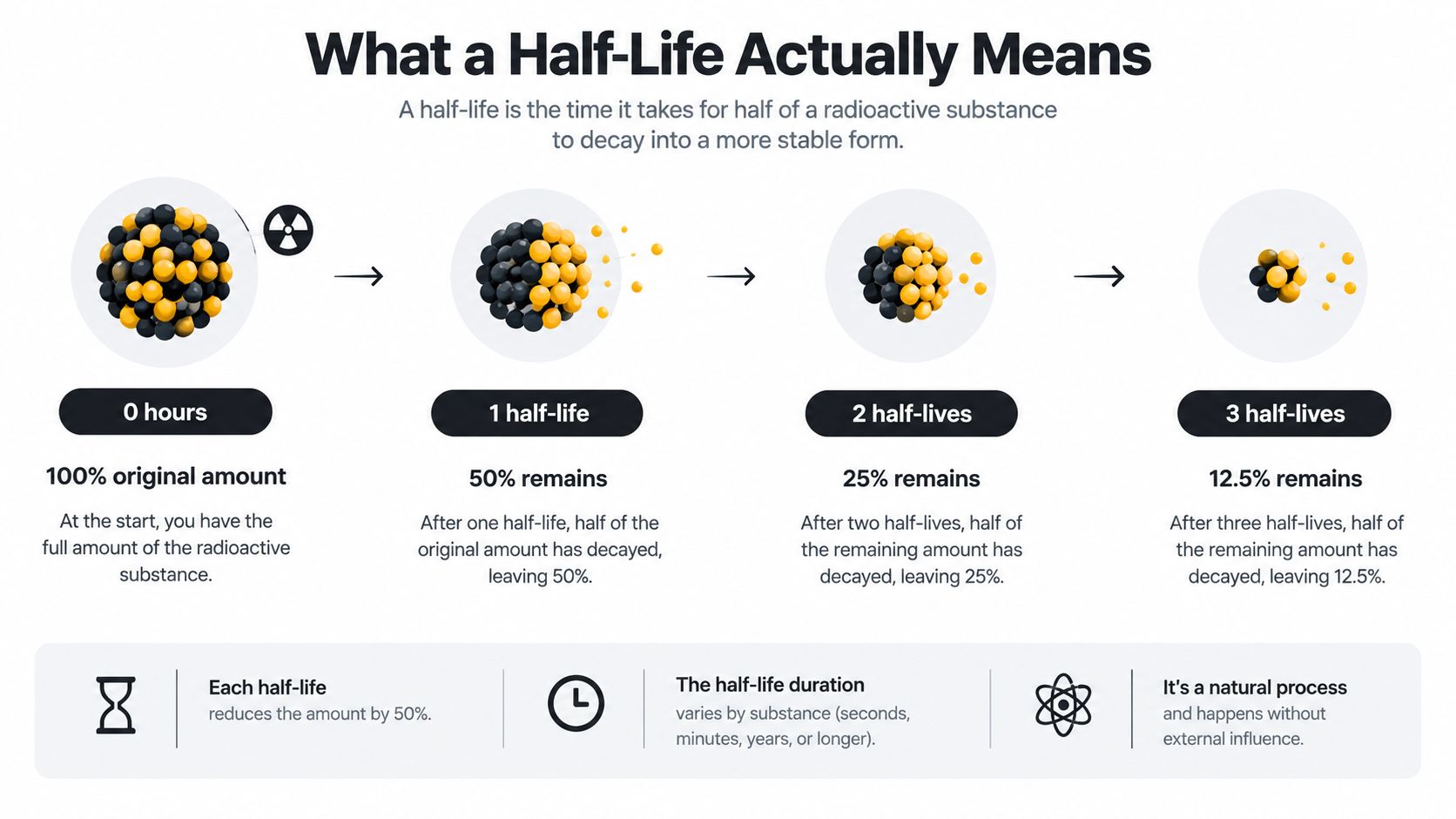
A half-life is the time required for the amount of a drug in the body to decrease by half. It doesn't mean the entire dose disappears at the end of that period. It means the remaining amount is reduced again and again.
Think of a 100-milliliter beaker connected to a drain that removes half its contents each week. After one week, 50 milliliters remain. After two weeks, 25 milliliters remain. After three weeks, 12.5 milliliters remain. The drain keeps working, but the visible amount becomes smaller rather than reaching zero all at once.
Semaglutide follows this same simplified pattern:
- After one week: about 50% remains.
- After two weeks: about 25% remains.
- After three weeks: about 12.5% remains.
- After four weeks: about 6% remains.
- After five weeks: approximately 3% remains.
These figures are a pharmacokinetic illustration based on the approximate one-week half-life, not a promise about the exact concentration in every individual. The FDA semaglutide label provides the regulatory foundation for the long half-life that supports once-weekly GLP-1 treatment.
Presence is not the same as effect
Clinicians often distinguish pharmacokinetics, what the body does to the drug, from pharmacodynamics, what the drug does to the body. A small amount of semaglutide may still be detectable while its appetite or glucose effects have weakened. Conversely, changes triggered during treatment may continue after the bloodstream level becomes very low.
After about five half-lives, many medicines are treated as pharmacologically cleared because only a small residual amount remains. For semaglutide, that logic explains the practical five-week estimate. It doesn't mean a laboratory test will necessarily show absolutely nothing at that exact point, and it doesn't mean every symptom stops on the same day.
A Week-by-Week Clearance Timeline
A final injection on Monday does not mean semaglutide disappears by the following Monday. The drug declines in stages, much like a dimmer switch being turned down rather than a light being switched off. The table uses the approximate one-week half-life to show the pattern, not an individual's exact blood concentration.
| Week After Last Dose | Approx. % Remaining in Body | Expected Effects |
|---|---|---|
| Week 0 | Starting amount | The final injection continues releasing semaglutide, with ongoing GLP-1 activity. |
| Week 1 | About 50% | Appetite control and digestive effects may remain noticeable. |
| Week 2 | About 25% | Some people notice returning appetite or slower weight progress as exposure declines. |
| Week 3 | About 12.5% | Glucose-lowering effects may begin tapering, especially when other diabetes medicines are involved. |
| Week 4 | About 6% | Appetite and weight-stabilizing effects may be less pronounced. |
| Week 5 | About 3% | The drug is generally treated as pharmacologically cleared, although trace exposure can vary. |
The FDA information for Wegovy states that semaglutide can remain in circulation for about five to seven weeks after the last 2.4 mg dose. That range matters in real life. A calendar estimate should not replace clinical planning, particularly before a procedure or during a change in diabetes treatment.
Symptoms don't follow a perfect schedule
A missed injection usually does not cause an immediate change because substantial exposure remains during the first week. By the second or third week, some people notice more food thoughts, less fullness, or a gradual return of appetite. Others feel little difference until later, because symptoms reflect both the falling drug level and the body's response to it.
Blood sugar requires separate attention. As semaglutide's glucose-lowering contribution fades, a person with type 2 diabetes may need closer monitoring, especially when insulin or a sulfonylurea is also being used. The prescriber should decide whether another medicine needs adjustment.
Gastrointestinal effects can change on their own schedule. Nausea may ease as exposure declines, while constipation, vomiting, or slowed stomach emptying can persist. Severe or ongoing symptoms need medical attention rather than a wait-and-see approach.
Weeks four and five are therefore useful planning markers, not guaranteed symptom deadlines. Lingering semaglutide can still influence appetite, blood sugar, and digestion while someone is preparing for fasting, considering surgery, or transitioning to another medication. Individual dose history and health conditions can widen the range of experiences.
Factors That Can Shift the Timeline
The five-week estimate is a practical population-level benchmark, not a stopwatch. Two people can take their last injection on the same day and have different exposure patterns afterward.
Kidney function is one consideration. Semaglutide is metabolized through several pathways, and renal health can influence how the body handles medicines and manages fluid balance. The exact effect isn't identical for every patient, so kidney disease should prompt individualized advice rather than a self-calculated extension.
The total amount of drug recently used also matters in practical terms. A person who has been stable on a higher weekly dose has more semaglutide to clear than someone who has just started at a low dose. The half-life remains the anchor concept, but the absolute amount present at each point can differ.
Variables clinicians review
- Dose history: Recent dose increases can change the amount being cleared.
- Kidney and liver health: Organ function may affect medication handling and treatment decisions.
- Body size and composition: Distribution in the body can vary between individuals.
- Age and concurrent illness: Other conditions may alter tolerability, appetite, hydration, or gastrointestinal function.
- Formulation and treatment history: Different semaglutide products and dosing patterns aren't automatically interchangeable.
| Factor | Effect on Clearance | Direction | Estimated Impact |
|---|---|---|---|
| Kidney health | May change individual medication handling | Variable | Individualized assessment needed |
| Recent dose | Changes the total amount present | Higher dose may mean more to clear | Not a fixed interval |
| Body composition | Can influence distribution | Variable | Person-specific |
| Age and illness | May affect tolerability and overall response | Variable | Clinically reviewed |
| Formulation | Products can have different labeled uses and doses | Variable | Follow product-specific guidance |
The Ozempic dosing guide can help explain scheduling questions, but it can't determine a personal washout period. Don't try to speed clearance by changing injection timing, taking extra doses, or stopping another medicine without professional guidance.
What This Means for Surgery and Medication Changes
A procedure involving anesthesia or deep sedation can require a different plan even after a missed Ozempic dose. Semaglutide may slow stomach emptying, so the key question is not whether the medicine remains detectable. The surgical team must consider whether lingering effects could change fasting instructions, aspiration-risk assessment, nausea treatment, or glucose control.
The medicine's roughly one-week half-life works like a slow drain rather than an on/off switch. Each week, the amount in circulation falls, while some medication remains. For that reason, tell the anesthesiologist and surgeon the date of the last injection, the current dose, any nausea, vomiting, bloating, or early fullness, other diabetes medicines, and the planned type of anesthesia. Follow their individualized instructions instead of using a generic online schedule.
Medication transitions require coordination
Changing from semaglutide to another GLP-1 medicine, or to tirzepatide, also needs prescriber guidance. Overlapping effects can increase nausea, vomiting, reduced food or fluid intake, dehydration, or glucose changes. The prescriber may set the start date and dose according to the previous treatment, the reason for switching, and the patient's tolerance.
A missed dose is different from permanent discontinuation. FDA-approved instructions give a limited window for taking a missed Ozempic dose, followed by a return to the regular schedule. Do not double doses or restart solely according to symptoms. The appropriate plan depends on how long the dose was missed and the prescribed regimen.
Pregnancy planning should begin before treatment changes. Because semaglutide can remain in the body for weeks, stopping after a positive pregnancy test does not prevent all later exposure. Anyone planning pregnancy should discuss timing with the prescriber before stopping contraception or changing medication.
Contrast imaging generally does not create a separate clearance issue. Still, inform the imaging team about semaglutide, digestive symptoms, diabetes treatment, and any fasting instructions so they can coordinate the appointment safely.
Weight Regain and Lingering Effects After Stopping
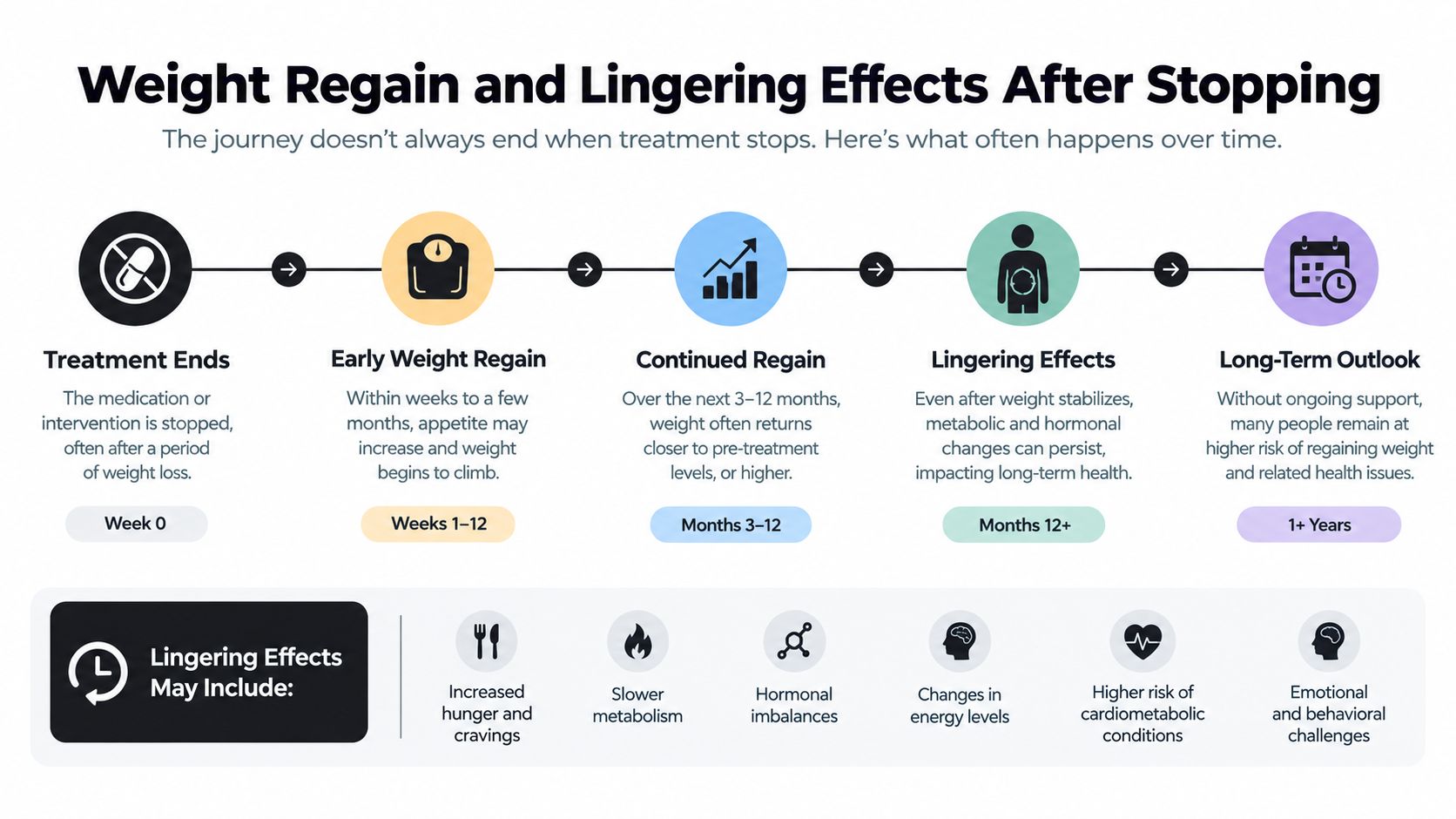
A patient may reach the end of semaglutide's clearance window and still notice stronger hunger, less fullness, or changes in eating patterns. Drug levels and treatment benefits follow related, but different timelines. The medication can become minimal in the bloodstream while the body continues adjusting to its absence.
A meta-analysis summarized in GoodRx's review of semaglutide discontinuation reported clinically meaningful weight regain after GLP-1 treatment ended, including about 5.63 kilograms in obesity populations. The same review describes another analysis in which semaglutide had the highest post-discontinuation regain among common anti-obesity medications. These findings do not predict one person's result, but they explain why stopping should include a plan for appetite, weight, and glucose management. For a detailed look at appetite and weight changes after discontinuation, see this guide to what happens when you stop GLP-1 treatment.
Why appetite can return after clearance
While semaglutide is active, GLP-1 receptor signaling helps regulate hunger, fullness, stomach emptying, and glucose control. As that signal fades, hunger may gradually strengthen and the same meal may feel less satisfying. The body's weight-regulation systems do not reset the moment semaglutide leaves the blood.
Two timelines help explain the experience:
- Drug clearance: semaglutide levels decline progressively over several weeks.
- Clinical adaptation: appetite, food preferences, body weight, and glucose patterns may keep changing after drug exposure becomes very low.
Residual medication in the third or fourth week may still soften the return of hunger. Later, the change can feel abrupt because its influence has become weaker, even though the concentration has been falling continuously.
After stopping, track more than body weight. Record appetite, fullness, relevant glucose readings, gastrointestinal symptoms, and eating routines. Sharing those changes with a clinician helps separate the expected return of medication effects from problems needing prompt assessment, including persistent vomiting, dehydration, or uncontrolled blood sugar.
Common Misconceptions About Ozempic Clearance
Myth one: A weekly injection clears in a week. Weekly dosing describes the interval between scheduled doses, not the time required for the previous dose to disappear. The one-week half-life means the body has reduced the amount by half, while a smaller amount remains active and continues declining afterward.
Myth two: Missing one dose resets the body immediately. It doesn't. A missed injection changes future dosing, but it doesn't erase semaglutide already present. The remaining medication continues following its elimination pattern, which is why patients should use the product instructions and prescriber guidance rather than taking an unscheduled replacement dose.
Myth three: Falling blood levels mean every effect stops. Drug concentration and clinical response aren't mirror images. Nausea may improve before appetite returns, while constipation or fullness may persist longer than expected. A person can also regain hunger gradually after the drug has become pharmacologically negligible.
Other questions patients often ask
- Can a drug test show Ozempic? Standard workplace drug screens aren't designed to assess semaglutide exposure. A specialized clinical assay would be a different matter, but routine testing shouldn't be interpreted as proof that the medicine has or hasn't affected the body.
- Does breast milk transfer equal zero exposure? A medication's presence in circulation doesn't answer every question about breastfeeding. Discuss lactation specifically with a clinician who can review the current product information and your medical circumstances.
- Can anything flush it out faster? There isn't a safe home method that removes semaglutide on demand. Hydration and food choices may support general well-being, but they don't change the drug's established elimination process.
- Does five weeks mean the effects are over? No. It means the circulating amount is expected to be very low under the standard pharmacokinetic model. Appetite, weight, and glucose effects still require monitoring.
The phrase “one week on, five weeks off” is therefore too simple. It hides the difference between dose scheduling, declining concentration, residual receptor activity, and the longer process of adjusting after treatment ends.
Practical Takeaways for Patients and Providers
The most useful answer to how long does Ozempic stay in your system starts with one anchor: semaglutide's elimination half-life is about one week. The FDA's practical estimate is about five weeks in circulation after the last dose, with some product labeling describing a longer range after a higher dose. That anchor informs decisions, but it doesn't replace individualized medical planning.
Three points to bring to an appointment
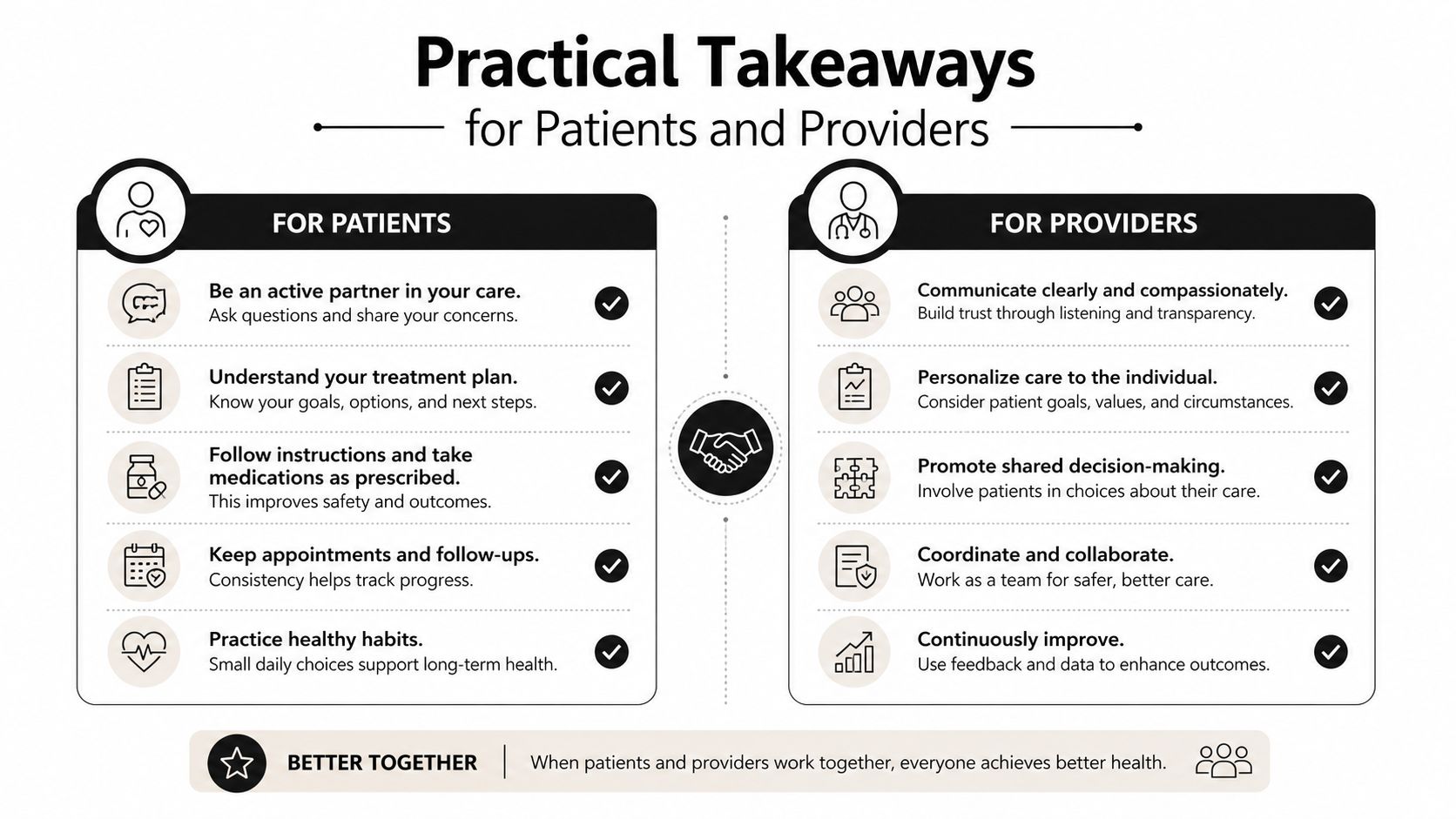
- Plan around exposure, not injection day alone. Tell the surgical, anesthesia, pregnancy, or prescribing team exactly when you took the last dose and what dose you were using.
- Separate clearance from symptom resolution. Ask how long appetite changes, delayed gastric emptying, nausea, constipation, and glucose effects might matter for your situation.
- Create a transition plan. If you're stopping, switching medicines, or restarting after a missed dose, confirm the next step before taking extra medication.
Providers can make the discussion more precise by reviewing the patient's dose history, diabetes medicines, renal and hepatic health, digestive symptoms, procedure type, and treatment goals. Patients can help by bringing a medication list and reporting changes in food intake, hydration, bowel habits, glucose readings, and weight trends.
Clinical planning rule: “The drug is nearly gone” isn't the same question as “Is it safe to proceed?” The answer depends on the procedure, the patient's symptoms, and the medicines used alongside semaglutide.
If you're considering a supervised GLP-1 treatment plan or need help thinking through dosing changes, Weight Method offers online provider consultations, medication guidance, progress tracking, messaging support, and home delivery options for eligible adults. Visit Weight Method to complete the online intake and discuss semaglutide or tirzepatide with a licensed provider.