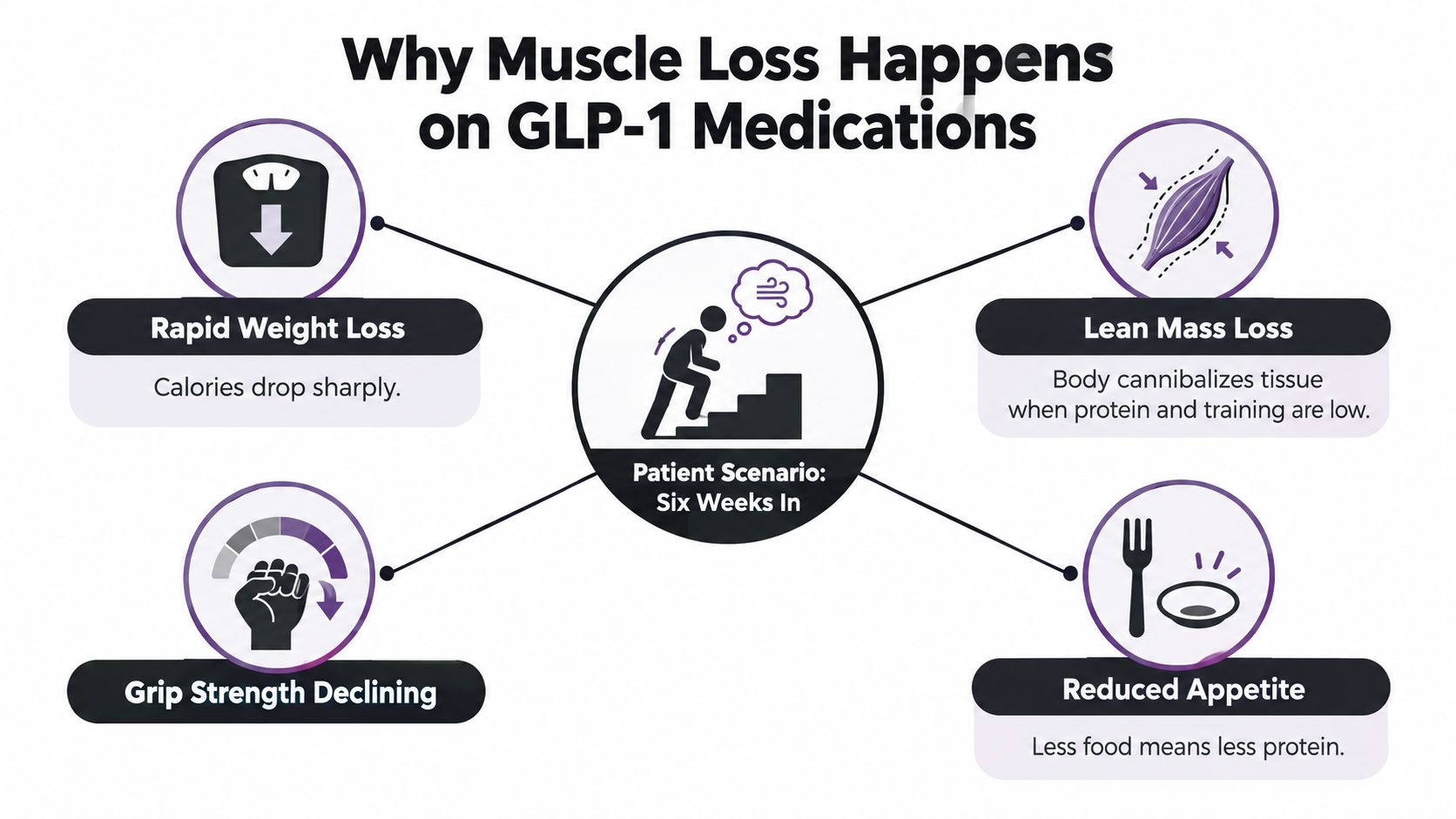
Six weeks into GLP-1 treatment, the scale is moving in the right direction, but the stairs feel steeper. Your grip feels less secure, your usual grocery bags seem heavier, and a workout that used to feel manageable now leaves you drained. That combination deserves attention, even if the weight-loss result looks successful.
How to prevent muscle loss on GLP-1 isn't mainly a matter of buying a protein powder or forcing yourself through random workouts. It starts with monitoring whether fat loss is occurring alongside preserved strength and function. Nutrition comes next, followed by resistance training that gives your body a reason to retain lean tissue.
Why Muscle Loss Happens on GLP-1 Medications
GLP-1 medications make weight loss easier partly by reducing appetite. That benefit can become a problem when meals become too small, protein disappears from the plate, and nausea or early fullness makes eating feel like work. A sharp calorie deficit can then combine with less physical activity and less mechanical loading on the muscles.
During substantial weight loss, the body draws on stored energy. If protein intake and resistance exercise don't provide enough support, some lean tissue may be lost along with fat. Reduced training drive, fatigue, and a catabolic energy state can compound the issue. The medication isn't a signal to abandon food or strength work. It makes both inputs more important.
The order of operations matters
Most advice starts with, “Eat more protein and lift weights.” Those recommendations matter, but they're incomplete if nobody checks whether the plan is working. A patient can reach a protein target and still lose strength if weight is falling too quickly, training is poorly programmed, or side effects prevent adequate overall intake.
I use this order:
- Monitor the trajectory. Track weight, waist, strength, physical function, and relevant body-composition measures.
- Protect intake. Set a protein target and make meals workable despite appetite suppression.
- Apply mechanical demand. Use progressive resistance training, not only walking or general cardio.
A network meta-analysis of 22 randomized trials involving 2,258 participants found that GLP-1 therapies reduced lean mass by 0.86 kg versus control, with lean mass representing approximately 25% of total weight lost (network meta-analysis of GLP-1 therapies). Those findings don't mean every kilogram of lean mass represents skeletal muscle, but they do establish that tissue preservation needs a deliberate plan.
Practical rule: If the scale is dropping but your strength and daily function are deteriorating, don't congratulate the scale and ignore the body.
Your first job isn't to panic over one reading. It's to identify a pattern early enough to adjust food intake, training, recovery, or medication pacing with your prescriber.
What the Research Shows About Lean Mass
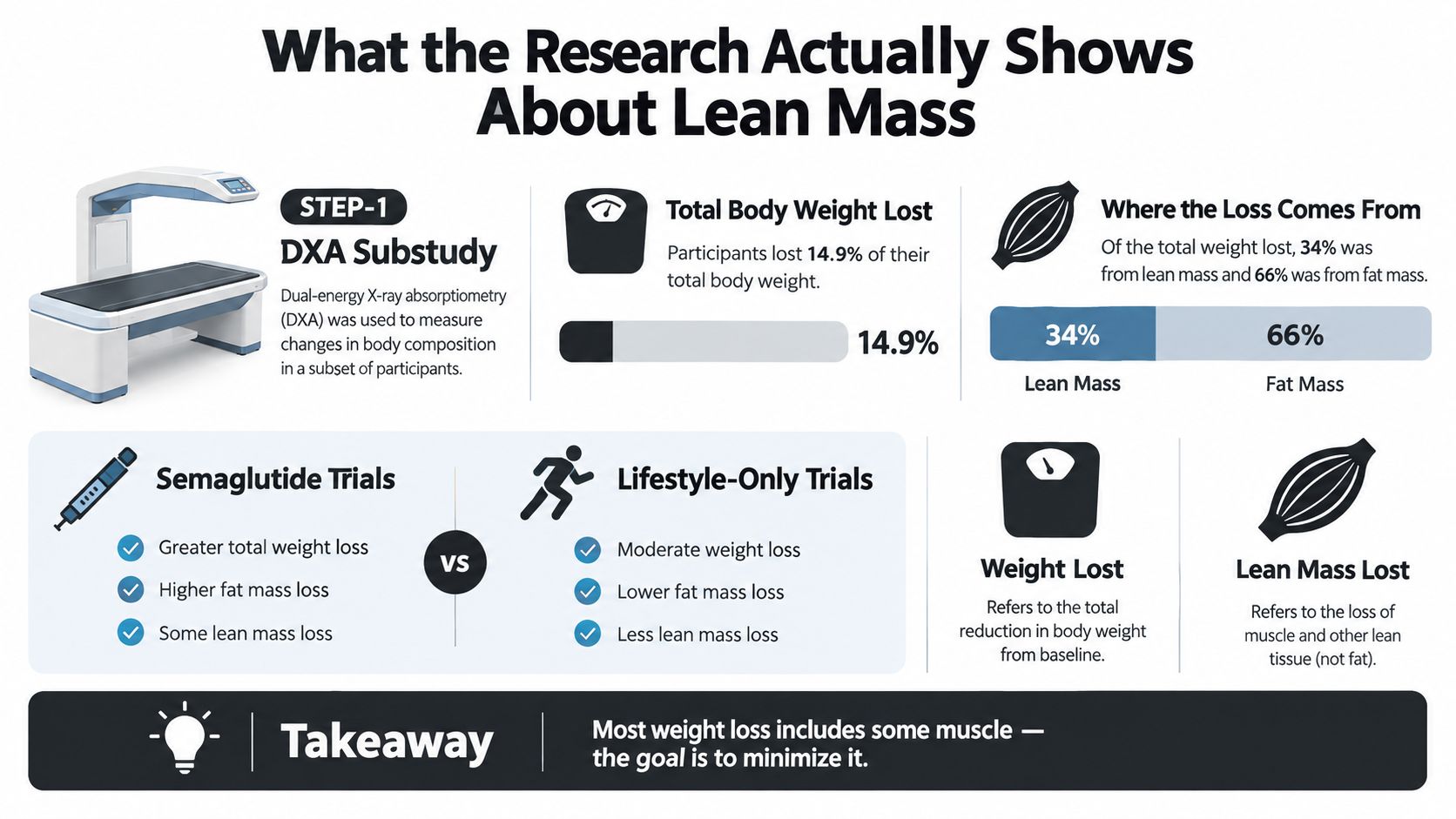
A lean-mass result can look alarming while masking what matters clinically. Lean mass isn't synonymous with skeletal muscle. DXA also counts water, organs, connective tissue, and other non-fat tissue. A lower lean-mass value therefore cannot, by itself, prove meaningful loss of contractile muscle.
The STEP-1 semaglutide 2.4 mg DXA substudy illustrates the point. After 68 weeks, adults with overweight or obesity lost approximately 14.9% of body weight, and about 34% of that loss was attributed to lean mass (STEP-1 and SURMOUNT-1 body-composition findings). Lean mass also made up a larger proportion of total body weight after treatment, while available analyses did not identify consistent clinically meaningful declines in physical function.
The SURMOUNT-1 tirzepatide DXA substudy showed a comparable measurement issue. After 72 weeks, participants lost 21.3% of body weight, 33.9% of fat mass, and 10.9% of lean mass. About 25% of total weight loss came from lean mass (SURMOUNT-1 DXA substudy findings). These figures describe tissue compartments, not muscle performance. The practical question is whether the patient is becoming weaker, less capable, or less active.
Function beats a frightening label
Use body-composition testing to support decisions, not to replace performance checks. I want to know whether a patient can rise from a chair, climb stairs, carry ordinary loads, maintain grip, and repeat familiar lifts. Those tasks show how treatment is affecting daily capacity.
Track a small set of measures under consistent conditions:
- Strength: Repeat one key movement, grip test, or resistance exercise.
- Function: Record sit-to-stand ability, stair tolerance, gait confidence, or carrying capacity.
- Body shape: Measure waist circumference alongside body weight.
- Composition: When clinically appropriate, use DXA or validated bioimpedance.
One reading cannot establish a trend. The useful signal is whether strength, function, intake, and body composition are trending together. Stable or improving performance is more reassuring than scale loss alone. Persistent deterioration warrants clinical review, even when total weight loss appears impressive. Monitoring comes first because it shows whether nutrition and training need adjustment.
Setting Your Protein Target the Right Way
By midafternoon, appetite suppression can leave you with coffee, a few bites, and no clear protein source. That is how muscle loss begins to hide inside otherwise successful weight loss. Monitoring comes first, because it shows whether your intake is supporting strength and function. Protein comes next, then training can reinforce the tissue you want to keep.
The American Association of Clinical Endocrinology recommends approximately 1.2 to 1.5 grams of protein per kilogram of body weight per day for patients taking obesity medications. Spread that intake across meals and choose foods such as poultry, fish, legumes, and low-fat dairy (AACE guidance for patients taking obesity medications).
For a 100-kilogram adult, that equals roughly 120 to 150 grams of protein daily. That figure is a starting framework, not a prescription for every person. Kidney disease, age, body size, activity level, and other medical conditions can change the appropriate target. Ask your clinician or dietitian to individualize it.

Use a protein-first eating pattern
Do not wait until dinner to discover that you have eaten almost no protein. Divide the daily target across the meals and snacks you can realistically tolerate.
- Start with protein: Choose eggs, Greek yogurt, cottage cheese, poultry, fish, tofu, or legumes before filling the plate with carbohydrates.
- Use small portions: Early fullness makes lower-volume foods practical. Greek yogurt, cottage cheese, eggs, and fish can provide protein without requiring a large meal.
- Keep liquids available: If nausea or food aversion makes solid food difficult, a clinician-approved protein shake can help temporarily. It should not replace all meals.
- Record intake briefly: A food diary or meal checklist can reveal the quiet problem of consistently eating too little.
If you need help translating body weight into a daily target, use this protein-to-weight calculator as a planning aid, then confirm the result with a qualified professional.
Nausea, vomiting, persistent abdominal symptoms, or difficulty maintaining fluids changes the plan. Do not force a larger protein target. Contact your provider, since medication timing, dose escalation, hydration, and medical safety may need review.
Once intake is consistent, optimize your muscle recovery routine by coordinating food, training, hydration, and rest instead of treating supplements as the entire solution.
Resistance Training That Actually Preserves Muscle
Resistance training is the third step, but it's the physical signal that tells your body, “This tissue is still needed.” Walking supports health and aerobic capacity. It doesn't provide the same progressive loading stimulus as squats, presses, rows, hinges, and carries.
The S-LiTE trial offers a useful benchmark. Supervised aerobic-plus-resistance training exceeded 150 minutes per week at 60% to 85% of maximum heart rate and, when paired with liraglutide, produced substantial weight loss while better preserving lean mass than medication or lifestyle treatment alone (S-LiTE trial). You don't need to copy a supervised trial, but you do need regular, progressive resistance work.
Build around five movement patterns
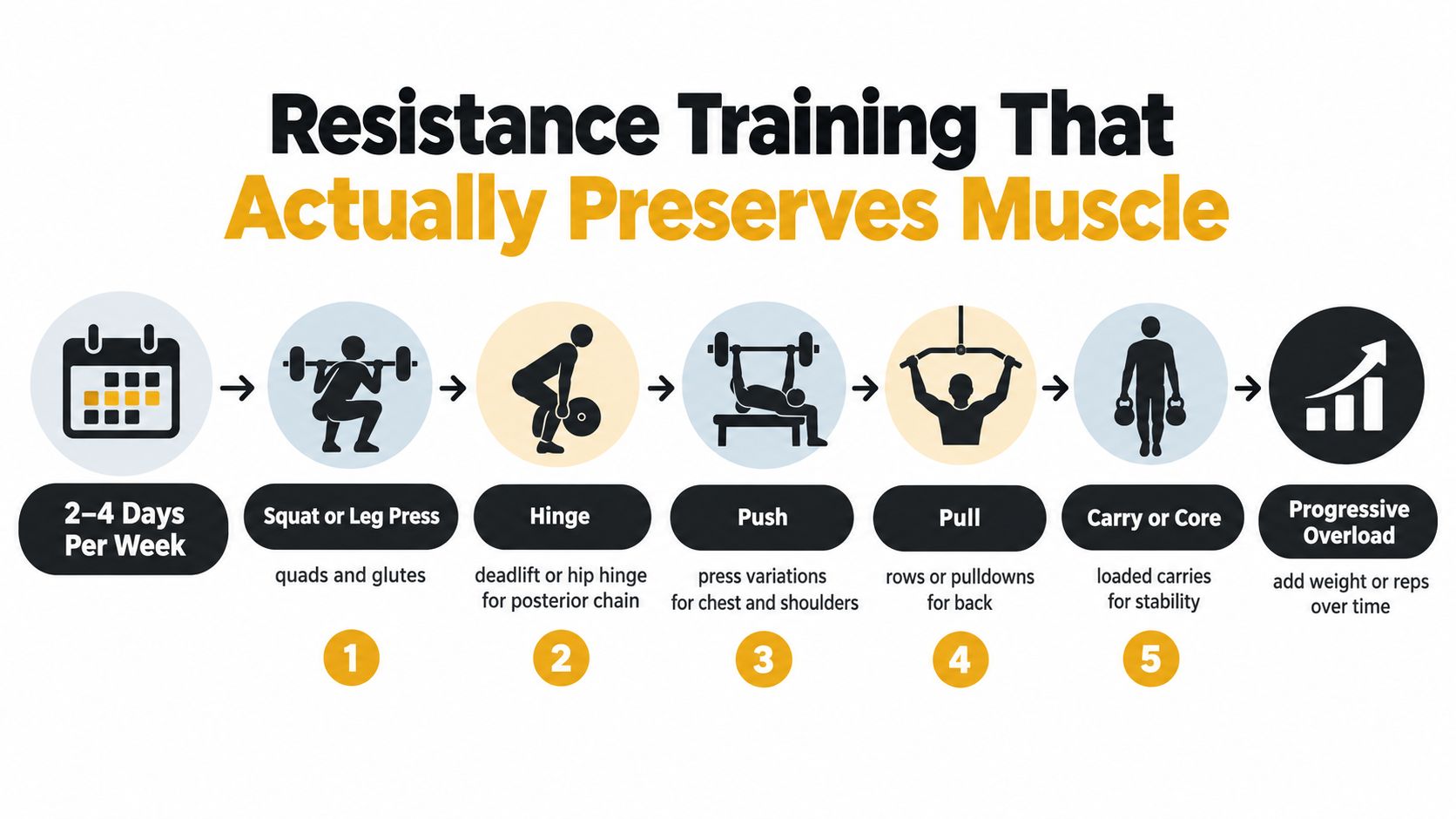
Train on two to four nonconsecutive days per week, using manageable resistance and controlled technique. A full-body session can include one movement from each category:
- Squat or leg press: Use a chair squat, goblet squat, supported squat, or leg press. Keep the range comfortable and prioritize control.
- Hinge: Practice a hip hinge, Romanian deadlift with light weights, or banded good morning. The movement should load the hips and posterior chain without forcing the lower back to compensate.
- Push: Choose a wall push-up, incline push-up, dumbbell press, machine chest press, or overhead press if your shoulders tolerate it.
- Pull: Use a resistance-band row, cable row, dumbbell row, or pulldown. Pull with the back rather than shrugging through every repetition.
- Carry or core: Try a suitcase carry, farmer carry, dead bug, plank variation, or Pallof press. Choose the option that challenges stability without aggravating symptoms.
Begin with a load that lets you finish the prescribed repetitions with sound technique and a few repetitions still available. Add repetitions first. When you can complete all planned repetitions comfortably, increase resistance modestly. Add another set only when recovery, appetite, and form remain stable.
Make the plan fit real constraints
A home routine can use bands, adjustable dumbbells, a sturdy chair, and a backpack. A gym routine can use machines if balance, joint pain, or confidence makes free weights intimidating. Knee discomfort may favor a supported sit-to-stand or leg press, while shoulder symptoms may call for a neutral-grip press or a lower range of motion.
Don't turn every session into a test. GLP-1 treatment can reduce appetite and energy, so excessive volume may worsen recovery when food intake is already inadequate. The right program is the hardest one you can recover from consistently, not the most punishing workout you can survive once.
For movement ideas that account for medication-related fatigue and changing capacity, review these practical GLP-1 strength routines. You can also use this strength training weight-loss program as a framework for organizing sessions around major muscle groups.
How to Monitor Progress Without Obsessing Over the Scale
A monitoring system should reduce anxiety, not create a second job. The scale answers one question, total body weight. It doesn't tell you whether your waist is shrinking, your strength is stable, or your body composition is changing in a useful direction.
Use a small dashboard and collect each measure on a consistent schedule.
| Metric | Frequency | Target or Threshold | Red Flag |
|---|---|---|---|
| Body weight | Weekly, under similar conditions | A planned downward trend that doesn't impair function | Rapid or unplanned loss paired with weakness, poor intake, or fatigue |
| Waist circumference | Every two weeks | A downward trend can support the interpretation that fat mass is decreasing | Waist remains unchanged while strength and function decline |
| Strength or function | Every four weeks | Stable or improving grip, sit-to-stand ability, stair tolerance, or a key lift | Persistent decline in everyday performance |
| Body composition | Approximately every 8 to 12 weeks when clinically appropriate | Interpret alongside strength, waist, and intake | A concerning trend confirmed by functional decline |
Use the BIA body-fat guide to understand why home and professional bioimpedance readings need consistent conditions and cautious interpretation. Hydration, food intake, and measurement timing can affect readings, so don't treat a single result as a diagnosis.
Know when the dashboard needs escalation
A falling scale with stable strength and a shrinking waist is a different situation from a falling scale with repeated falls, worsening stair tolerance, or persistent fatigue. Red flags include ongoing inability to eat adequately, repeated vomiting, clear strength decline, and weight loss that feels unplanned or too aggressive.
Don't self-adjust a GLP-1 dose in response to a smart-scale reading. Share the trend with the prescribing clinician, who can assess side effects, dose progression, hydration, dietary intake, and the need for additional body-composition testing.
A useful dashboard doesn't ask, “Did I lose weight?” It asks, “Am I losing fat while keeping the capacity to live, work, train, and recover?”
Three Myths That Undermine Muscle Preservation
Myth one, a large protein supplement fixes everything
Protein provides amino acids, but a shake cannot replace a muscle-preservation plan. A 2025 joint advisory from major nutrition and obesity organizations states that increasing protein is likely insufficient without structured resistance training (joint advisory on muscle preservation during weight loss).
Set an individualized protein target, divide it across meals you can tolerate, and train the major movement patterns consistently. More powder is not the answer when nausea limits intake. Tell your provider, then address the symptom and adjust the plan rather than escalating supplements indefinitely.
Myth two, walking replaces lifting
Walking supports daily activity, joint comfort, and gradual return to exercise. It does not provide the same muscle stimulus as progressive loading. Resistance exercise should stand on its own, with a practical minimum of two to three sessions weekly, as outlined in the same clinical guidance.
Keep walking if it helps you stay active. Add squats, hinges, pushes, pulls, and carries so your muscles receive a clear reason to retain strength. Increase resistance or repetitions over time when your technique and recovery allow it.
Myth three, any lean-mass reduction means treatment is dangerous
Some lean-mass reduction can accompany substantial weight loss, and DXA lean mass includes more than skeletal muscle. A single report cannot determine whether treatment is working safely.
Review body composition alongside strength and function. Stable grip, preserved stair ability, and maintained lifting capacity provide more useful context than a troubling percentage on one scan. If those measures decline together, bring the pattern to your provider. The right response is a clinical review, not automatic reassurance or an assumption that treatment must stop.
Putting It All Together and When to Call Your Provider
Choose one protein target, two to four resistance-training days, and a repeatable monitoring rhythm. Follow that plan long enough to identify a trend, not just a daily fluctuation. The most effective sequence is monitoring first, adequate nutrition second, and progressive training third.
Contact your provider if strength continues to fall, you can't reach your protein target for more than two weeks, nausea or vomiting interferes with food and fluids, fatigue or falls appear, or weight loss becomes unplanned and unusually rapid. Planned dose escalation also deserves review when intake is already poor. Never change the dose or add unproven anabolic supplements on your own.
The goal isn't the lowest possible scale number. It's meaningful fat loss with preserved strength, mobility, and independence. A medically supervised service such as Weight Method can coordinate provider consultations, progress tracking, messaging, and dosage adjustments while you report the nutrition and function signals that matter.
Weight Method can help you pursue GLP-1 treatment with provider oversight, ongoing progress tracking, and dose adjustments that account for how you're eating and functioning. Visit Weight Method to complete the intake process and discuss a plan that treats muscle preservation as part of successful weight loss.