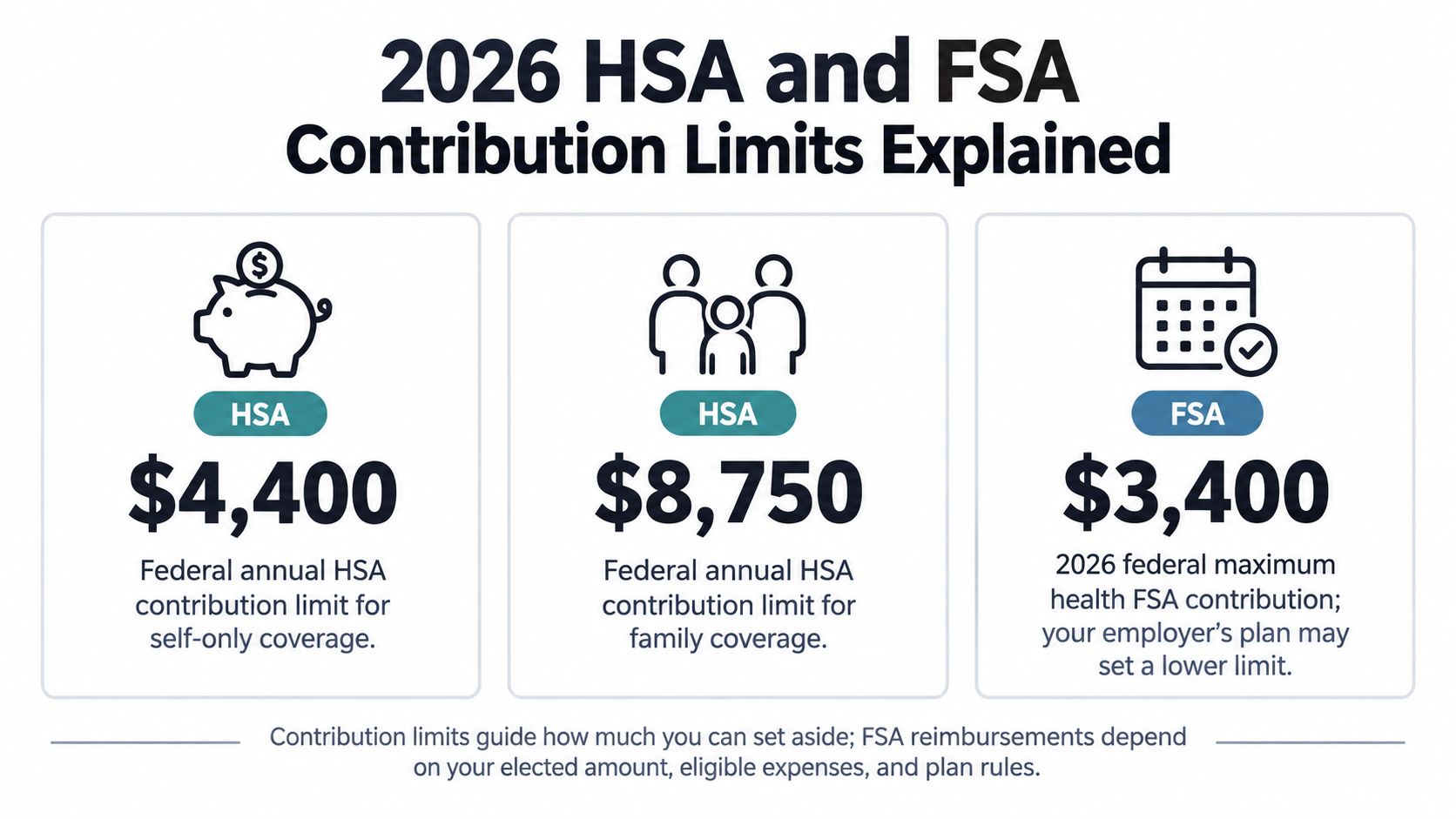
For 2026, the HSA eligible amount is governed by medical purpose and documentation, not only by whether a service helps with weight loss. The federal HSA contribution ceiling is $4,400 for self-only coverage and $8,750 for family coverage, while the amount you can claim depends on the qualified portion of the expense and your available account balance.
You may be paying a monthly fee to a telehealth provider that includes a video visit, a prescription, messaging, dosage changes, progress tracking, and shipping. Your HSA or FSA card may be accepted at checkout, but that doesn't automatically make every part of the bundle reimbursable. The key question is not, “Is this weight-loss program eligible?” It's, “Which charges treat a diagnosed medical condition, and can I prove what each charge covers?”
HSA FSA Eligible Amount for Weight-Loss Treatment
Suppose you enroll in a medically supervised weight-management program and receive one monthly invoice. The invoice might show only a membership name and one total, even though the provider delivered several different services. That format creates the central compliance problem.
The HSA FSA eligible amount isn't the same as your annual contribution limit. It also isn't the same as your available account balance, and it has nothing to do with whether your health insurer covers the program. These are four separate questions:
- Medical eligibility: Does the expense qualify as medical care under IRS rules?
- Contribution limit: How much can go into the account during the tax year?
- Account balance: How much money is currently available to spend?
- Insurance coverage: Will your health plan pay any portion of the treatment?
A tax-advantaged account can pay a qualified medical expense even when insurance doesn't cover it. The reverse also applies. A provider may call a program “HSA/FSA eligible,” but your administrator can still request documentation or reject a bundled charge that includes nonmedical services.
Practical rule: Treat the invoice, not the marketing label, as the starting point for your claim.
Telehealth makes this distinction especially important because a single payment may combine a prescribed medication, clinician services, monitoring, coaching, supplies, and shipping. You should ask the provider for a line-item statement before submitting the charge. For general reference, you can also browse eligible FSA expenses and review this guide to FSA and HSA eligible expenses, but your own plan administrator has the final say on reimbursement procedures.
Start by identifying the medical purpose. Then separate the charges. Finally, compare the qualified total with your actual account balance. That sequence prevents the most common mistake, which is assuming that a high annual contribution limit means the entire monthly program fee is payable.
2026 HSA and FSA Contribution Limits Explained
A telehealth weight-loss charge can exceed the amount you can claim, even when the account's annual limit looks sufficient. Separate the prescription, clinician consultation, monitoring, wellness coaching, supplies, and shipping before comparing the medical charges with your available balance.
For 2026, the federal HSA contribution limit is $4,400 for self-only coverage and $8,750 for family coverage under an HSA-qualified high-deductible health plan. Employee and employer contributions count toward those ceilings. An eligible account holder who is at least 55 by the end of the tax year may add a $1,000 catch-up contribution, allowing potential totals of $5,400 for self-only coverage or $9,750 for family coverage. These figures appear in IRS Publication 969.
The 2026 health FSA salary-reduction limit is $3,400. An employer may permit a carryover of up to $680, but the plan document determines whether a carryover or grace period applies. The carryover is not automatic and does not guarantee that every participant can retain that amount. See Mercer's 2026 benefits limits guidance for the contribution and carryover figures.
Why the annual figures matter
The HSA ceilings rose from $4,300 and $8,550 in 2025, and from $4,150 and $8,300 in 2024, reflecting inflation-adjusted limits rather than fixed amounts. Those figures govern contributions during the year, not the amount available for a claim today.
Your administrator may also reject a bundled telehealth invoice that fails to distinguish treatment from wellness services. Request a line-item statement identifying the prescription, consultation, and any separate coaching or monitoring charge. Then compare only the documented qualified expenses with your current account balance.
Use annual limits to plan contributions. Use medical eligibility, itemization, and substantiation to decide whether a claim is payable.
When Weight Loss Becomes a Qualified Medical Expense
Weight loss qualifies for HSA or health FSA treatment when it serves a documented medical purpose. Under Internal Revenue Code Section 213, a weight-loss program generally qualifies only when it treats a specific disease diagnosed by a physician, such as obesity, diabetes, hypertension, or heart disease. The IRS explains this distinction in its guidance on nutrition, wellness, and general health expenses.
A program purchased only to improve appearance, general health, or well-being doesn't meet that standard. The fact that a service involves weight loss isn't enough. A provider's diagnosis, treatment plan, prescription, and invoice should show why the expense was incurred.
The medical purpose controls
Consider two descriptions for a similar service:
- “Weight-loss coaching for appearance and wellness.”
- “Physician-supervised treatment of diagnosed obesity, including prescribed medication and clinical follow-up.”
The second description gives an administrator a medical basis to evaluate. The first points toward a general-wellness expense. The wording shouldn't be manipulated, but it should accurately reflect the provider's actual treatment purpose.
Prescription medication usually creates the clearest documentation trail because the prescription identifies the drug and the prescriber. A consultation, dosage adjustment, or clinical monitoring service may also qualify when it's medically necessary and connected to treatment. General coaching, lifestyle content, optional messaging, or cosmetic-focused add-ons may be evaluated separately.
A medication can be medically eligible while an attached wellness membership is not.
Keep the provider's diagnosis or letter of medical necessity, the prescription, itemized receipts, service dates, and proof of payment. FSA administrators may require substantiation before reimbursement. You also can't use the same expense for both HSA or FSA reimbursement and an itemized medical deduction. The safest approach is to identify the qualified medical components before submitting anything, rather than asking the administrator to interpret an opaque bundled fee.
How to Document FSA and HSA Eligible Amounts
The difficult question is usually not whether a prescription exists. It's which portion of the monthly telehealth purchase qualifies.
A bundled charge may include medication, a clinician consultation, secure messaging, monitoring, dosage adjustments, shipping, and general coaching. If the provider gives you one undifferentiated total, you may not have enough information to establish the eligible amount. Request a revised statement that identifies each component and its charge.
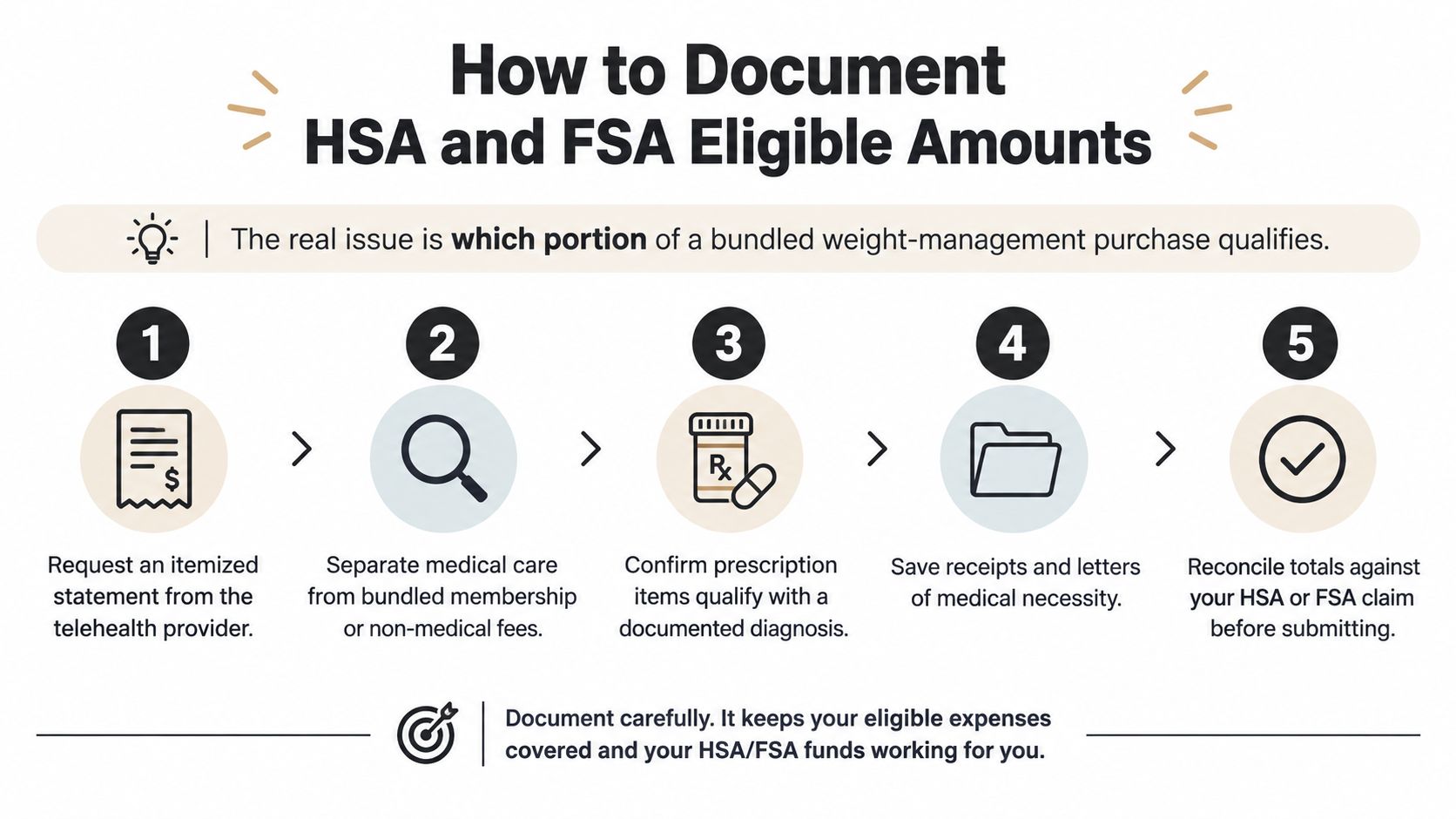
Build a claim file
Keep these documents together for every billing period:
- Prescription documentation: Save the prescription or medication record showing the prescribed drug and prescriber.
- Itemized invoice: Ask the telehealth provider to list medication, consultations, monitoring, and nonmedical services separately.
- Medical-necessity support: Retain the diagnosis or letter explaining the condition being treated.
- Payment record: Keep the receipt, account-card record, or bank statement showing what you paid.
- Provider correspondence: Save messages confirming what each line item includes.
The prescription and clinically necessary provider services are generally the strongest parts of a weight-management claim. A wellness membership, optional coaching package, or shipping charge may not receive the same treatment. Do not submit the full invoice just because the program advertises itself as eligible.
Use the same discipline when reviewing FSA and HSA reimbursement procedures. A clear invoice lets you submit only the amount supported by the medical documentation. It also gives the administrator a reasonable way to evaluate the claim without guessing what the monthly fee covered.
Your account administrator may impose rules beyond the general IRS definition. Verify whether it wants a letter of medical necessity, a prescription, a specific receipt format, or additional provider information. Eligibility is not automatic reimbursement, and a tax-qualified expense isn't necessarily insurance-covered.
HSA vs FSA for GLP-1 and Telehealth Weight-Loss Payments
A monthly telehealth bill can combine a GLP-1 prescription, clinical consultation, monitoring, coaching, and shipping. Treating that entire charge as one eligible amount creates avoidable claim risk. Separate the medical treatment from membership and wellness services before choosing an HSA or FSA.
An HSA generally lets unused funds roll forward, and the account remains yours. Qualified expenses incurred after the HSA is established can generally be paid from it. An FSA usually follows a use-it-or-lose-it structure, subject to the employer's selected grace period or carryover. For 2026, the possible health FSA carryover is up to $680, and the salary-reduction limit is $3,400. Confirm the actual rules in your employer's plan.
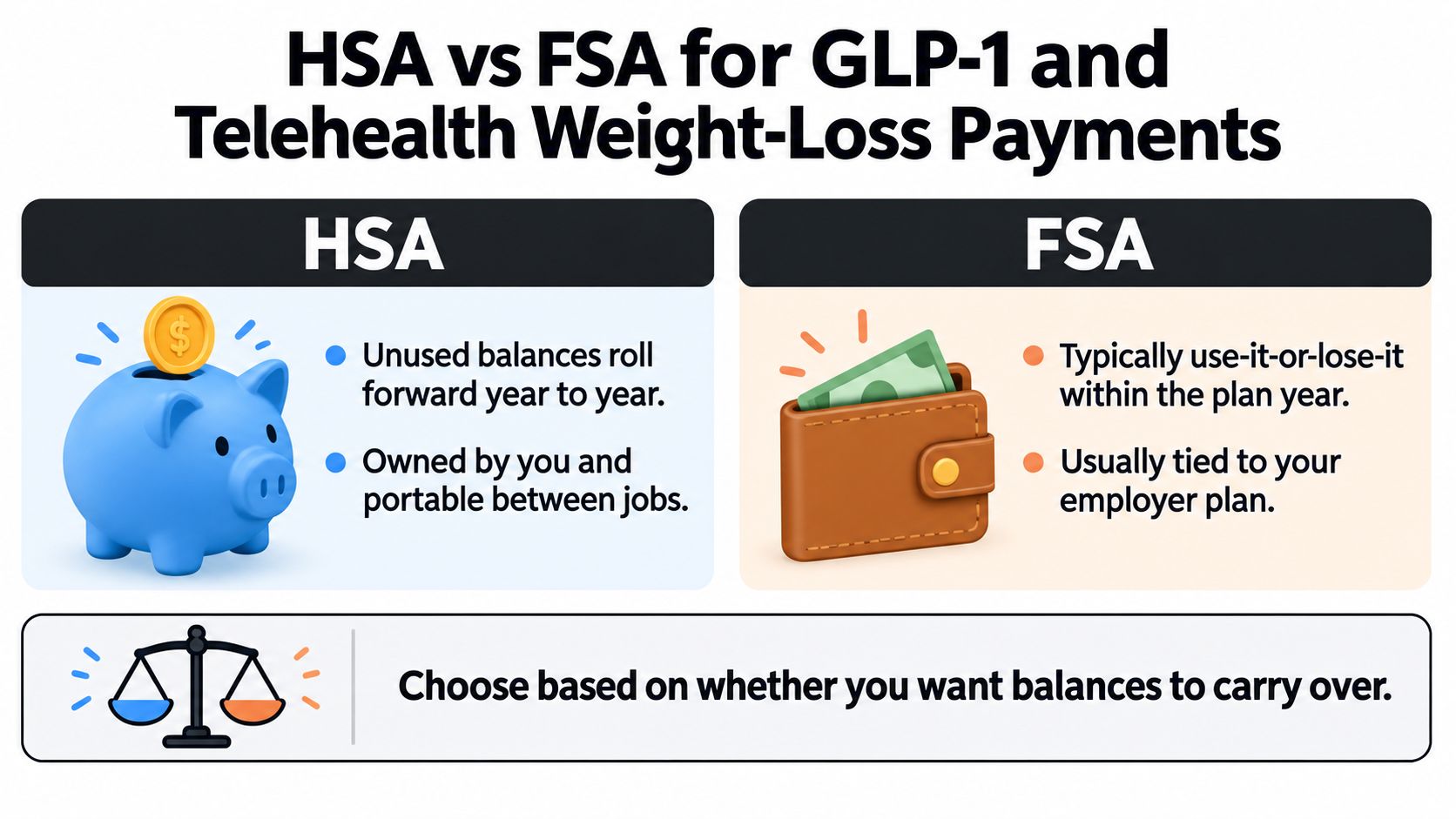
Choose based on timing and control
| Consideration | HSA | FSA |
|---|---|---|
| Balance timing | Unused funds generally roll forward | Usually subject to plan-year deadlines |
| Account control | Generally remains with you | Usually tied to the employer plan |
| Claim rules | Qualified expense and documentation still matter | Plan rules and administrator review matter heavily |
| Recurring telehealth charges | Less pressure to spend before a deadline | Requires planning around balance and plan dates |
An FSA may reimburse only the documented medical portion of a bundled program. The plan document can impose narrower requirements than general IRS guidance. Ask the provider for separate line items for the prescription, consultation, clinical monitoring, wellness coaching, and shipping before treatment begins.
An HSA may offer more flexibility for recurring charges, but it still requires substantiation. Keep the prescription and clinical records with the invoice. If prior authorization delays interrupt access to medication, review guidance on handling prior authorization delays and retain the related payer correspondence.
For the account distinction, compare whether FSA eligibility is the same as HSA eligibility. Eligibility is not automatic reimbursement, and a tax-qualified expense is not necessarily insurance-covered.
Examples of Eligible Telehealth Weight-Loss Purchases
A telehealth invoice might show a monthly program with semaglutide or tirzepatide prescribed after a video consultation. The same charge may also include secure messaging, progress tracking, dosage adjustments, shipping, and access to general coaching.
The brand name and delivery method don't decide eligibility. The medical purpose of each component does.
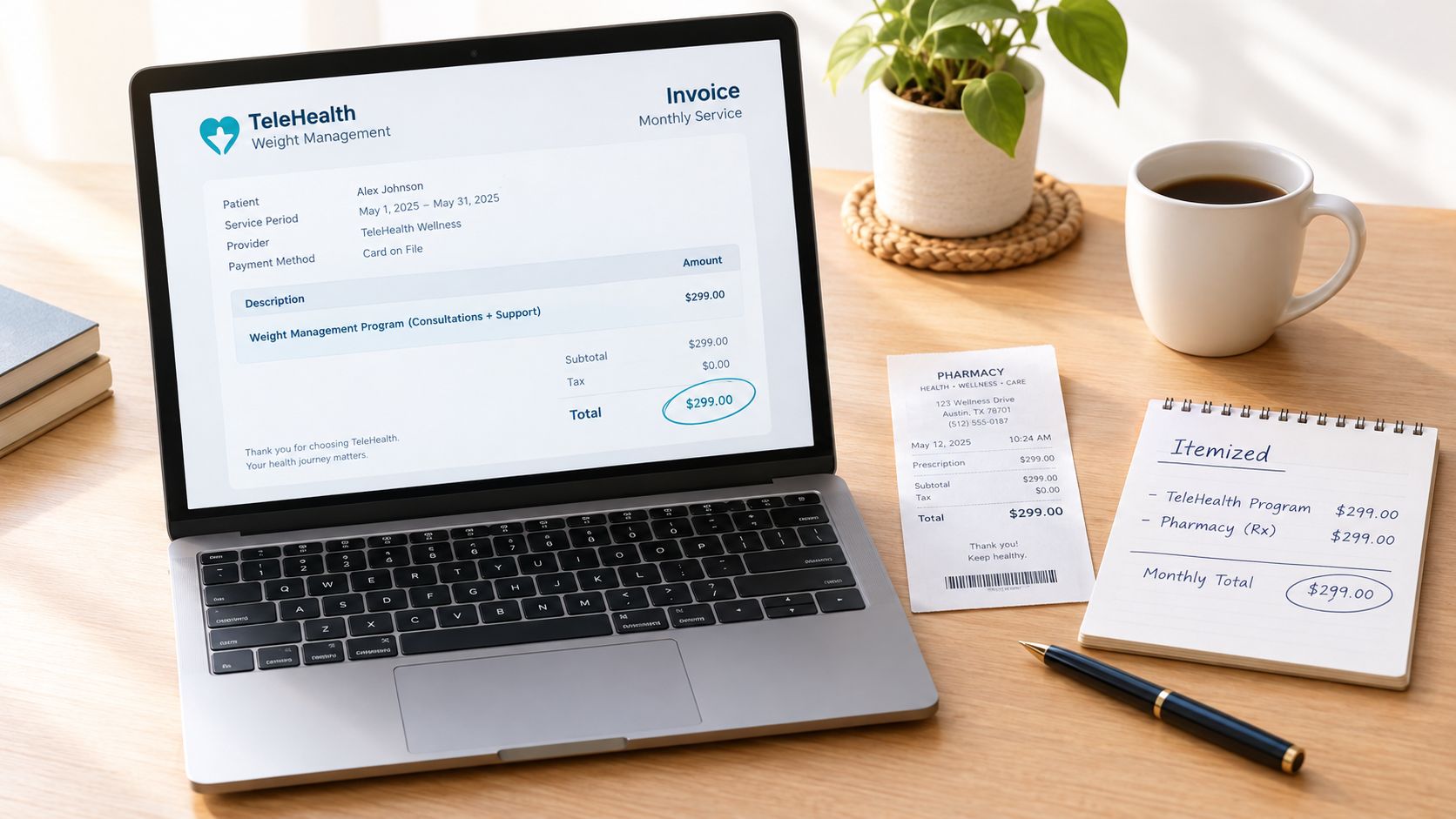
Example one, a separated invoice
Assume the provider issues an invoice with separate lines for:
- A prescribed GLP-1 medication
- A physician or licensed-provider consultation
- Clinically necessary dosage monitoring
- General wellness coaching
- Shipping
The prescribed medication is usually the easiest component to support because the prescription creates a direct record of medical treatment. The consultation and monitoring may also be defensible when they relate to the diagnosed condition and the provider documents their clinical purpose.
The wellness coaching requires closer review. If it's general lifestyle content available without a diagnosis or treatment plan, don't assume it qualifies. Shipping may also need separate evaluation rather than being folded into the medical total.
Example two, one bundled monthly fee
If the provider charges one monthly amount for everything, ask for an itemized statement before filing a claim. The statement should identify what medication was prescribed, when the clinician service occurred, what monitoring was performed, and which services are optional or nonmedical.
Submit only the portion supported by the documentation and your administrator's rules. If the provider can't separate the services, ask the FSA or HSA administrator how it wants the expense substantiated before using the account card. That conversation is more useful than relying on a generic “eligible” badge on a checkout page.
Step-by-Step Guide to Submitting FSA and HSA Claims
Start before treatment begins. Confirm whether you're using an HSA or an employer-sponsored FSA, then read the plan's reimbursement rules. This matters most with an FSA because the employer's plan document can limit eligible categories and require specific substantiation.
- Confirm the account rules. Ask the administrator whether prescribed weight-management medication, clinical consultations, and telehealth monitoring are accepted when tied to a diagnosed condition.
- Request an itemized invoice. Don't accept a single “program fee” if the provider can separate prescription medication, consultations, monitoring, messaging, coaching, and shipping.
- Collect medical support. Keep the diagnosis, prescription, letter of medical necessity if provided, and dates of service.
- Match the claim to your payment. Submit the qualified amount shown on the invoice, not an estimate or the full bundle by default.
- Use the administrator's portal. Upload the receipt and supporting records through the HSA or FSA claim system, following its file and documentation requirements.
- Retain the complete record. Save the submitted claim, approval or denial notice, provider correspondence, and proof of payment.
Your account balance still controls what you can spend. A medically eligible prescription won't create additional FSA funds, and a high account balance won't make a nonqualified wellness charge eligible. HSA funds can generally be used for qualified expenses without waiting for an insurance deductible to be met, but the expense still needs to satisfy the medical-care rules.
Never double-dip. The same expense can't be reimbursed through an HSA or FSA and also claimed as an itemized medical deduction. If the administrator denies a bundled claim, ask whether it will reconsider a properly separated portion instead of resubmitting the entire invoice.
Final Checklist Before Paying With FSA or HSA Funds
Use this checklist before you authorize a monthly charge:
- Medical purpose: Does the treatment address a physician-diagnosed condition such as obesity, diabetes, hypertension, or heart disease?
- Prescription record: Do you have the prescription or medication documentation?
- Itemized billing: Does the invoice separate medication, consultations, monitoring, coaching, shipping, and other fees?
- Medical necessity: Can the provider supply a diagnosis or letter of medical necessity if the administrator requests one?
- Available balance: Is enough money available in the HSA or FSA, separate from the annual contribution ceiling?
- Plan rules: Has your employer's FSA administrator confirmed that it accepts the relevant charge?
- Timing: Do you understand whether your FSA has a deadline, grace period, or employer-selected carryover?
- No duplicate tax benefit: Are you avoiding an itemized medical deduction for an expense already reimbursed through an HSA or FSA?
The phrase “HSA eligible” or “FSA eligible” shouldn't end your review. It describes a possible tax treatment, not guaranteed reimbursement, insurance coverage, or eligibility for every line in a bundled telehealth program. The defensible amount is the portion tied to qualified medical treatment, supported by a diagnosis, prescription, itemized invoice, and payment record.
Check the plan administrator's rules before paying, especially if the provider uses one monthly charge for medication and wellness services. Keep the complete documentation for your tax records and respond promptly if the administrator requests substantiation.
Weight Method provides telehealth weight-management care with licensed-provider consultations, prescribed GLP-1 treatment options, ongoing messaging, monitoring, and dosage support. If you want to review a medically supervised program and clarify how its documentation may fit your HSA or FSA process, visit Weight Method and confirm the details with your plan administrator before submitting a claim.