You're probably here because the internet made this decision look easier than it is. One ad says semaglutide is a fast track to weight loss. Another says buying it online is basically a legal trap. Both are incomplete.
The question isn't “Can I get semaglutide injection online?” You can. The question is whether you can get it safely, legally, and with real medical follow-up instead of ending up with a vague subscription, a mystery pharmacy, or medication that shouldn't have been dispensed to you in the first place.
I've got a blunt view on this. If a platform makes it easier to pay than to verify the clinician, pharmacy, and formulation, walk away. Semaglutide works. In the STEP 1 trial, adults with overweight or obesity who took once-weekly semaglutide 2.4 mg for 68 weeks lost an average of 14.9% of baseline body weight versus 2.4% with placebo, according to the FDA summary of Wegovy approval and clinical evidence. But strong efficacy is exactly why low-quality sellers crowd this market.
Starting Your Search for Semaglutide Online
You find a site at 11 p.m. The price looks decent, the quiz takes two minutes, and checkout appears before you have seen a clinician's name, a pharmacy, or a real explanation of what version of semaglutide you may receive. That is the moment to stop clicking.
Your first job is not to find the fastest seller. It is to sort the decision points in the right order: are you a reasonable candidate, what product are you seeking, and what information should any legitimate prescriber require before writing anything.
Know what you're actually shopping for
Start with your own medical snapshot, not the marketing page. Write down your height, current weight, weight-related conditions, full medication list, any prior GLP-1 use, and whether you want ongoing obesity care or a narrower prescription-and-monitoring service.
That sounds basic. It prevents bad comparisons.
A reader who wants insurance-based Wegovy, a reader replacing a prior semaglutide prescription, and a reader considering a compounded version during shortages are not shopping for the same thing. Many online programs blur those paths on purpose. Do not let them.
A neutral overview helps before you hand over your history or your card details. DoseRoutine's GLP-1 medication library is useful for sorting product names, common use cases, and the questions patients usually should answer before treatment starts.
Here's the checklist version you need at the start:
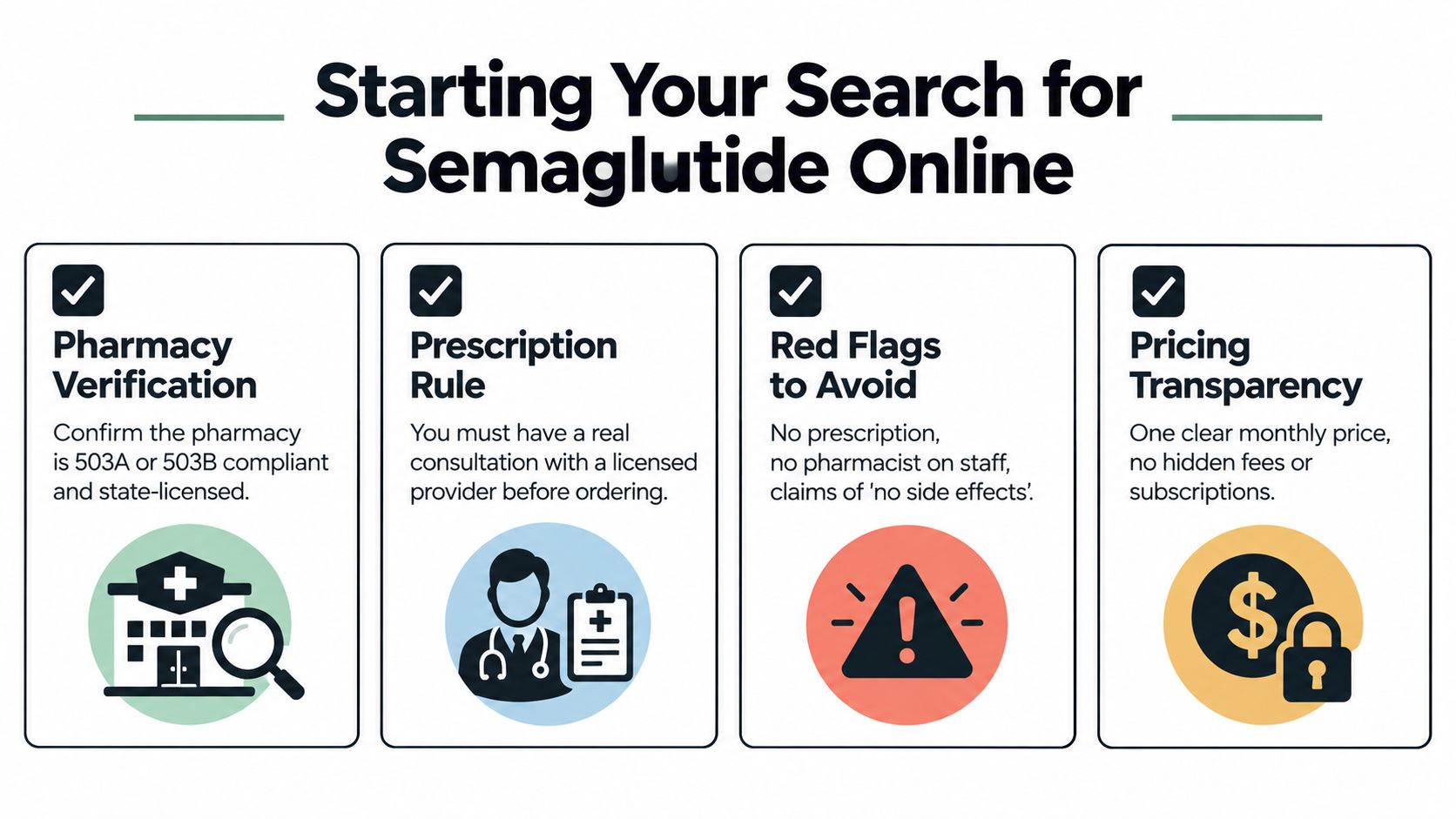
Eligibility comes before convenience
Online access should not erase screening. It should organize it.
For FDA-approved semaglutide used for chronic weight management, the standard adult framework is a BMI of 30 or higher, or 27 or higher with at least one weight-related condition, as described in the Wegovy prescribing information. If a platform asks about hypertension, sleep apnea, prediabetes, dyslipidemia, or prior weight-loss treatment, that is a good sign. Those details affect whether semaglutide fits and which treatment path makes sense.
The exclusion questions matter just as much. A proper intake should ask about:
- Personal or family history of medullary thyroid carcinoma or MEN 2
- Past pancreatitis or significant gastrointestinal disease
- Pregnancy, trying to conceive, or breastfeeding
- Current use of another GLP-1 receptor agonist
- Relevant kidney, gallbladder, or diabetes medication history
If those questions are missing, the platform is collecting revenue faster than it is collecting risk information.
Brand versus compounded is an early decision, not a footnote
Many readers miss this and end up confused after they pay.
Some telehealth companies prescribe branded products such as Wegovy or Ozempic when appropriate and available. Others focus on compounded semaglutide through partner pharmacies. Those are different supply chains, different pricing structures, and, after the regulatory shifts that followed the shortage period, different questions to ask before you proceed.
Ask directly what you may be prescribed. Ask whether the pharmacy is dispensing an FDA-approved brand product or a compounded preparation. Ask why that route is being used in your case. If a company stays vague until after payment, leave.
Do not clean up your history to get approved
Patients do this more often than they admit. They leave out prior nausea, omit another GLP-1 prescription, or gloss over a family thyroid cancer history because they do not want friction.
That is reckless. Semaglutide can produce meaningful weight loss, and a review published in PubMed Central reported mean losses of 14.9% to 17.4% at week 68 across STEP 1, 3, 4, and 8, with many participants reaching 10% or 15% weight-loss thresholds on semaglutide 2.4 mg, based on the STEP trial review in PubMed Central. A drug with that kind of effect deserves honest screening, dose planning, and follow-up from the start.
A denial is not always the end of the road. Sometimes it means your clinician needs records, labs, clarification on drug interactions, or a different treatment plan. That is how medical prescribing is supposed to work.
Choosing a Reputable Telehealth Provider
A good online semaglutide experience is decided before the first prescription is written. Provider quality shows up in credentials, pharmacy disclosure, follow-up structure, and billing honesty.
What to verify before you pay
If a program hides the clinician's identity, hides the pharmacy, or hides renewal terms, don't rationalize it. Move on.
| Criterion | What to Verify | Red Flag |
|---|---|---|
| Prescribing clinician | Licensed MD, DO, NP, or PA in your state, with visible name and credentials | No clinician named before payment |
| State authorization | The clinician can legally treat patients in your state | “Nationwide” claim with no state-by-state disclosure |
| Pharmacy source | U.S.-licensed pharmacy with verifiable state board license; if compounded, clear 503A or 503B status | No pharmacy named, or “partner pharmacy” with no details |
| Pricing | Medication, consult fees, shipping, refill fees, and renewals are itemized | One teaser price, then charges appear at checkout |
| Follow-up access | Clear path to message a clinician about side effects or dose holds | Customer support only, no clinical access |
| Clinical protocol | Intake review, relevant history, and some structure for follow-up | Instant approval with almost no screening |
One practical reference for what a legitimate online GLP-1 workflow should look like is this guide to an online GLP-1 prescription. Use it as a comparison tool, not as a substitute for verifying any specific provider.
The compounded question matters
A provider can be legitimate while still offering a formulation or fulfillment pathway you don't fully understand.
You need to know whether you're being prescribed brand semaglutide or a compounded version, which pharmacy dispenses it, and what documentation supports that route. Recent guidance has changed access patterns for compounded semaglutide after the broad shortage-driven compounding window ended in 2025, while telehealth prescribing for approved products remained viable, as explained in this review of compounded semaglutide legality in 2026.
If a company markets compounded semaglutide as if it's automatically interchangeable with branded products, without explaining the pharmacy and legal pathway, that's not transparency.
What Happens During the Online Consult
A real semaglutide consult shouldn't feel like buying shampoo with a quiz attached. It should feel like a clinician is building a prescribing decision.
The intake form is doing clinical work
You'll usually start with an online questionnaire. Expect questions about your weight history, current weight, height, medical diagnoses, medications, allergies, prior weight-loss attempts, and any relevant lab work you already have.
Each part serves a purpose. Weight and height help determine eligibility. Current medications help catch interactions or duplication. History of pancreatitis, thyroid cancer risk, pregnancy, or prior GLP-1 intolerance can stop or redirect the prescription.
If the platform asks for recent A1C or lipid results, that isn't overkill. It helps the clinician understand the bigger metabolic picture and whether your care plan needs more than a prescription.
What the clinician should ask
Some consults are live video. Others are asynchronous with secure messaging and chart review. Either can be appropriate if the review is real.
Expect questions like these:
- How long has your weight been trending upward?
- What have you already tried?
- Do you have nausea, reflux, constipation, or other GI symptoms now?
- Have you ever taken Ozempic, Wegovy, or another GLP-1?
- Is there any personal or family history that changes risk?
The clinician should also document whether the plan is brand medication or compounded, how dose escalation will work, and what happens if side effects show up early.
Ask one direct question before you accept the prescription: “Who is dispensing this medication, and how do I contact the clinical team if I don't tolerate the starting dose?”
Approval, deferral, or denial
Approval isn't the only legitimate outcome. Some patients get asked for more records. Some get told they need updated labs. Some are denied because the risk profile doesn't fit.
That's frustrating, but it's better than getting approved by a platform that isn't taking your history seriously.
Shipping, Storage, and Your First Injection
Your box shows up on a Friday afternoon. You are busy, the ice pack feels cool enough, and it is tempting to leave it unopened until later. Don't. The riskiest part of online semaglutide often starts after approval, when you have to confirm that the right drug, from the right source, arrived in usable condition.
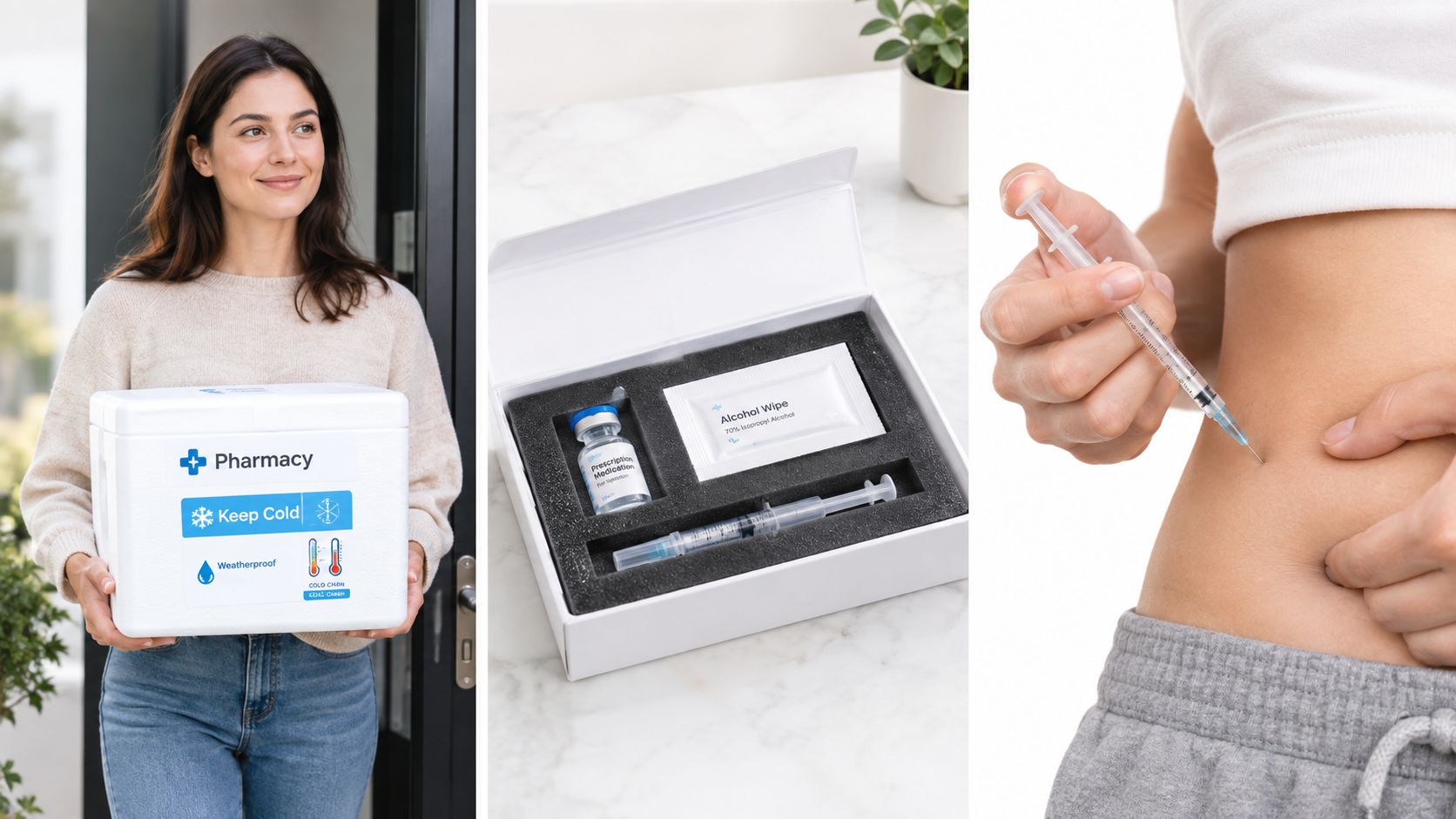
Inspect the shipment before it goes into the fridge
Open the package the day it arrives and verify the basics before you store anything. This is one of the clearest decision points in online treatment. If the shipment looks sloppy, treat that as a warning, not a minor inconvenience.
Check for:
- Patient-specific labeling: Your full name should match the prescription.
- Dispensing pharmacy identification: You should be able to see who filled it without guessing.
- Lot number and expiration date: Missing traceability is a problem.
- Packaging condition: Leaks, cracks, broken seals, or signs of heat exposure are reasons to stop and call.
If you are receiving a compounded product, ask for plain documentation on concentration, beyond-use dating, and storage directions. Vague labels create dosing mistakes.
If you want context on why handling details matter with prepared materials, this overview of semaglutide peptide water for researchers is useful background. It is not a consumer dosing guide, but it will help you spot loose claims and poor labeling faster.
Storage errors can ruin an expensive month of treatment
Follow the exact storage instructions for the product you received. Brand pens and compounded vials do not always come with the same handling rules, so do not assume one set of instructions covers both.
For Wegovy, the FDA-approved prescribing information says unopened pens should be refrigerated at 36 to 46 degrees Fahrenheit, should not be frozen, and may be kept for 28 days in the refrigerator or at room temperature up to 86 degrees Fahrenheit before cap removal, according to the Wegovy prescribing information.
Here is the practical advice. Put the medication away promptly. Do not store it in the fridge door where temperatures swing. Do not use it if it froze, sat in excessive heat, or arrived with obvious temperature-control problems. Expensive medication is still unusable medication if it was mishandled.
Your first injection should feel organized, not improvised
Set everything out before you start. Read the label. Confirm the dose. Wash your hands. Pick an injection site you can reach easily and see clearly.
Typical subcutaneous injection sites are the abdomen, thigh, or upper arm. Rotate sites to reduce irritation, avoid broken or inflamed skin, and use the device exactly as instructed by the manufacturer or dispensing pharmacy. If your program shipped a vial and syringe instead of a branded pen, slow down and verify the units on the syringe against the prescribed dose.
For a practical patient walkthrough, review how to inject semaglutide step by step before your first dose.
The early mistakes are predictable. Patients inject when they are rushed, misread syringe markings, skip site rotation, or realize halfway through that they never found the sharps container. Build ten quiet minutes into the process and make the first dose boring for the right reason. It was checked, stored correctly, and given correctly.
Monitoring Progress and Adjusting Your Dose
Week three is where many online semaglutide plans either settle in or start to go sideways. The usual pattern is predictable. A patient expects fast, steady loss, gets nausea instead, then asks for a higher dose because the scale did not move enough. That is exactly backward.
Dose changes should follow tolerance, not impatience
Semaglutide works best when the dose increases are boring and deliberate. Rushing up the schedule is one of the fastest ways to turn a workable medication into a miserable month. Gastrointestinal side effects are a common reason patients stop treatment early, especially when the dose climbs before the body has caught up.
A careful prescriber should ask two separate questions at follow-up. Are you tolerating the current dose? Are you getting the appetite control you need? Those are not the same question, and they should not get the same answer by default.
If nausea, vomiting, reflux, constipation, or diarrhea starts to interfere with eating, hydration, work, or sleep, do not improvise your own dose change. Message the prescriber. In many cases, the right adjustment is to stay at the current dose longer, clean up meal size and timing, or delay escalation. Stopping treatment and slowing titration are different decisions.
Track the pattern, not just the number
The scale matters. It is not enough on its own.
Use a simple weekly log that captures:
- Weight: Same day and similar conditions each time.
- Waist measurement: Useful when fluid shifts or constipation muddy the picture.
- Blood pressure or glucose readings if relevant: Especially if treatment started for metabolic risk, not just body weight.
- Side effects: Write down what happened, when it started, and how long it lasted after the injection.
- Appetite and food intake: “Less hungry” is vague. “Full after half my usual lunch” is useful.
- Function: Energy, walking tolerance, sleep, snoring, and how clothes fit often improve before the trend looks dramatic.
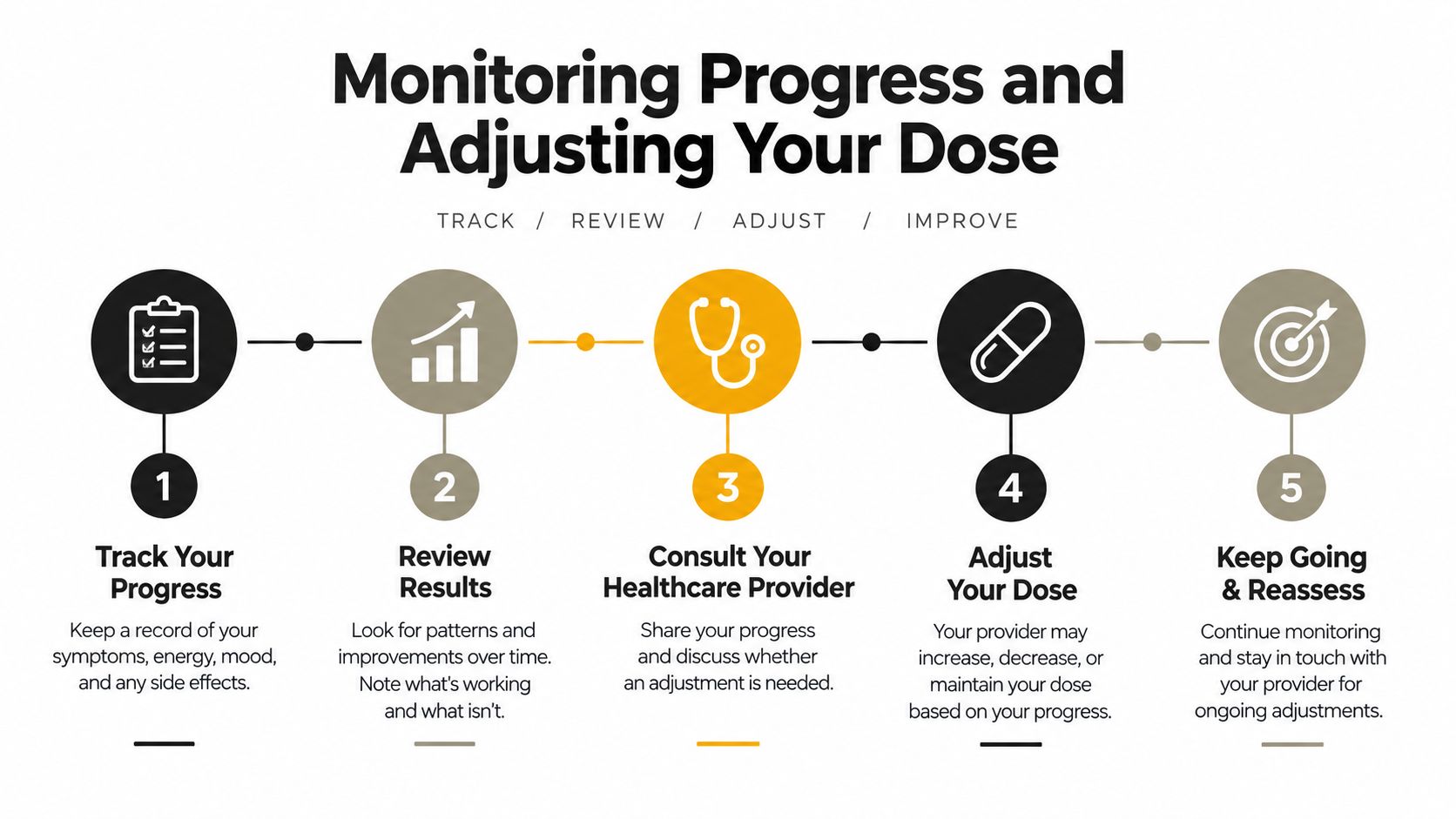
This is also where online care separates good programs from lazy ones. A refill form that asks only for your current weight is not enough. The provider should be checking whether the medication is working, whether the current dose is tolerable, and whether the next step still makes sense for you.
Ask follow-up questions that get a real answer
Do not send, “It's going okay.”
Send the details your clinician can act on. For example: “My appetite is clearly lower, but I get nausea the day after the injection and I am eating very little until evening. Should I stay at this dose another month?” That message gives a prescriber something to evaluate.
If you need a reality check on expectations, this article on how fast should you lose weight is worth reading. It helps cut through the worst online noise, which is the idea that every normal week should look dramatic.
Understanding Cost, Insurance, and FSA-HSA Options
Online semaglutide gets murky fast. Many companies advertise one number and collect three. If you can't see the total monthly cost before checkout, you don't know what you're buying.
Compare the pathway, not just the sticker price
You'll usually be sorting among brand medication, compounded medication when legally dispensed through an appropriate pathway, and telehealth bundles that combine clinical care with fulfillment. The right comparison is the all-in structure.
| Option | Monthly Medication Cost | Telehealth/Service Fee | Insurance Accepted | FSA/HSA Eligible | Typical Out-of-Pocket |
|---|---|---|---|---|---|
| Brand Wegovy or Ozempic | Varies by pharmacy, dose, and coverage | May be separate | Sometimes | Often with prescription and documentation | Highly variable |
| Compounded semaglutide | Varies by pharmacy and formulation pathway | May be bundled or separate | Usually limited | Often depends on documentation and merchant setup | Variable |
| Telehealth-bundled program | Often presented as one monthly price or subscription | Often included | Depends on model | Often possible with proper receipts | Variable |
I'm being intentionally strict here: if a company won't itemize medication, consults, shipping, refill requirements, and renewal policy, don't hand them your card.
Insurance can help, but don't assume it will
Coverage for weight-loss indications remains inconsistent. Prior authorization may be required. Some patients get coverage for one semaglutide use case and not another, depending on diagnosis and plan rules.
That's why your first billing question should be simple and specific: “If insurance doesn't approve this, what exact amount will I pay this month, including every platform and pharmacy fee?”
For reimbursement planning, keep:
- The prescription record
- Itemized pharmacy receipt
- Telehealth invoice
- Any prior authorization paperwork
- Any letter of medical necessity if requested by your plan or tax-advantaged account administrator
If you're evaluating a platform-based route, Weight Method is one example of a telehealth program built around online assessment, clinician review, prescription access if appropriate, and home delivery. Before using any program like that, review how FSA/HSA reimbursement works so you know what records to save from the beginning.
Legality, Safety, and Common Questions
The biggest mistake I see is treating legality as a side issue. It isn't. It determines whether you're receiving actual medical care or taking a gamble dressed up as convenience.
Common questions with straight answers
Can you legally get semaglutide injection online?
Yes, through legitimate telehealth prescribing and lawful pharmacy fulfillment. The key issue is not “online versus in person.” The key issue is whether the clinician is licensed for your state and whether the dispensing pathway is compliant.
Are fake or unsafe online GLP-1 products a real problem?
Yes. The FDA says it monitors the internet for fraudulent or unapproved GLP-1 drugs and has issued warning letters, while SafeMedicines has reported online sites selling substances claiming to be semaglutide or tirzepatide with questionable sourcing from foreign factories not registered with the FDA, according to this review of GLP-1 online safety risks.
What should make you stop the purchase immediately?
Any of these:
- No prescription required
- No named clinician
- No pharmacy disclosure
- Claims of no side effects
- Marketing that sounds like a supplement ad instead of a medical service
What if my shipment arrives warm, damaged, or mislabeled?
Don't use it until the pharmacy gives you clear instructions. A damaged cold-chain medication is not something to “probably” use.
Screenshot this rule set if you need to. Verify the clinician. Verify the pharmacy. Verify the formulation. If any one of those is fuzzy, don't buy.
Do you need primary care follow-up too?
Not always as a formal requirement, but it's smart. Telehealth can manage the prescription. Your broader health still benefits when your regular clinician knows what you're taking.
If you want a telehealth option that's built around this exact decision path, Weight Method offers online medical screening, licensed-provider review, and semaglutide access when appropriate, with medication shipped to your door. If you want to compare that process against the safety checks in this article, start with Weight Method and verify the details the same way you should with any provider.