Food noise is persistent, intrusive thoughts about food, eating and cravings that are hard to switch off and disrupt daily life, and it is not yet a formal diagnosis.
If thinking about food always meant you needed to eat, why might those thoughts continue after a satisfying meal? That gap helps explain why people find the term useful. It describes an experience that hunger alone doesn't fully capture, without telling you what caused it or which treatment you need.
What Food Noise Means in Plain Terms
Think of food noise as static on a radio. You're trying to listen to the station you chose, perhaps a conversation or a work task, but another signal keeps interrupting. Eating may turn down physical hunger without stopping the mental interference.
The important distinction is how the thoughts feel and what they interrupt, not whether you enjoy thinking about food. Choosing recipes, anticipating a birthday dinner and planning groceries can all be ordinary, useful activities.
An emerging clinical discussion of food noise describes unwanted, distressing food preoccupation while emphasizing uncertainty about its boundaries and overlap with disordered eating. Researchers are developing measurement tools, but a familiar description isn't the same as a diagnosis.
Hunger, Cravings and Food Noise Compared
Physical hunger is a bodily signal that you need nourishment. A craving is usually a pull toward a particular food. Food noise describes the repetitive mental pattern, which may include cravings but also planning, bargaining or guilt.
| Experience | What it feels like | Typical trigger | Usual response |
|---|---|---|---|
| Physical hunger | Stomach emptiness or low energy that eases after eating enough | Time since eating or inadequate energy intake | A satisfying, balanced meal usually quiets the signal |
| Craving | A strong, episodic pull toward one specific food | A familiar smell, sight, situation or emotional cue | May ease when the cue passes or after eating the desired food |
| Food noise | Repetitive, unwanted food thoughts, sometimes despite fullness | Food cues, habits, stress, disrupted sleep and constant availability | Can persist and interfere with attention or everyday decisions |
These experiences can overlap. You might be hungry, crave pizza and find yourself repeatedly debating whether you're allowed to eat it. Sorting them into separate observations is more useful than forcing everything into one label.
Practical check: Notice whether food thoughts continue after a satisfying meal. That's a pattern worth recording, not proof that you have a particular condition.
You don't need to suppress ordinary enjoyment of food. The concern is whether you can redirect your attention when you want to, and whether the thoughts cause distress or interfere with living.
Why the Brain Keeps Turning Up the Noise
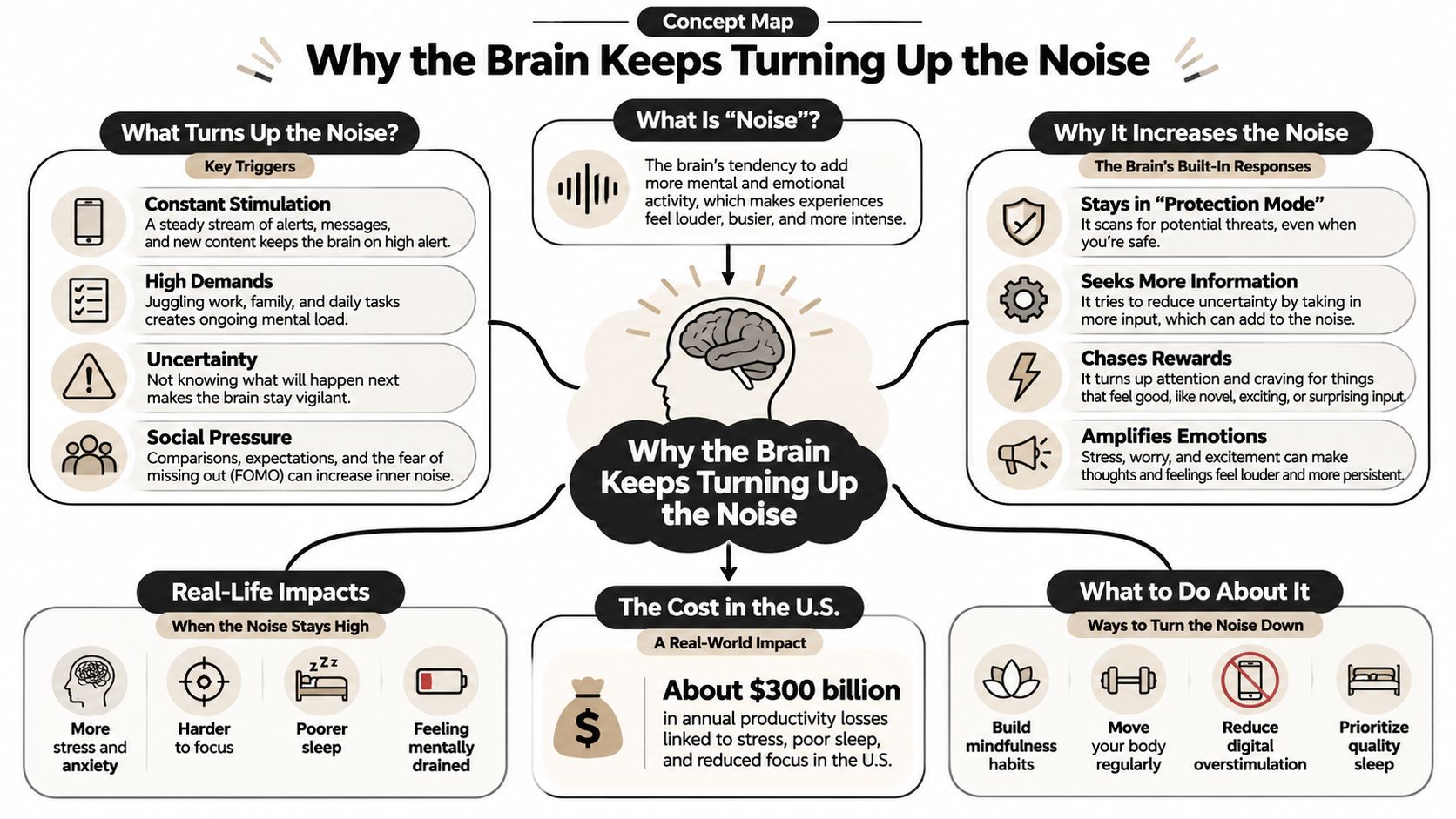
Your appetite involves more than an empty stomach. A review of appetite and food-cue neurobiology describes interacting systems that respond both to energy needs and to the appeal of food.
The homeostatic system, involving the hypothalamus and hindbrain, reads signals from the gut and fat tissue. Think of it as a thermostat monitoring whether your body has enough energy.
The reward system responds to food's sight, smell, availability and learned value. It's more like a sensitive alarm that can activate when you pass a bakery, even though the thermostat says your energy needs are met. Neither system is a moral judgment about your choices.
What Makes Food Cues Harder to Ignore
Cue-triggered appetite tends to be selective. You may want the biscuits in the cupboard without wanting an ordinary meal. That specificity makes the experience closer to craving than to a general need for calories.
Several everyday conditions may amplify the pattern:
- Highly appealing foods: Taste, texture and familiarity can make particular foods especially attention-grabbing.
- Learned routines: Opening a snack drawer or starting a favourite programme can become associated with eating.
- Stress and disrupted sleep: Changes in these areas can affect appetite and responses to food cues.
- Constant exposure: Food advertising, delivery apps and readily available snacks create repeated prompts.
The gut, microbiome and social environment also contribute to appetite regulation. That complexity is one reason there isn't a single established explanation for every person's food noise.
For useful observation, separate hunger, fullness, craving strength, triggers, intrusive thoughts and loss of control. Someone can feel comfortably full yet experience a strong cue-triggered urge; someone else may be thinking about food because they haven't eaten enough.
If unwanted thoughts extend beyond food or interfere substantially with daily life, Uptown Psychology's resource on when to seek help for intrusive thoughts offers context for discussing them with a mental-health professional. Using that resource doesn't imply that food noise is an anxiety disorder or another specific diagnosis.
Everyday Examples of Food Noise at Work and Home
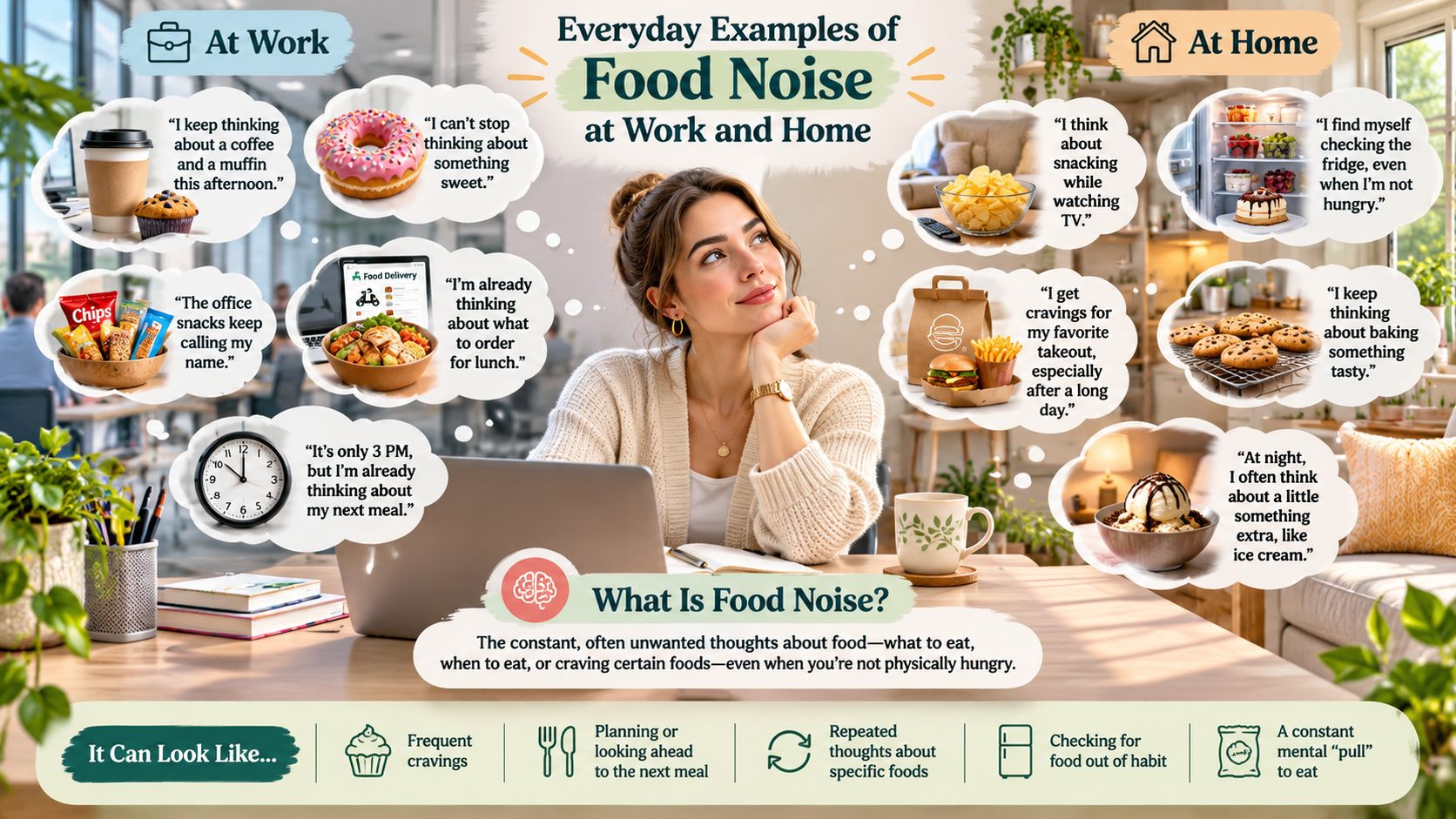
Say you've finished a full lunch and are working on a report. You keep thinking about the vending machine down the hall: what's available, whether to buy something and whether you'll regret it. You reread the same paragraph because your attention keeps returning to the decision.
Contrast that with missing breakfast, feeling hungry and then returning comfortably to work after eating. The difference isn't whether food entered your thoughts. It's whether the mental loop remains difficult to leave.
When Planning Stops Being Useful
A parent might decide what to cook, then mentally revisit dinner throughout meetings despite having settled the question. At bedtime, another person might replay what they ate and rehearse tomorrow's meals when they'd rather be sleeping.
The common thread is repetition without resolution. Useful planning ends with a workable decision; intrusive planning keeps demanding attention.
In a 2024 survey, 57% of U.S. respondents living with overweight or obesity said they had experienced constant, intrusive food thoughts that disrupt daily life, according to the report published by WeightWatchers and the STOP Obesity Alliance at George Washington University.
Recognizing yourself in an example can help you describe an experience. It doesn't establish its cause.
The term resonates because people can describe this lived experience even while clinicians are still refining how to define and assess it.
How to Measure Food Noise Before a Doctor Visit
A useful assessment looks beyond the label. A clinician may consider weight-related health, eating-disorder symptoms, medications, sleep and mental health alongside your description of food thoughts.
The Food Noise Questionnaire offers a more structured approach. Its 2025 validation study analyzed 396 participants and reported excellent internal-consistency reliability, with Cronbach's alpha of 0.93. That means its items were strongly related to one another, not that the questionnaire can independently diagnose a condition.
Food Noise Measurement Tools
| Tool | What it measures | Evidence reported | How to use it |
|---|---|---|---|
| Food Noise Questionnaire | Intrusive food-thought frequency, intensity and distress | Excellent internal consistency in its validation study | Follow its instructions and share results with a clinician |
| RAID-FN inventory | Food-related intrusive thoughts and their daily-life effects | Emerging instrument; clinical interpretation still requires care | Ask a clinician whether it suits your situation |
| Personal two-week log | Intrusion, triggers, distress and functional impact | Not validated | Make brief daily entries and bring them to an appointment |
The RAID-FN inventory is another developing instrument. Check its current instructions and scoring with a clinician rather than interpreting an online score as a diagnosis.
Keep a Brief Personal Log
For a practical starting point, try a two-week observation period. This is a suggested recording routine, not a validated test or a requirement before seeking help.
Copy these fields into a notebook:
- Time occupied: Estimate how long thoughts intruded, without trying to time every thought.
- Hunger and fullness: Note whether you needed food and whether thoughts continued after eating.
- Context: Record the place, activity, people present, stress and recent sleep.
- Distress: Choose consistent descriptions, such as mild, moderate or severe.
- Daily impact: Note disrupted work, delayed sleep, conflict or avoidance.
- Eating control: Record any episode when you felt unable to control eating.
Keep entries short. If recording becomes another source of fixation, stop and explain that to your clinician.
Bring the log to an appointment rather than trying to diagnose yourself from it. A nutritionist consultation can also help you examine whether meal patterns support adequate nourishment, while loss-of-control eating deserves prompt clinical review.
What GLP-1 Medications Change About Food Noise
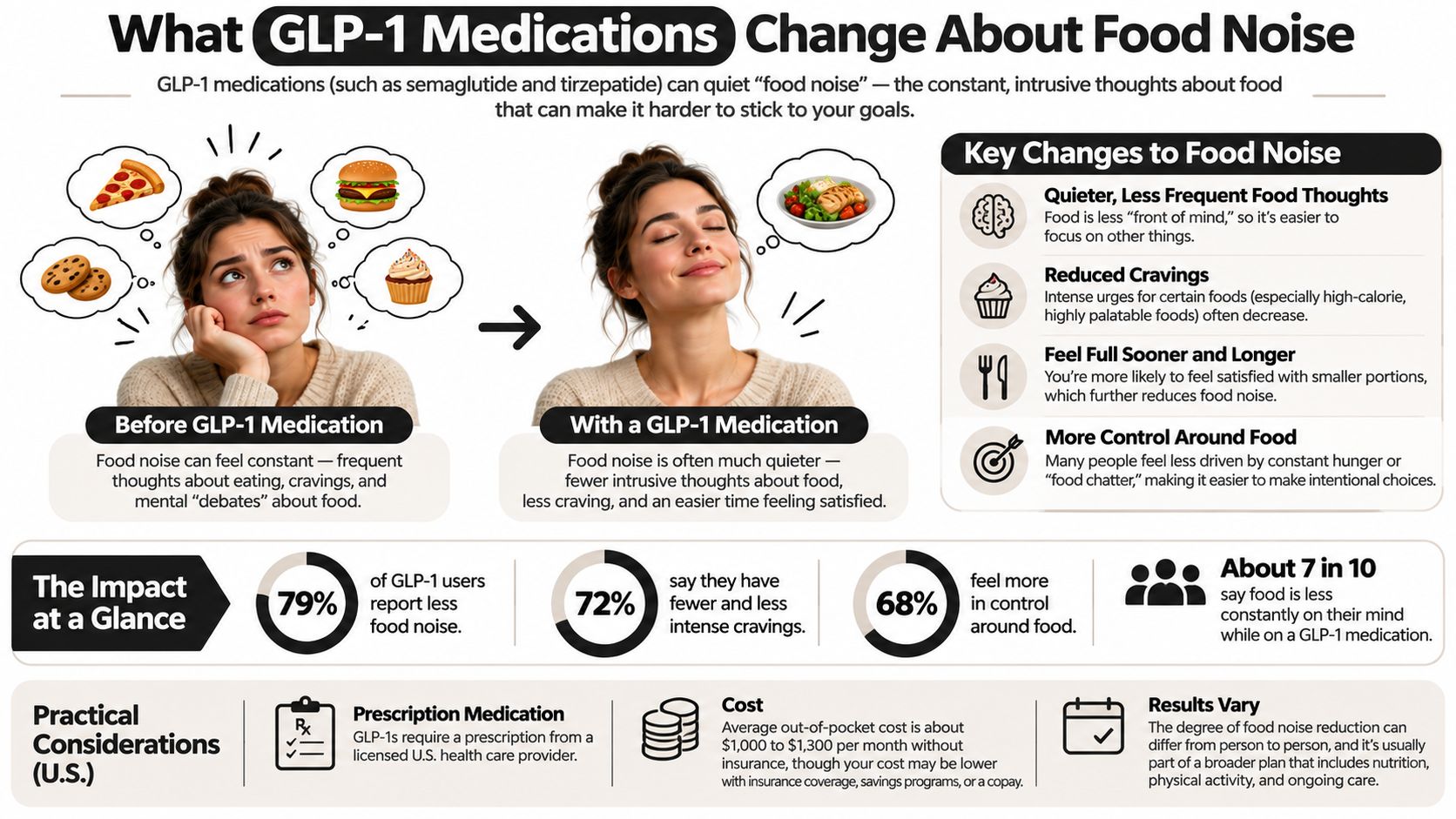
GLP-1 receptor agonists such as semaglutide influence appetite pathways in the hypothalamus and hindbrain. They may also reduce the reward pull of food cues, so their effects aren't explained solely by slower stomach emptying. For a plain-language mechanism overview, see how GLP-1 works for weight loss.
The evidence includes different kinds of studies. A controlled meal experiment can test intake under defined conditions; a survey can capture people's reported experiences. Neither automatically proves that intrusive food thoughts will disappear permanently.
Evidence on Food Noise and GLP-1 Treatment
| Study | Population | Reported result | Limitation |
|---|---|---|---|
| 20-week randomized trial of 2.4 mg weekly semaglutide, summarized in an expert review of appetite treatment | Adults compared with placebo | 35% fewer calories at an unrestricted lunch, with less hunger and fewer, weaker cravings | Reported through a review; a test meal doesn't establish lasting food-noise relief |
| Survey of injectable semaglutide users, described in a review of emerging food-noise evidence | 550 U.S. adults | Median Food Noise Questionnaire score fell by 5 points | Prospective studies are still needed |
| Observational cohort described in the same review | 417 adults receiving GLP-1 plus behavioural treatment or behavioural treatment alone | Adjusted one-month changes of about −4.1 versus −1.2 points, respectively | Association, not proof that medication alone resolves intrusive thoughts |
The controlled trial also reported greater fullness and improved eating control. The observational findings are encouraging, but treatment combinations and self-reported experiences make it harder to isolate exactly what caused improvement.
What Remains Uncertain
Researchers haven't established how consistently food-noise changes depend on dose, stress, sleep, eating-disorder history or medication interruptions. They also haven't settled how often symptoms return after stopping treatment or whether quieter thoughts lead to durable behavioural changes.
A subtler possibility is that experiencing a quieter baseline makes remaining thoughts more noticeable. A person may report returning noise partly because the contrast is clearer, not necessarily because treatment has stopped helping.
Clinical review should therefore include nutrition, mood, side effects, weight trajectory and eating patterns. If you notice reduced enjoyment more broadly, rather than just less interest in food, the Refresh Psychiatry & Therapy patient guidance offers context for a conversation with your prescriber.
Medication safety: Report worsening thoughts near the end of a dosing interval or episodes of loss-of-control eating. Don't increase your dose on your own.
The appropriate response may involve reviewing meals, sleep, mental health or treatment tolerability, not prescribing more medication.
Practical Ways to Ease Food Noise Without Medication
You can try modest changes before deciding whether medication belongs in your care. These are experiments in reducing friction and identifying triggers, not proven cures or tests of discipline.
Adjust the Pattern, Not Your Worth
-
Reduce repeated visual prompts. If a biscuit tin repeatedly interrupts desk work, move it out of direct view. Keep food accessible, but avoid placing your strongest cues beside every task. This isn't a requirement to ban favourite foods.
-
Make meals adequately satisfying. Include protein, fibre-rich foods and enough overall food. For example, add beans and vegetables to a rice bowl rather than trying to get through the afternoon on a small side salad. Observe whether eating enough changes the pattern.
-
Protect a consistent sleep routine. Compare days after disrupted sleep with better-rested days. Choose a realistic bedtime routine you can maintain rather than treating sleep as another perfection target.
-
Plan around a predictable pressure point. If you repeatedly debate snacks during afternoon meetings, arrange an accessible snack beforehand. If television prompts automatic eating, decide whether you want food before starting the programme, while leaving room to respond to genuine hunger.
-
Pause without making eating forbidden. When stress coincides with a craving, briefly name what's happening and choose what would help. That might be food, a break, support from someone else or a combination.
For a less rule-bound approach, you can explore the perks of intuitive eating with Be Your Best Self & Thrive Counseling, PLLC. The aim is a more flexible relationship with eating, not better suppression of hunger.
A helpful adjustment should make eating and daily life more manageable, not create another set of punishments.
Structured behavioural coaching may help translate observations into manageable routines. If your pattern isn't improving, seek clinical support rather than responding with tighter restriction.
Misconceptions and Your Next Step
Food noise isn't evidence of weak willpower. Describing yourself as undisciplined doesn't identify whether the relevant issue is cue exposure, inadequate nourishment, distress or another factor requiring assessment.
Medication isn't a guarantee of permanent silence. A useful treatment outcome is better daily functioning with adequate nutrition and acceptable side effects, not the lowest possible interest in food.
Don't Turn Every Food Thought Into a Symptom
Normal appetite changes don't automatically need a medical label. Enjoying food, looking forward to lunch and planning a celebration aren't problems merely because they occupy your thoughts.
Hunger shouldn't become something you have to disprove. You're allowed to eat when you need nourishment, even if you're also experiencing repetitive thoughts. A clinician can help untangle overlapping experiences without asking you to ignore your body.
Choose a Concrete Next Step
- Begin a brief log. Capture situations and effects rather than judging each food decision.
- Arrange an assessment if the pattern is disruptive. Bring your observations and medication list, and mention sleep, mood and any restrictive eating.
- Seek help promptly for loss of control or ongoing distress. You don't have to complete a tracking period before asking for care, and you shouldn't adjust prescription doses alone.
The most useful answer to “what is food noise?” is a description you can work with, not a verdict about you. Observing its pattern can improve a care conversation whether or not medication is chosen.
Weight Method offers telehealth weight-management care with provider consultations and ongoing support, including discussion of medication when appropriate. Visit Weight Method to explore its care options and bring your food-thought log to a conversation about your eating patterns, health and treatment goals.