Most patients on GLP-1 therapy reach a plateau between roughly months four and nine, and that plateau often represents maintenance at a new lower weight rather than the medication stopping working. In clinical analyses, a plateau meant less than 5% additional weight change across a 12-week period, not a few unchanged weigh-ins.
You may be standing on the bathroom scale, watching the same number appear for the third week in a row. Your appetite is still different from before treatment, your clothes may fit better, yet the early downward trend has gone quiet. That pause can feel like failure, especially when every weigh-in seems to ask whether the medication is still doing its job.
A better interpretation starts with the trend, not a single number. A GLP-1 weight loss plateau can be a normal treatment phase, but an unexpected stall can also signal missed doses, incomplete dose escalation, sleep problems, changing intake, side effects, or another medical issue. The useful question isn't, “How do I force the scale lower?” It's, “What kind of plateau is this, and what evidence should guide the next decision?”
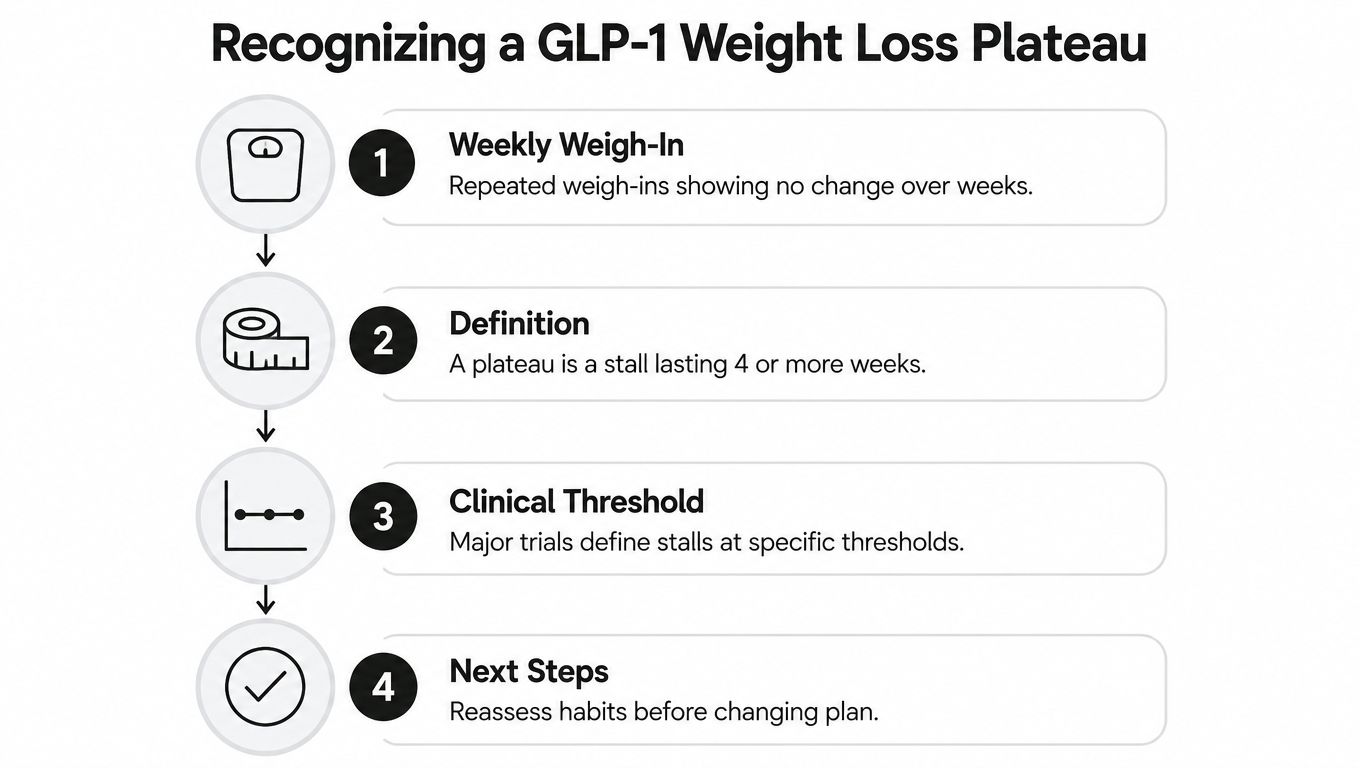
Recognizing a GLP-1 Weight Loss Plateau
A patient named Maya weighs herself every Monday morning. For several weeks, the scale barely changes, so she assumes semaglutide has stopped working. Her clinician asks for a longer view and learns that her waist measurement is smaller, her strength training has become more consistent, and her weight varies around the same range after different meals and workouts.
That isn't enough information to diagnose treatment failure. Day-to-day scale stability isn't the same as a clinical plateau. Water retention, gastrointestinal contents, menstrual-cycle changes, sodium intake, and resistance training can temporarily hide fat loss. A short pause is often normal noise.
Researchers analyzing the phase 3 SURMOUNT-1 and SURMOUNT-4 trials used a stricter definition: less than 5% additional weight change during a 12-week period, followed by less than 5% change in each subsequent 12-week interval (the published plateau analysis). That definition gives patients a more useful baseline for patience than reacting to a few static days.
Track the trend, not the drama
Use consistent conditions when you weigh yourself. Record the date, weight, dose, missed injections, notable gastrointestinal symptoms, menstrual-cycle timing when relevant, and major changes in exercise. A weekly log can reveal whether the line is flat or only moving within ordinary fluctuations.
You can also track waist fit, clothing, strength, energy, and appetite. Those measures don't replace medical assessment, but they help distinguish stable body composition from a complete loss of response. The GLP-1 weight loss timeline can help place your experience in the wider pattern of treatment progress.
Practical rule: Don't call a plateau from a handful of unchanged weigh-ins. Look for a sustained pattern under consistent treatment conditions.
A plateau may therefore mean your body has reached a temporary or lasting maintenance phase at a lower weight. It becomes actionable when the stability is sustained, the medication plan is being followed, and other explanations have been checked.
Why Plateaus Happen on GLP-1 Therapy
A plateau doesn't require a moral explanation. The body changes as body mass falls, and those changes narrow the energy gap that produced early weight loss.
The first shift is energy expenditure. A smaller body generally requires less energy to maintain itself, so the same food intake creates a smaller deficit than it did at a higher weight. Early treatment can produce a noticeable gap between reduced intake and energy use. Later, that gap can shrink until weight stabilizes.
The second shift involves appetite signals. As weight decreases, leptin can fall and ghrelin can rise, while resting energy expenditure and satiety signaling also change. These responses can increase biological pressure to eat and make continued loss harder, even when a GLP-1 medication remains active.
What the trial curve shows
The two-year STEP 5 trial offers a useful example. Adults receiving once-weekly semaglutide 2.4 mg with behavioral intervention experienced early weight reduction that plateaued at approximately week 60, while mean loss at week 104 was 15.2% of baseline body weight (STEP 5 analysis). The later stable phase doesn't erase the reduction. It shows that treatment can support a new lower weight after the fastest phase has ended.

Temporary factors can sit on top of this physiology. Constipation, fluid shifts, a harder resistance-training session, poor sleep, and changes in meal composition can all affect what the scale shows. Those factors don't prove that fat loss has stopped, and they shouldn't automatically trigger a dose change.
A practical response is to keep the medication schedule consistent, review intake and symptoms, and evaluate the trend over time. For readers who want additional ideas for meal structure, movement, and routine changes, proven ways to break a stall can serve as a supplementary resource. It shouldn't replace prescribing advice or turn a normal plateau into a demand for extreme restriction.
The key distinction is metabolic adaptation versus drug tolerance. A stable weight can reflect the body settling into a new energy balance. It doesn't automatically mean the medication has become inactive.
Evaluating Adherence, Dosing, and Behavioral Factors
Before calling a plateau biological, clinicians usually check the basics in a specific order. Memory is unreliable, so write down what happened rather than relying on a general impression that treatment has been “mostly consistent.”
Confirm medication exposure
Start with the prescription and the calendar.
- Injection timing: Record the actual day each dose was taken, including delayed or missed injections.
- Dose and escalation: Confirm whether you're still titrating, whether side effects prevented escalation, and whether the prescribed maintenance dose has been reached.
- Storage and access: Note interruptions caused by pharmacy delays, travel, or supply problems.
- Tolerability: Document nausea, vomiting, constipation, or other symptoms that change how much you can eat or whether you can continue treatment consistently.
A person still in dose escalation may not have the same exposure as a trial participant taking a maintenance dose. The GLP-1 titration schedule can help you understand why dose timing matters, but your prescriber should determine whether escalation is appropriate.
Audit the surrounding routine
Next, look for quiet changes that are easy to miss. Appetite may have returned gradually, portions may have expanded, or calorie-dense snacks may have become more frequent. On the other hand, nausea may have reduced protein and fiber intake so much that meals are now less balanced.
For a short period, record meals, fluids, protein-containing foods, fiber-rich foods, sleep quality, and physical activity. Don't use the log to punish yourself. Use it to identify a change that deserves attention.
Poor sleep can alter appetite and recovery. Reduced activity can follow fatigue, illness, travel, or a demanding work period. Resistance training can also make the scale less informative when body composition is changing.
Bring the evidence to the appointment
A useful appointment summary includes your weight trend, injection dates, current dose, side effects, food pattern, sleep, activity, and any new medicines. That gives your clinician something more reliable than a single frustrated sentence: “It stopped working.”
The aim is not to find fault. It's to distinguish inadequate exposure, temporary fluctuation, and true stabilization before deciding what comes next.
Plateau Timing by Medication and Starting Weight
A common mistake is reading a few flat weigh-ins as proof that treatment has stopped working. Timing is less tidy than that. Plateaus arrive at different points depending on the medication, the dose reached, how long treatment has continued, starting BMI, and individual response.
Tirzepatide shows this clearly. In SURMOUNT-1, the median time to plateau was 24.3 weeks among participants with overweight, 26.0 weeks among those with class I obesity, and 36.1 weeks among those with class II or class III obesity (SURMOUNT plateau analysis). Higher starting BMI was linked with a later median plateau in that analysis. That matters because a slower early trajectory can still fit a normal treatment course.
Dose changes the picture too. At week 72, mean weight changes in SURMOUNT-1 were approximately 15.0% with tirzepatide 5 mg, 19.5% with 10 mg, and 20.9% with 15 mg, compared with 3.1% with placebo. A person early in titration or staying on a lower dose should not expect the same pattern seen in a longer trial at higher maintenance doses. The scale is not judging effort. It is reflecting exposure, biology, and time.
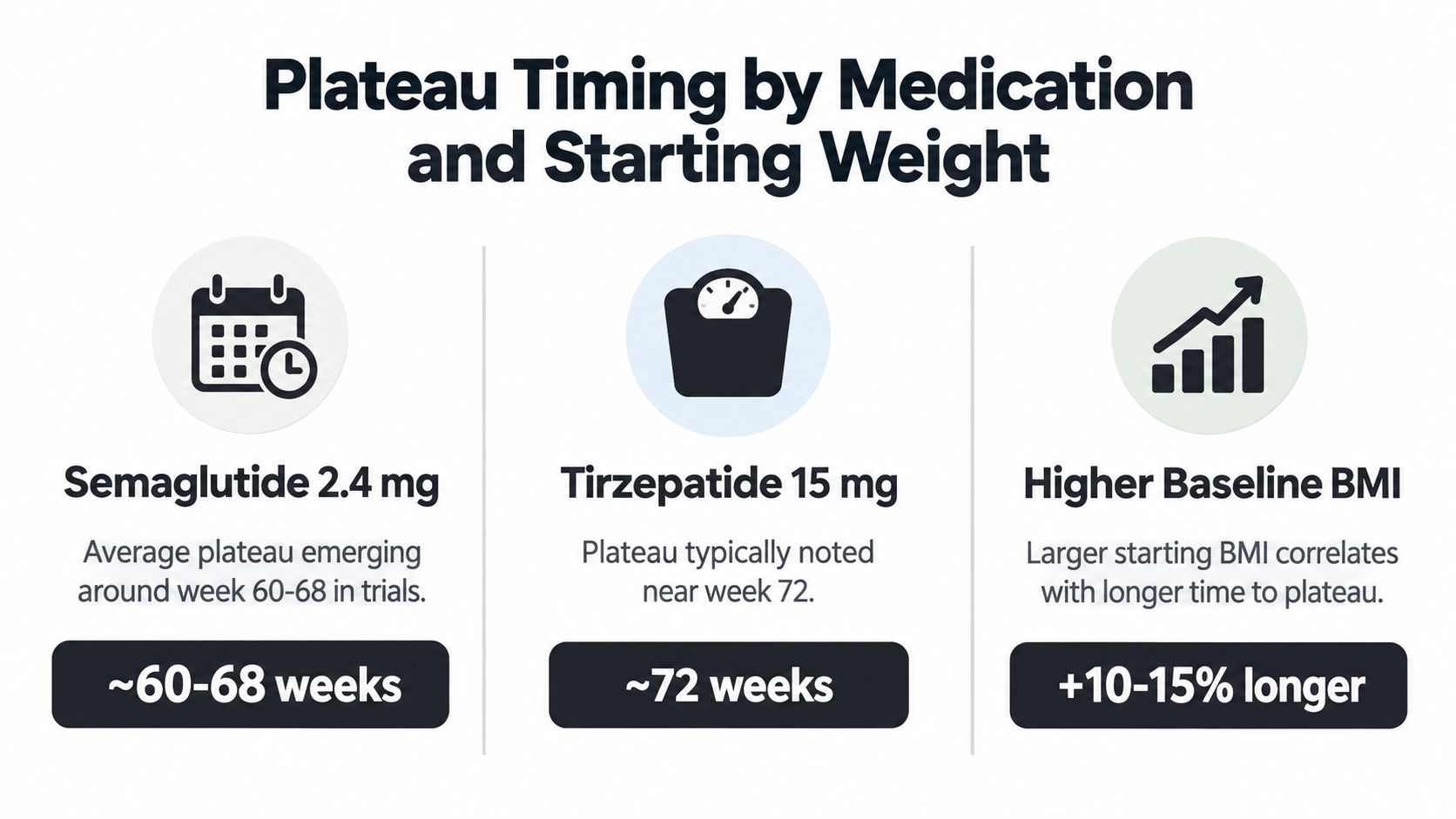
Semaglutide can level off gradually as well. In STEP 5, the treatment curve plateaued around week 60 and then stayed at a lower weight through week 104, as noted earlier. That pattern helps reframe what many patients call a failure. Sometimes it is treatment stabilization, not loss of effect.
The practical question is whether the timing fits the situation:
| Situation | What it may mean |
|---|---|
| Early stall during titration | Exposure may still be incomplete |
| Stable weight after extended treatment | Normal biological stabilization is possible |
| Stall after missed or delayed doses | Treatment continuity needs review |
| Higher starting BMI with slower early change | Plateau timing may differ from trial averages |
Use this section as a timing check, not a verdict. An early slowdown may reflect incomplete dose exposure or ordinary variation. A later plateau after meaningful loss may reflect maintenance at a new, lower weight.
Evidence-Based Strategies to Break Through a Plateau
A plateau deserves a layered response, not an automatic demand for more exercise or a self-directed dose increase. Begin with actions you can track, then discuss medical decisions with a licensed prescriber.
Start with the low-risk foundations
Review meal quality and adequacy first. Smaller appetite can make it difficult to consume enough protein, fiber, and fluids, especially when nausea or early fullness persists. Choose manageable portions built around protein-containing foods, vegetables, fruit, legumes, or whole grains as tolerated. The GLP-1 diet recommendations offer a starting point for organizing meals without turning the plateau into an extreme diet.
Resistance training can help preserve lean tissue during weight loss. Walking and other sustainable movement may support activity levels, while sleep and stress routines can improve appetite control and recovery. These changes aren't guaranteed to restart scale loss, but they can improve the quality and durability of treatment.

Then review the medical plan
If adherence is confirmed and stability persists, ask your prescriber whether the current dose is an effective maintenance dose. The clinician may consider continued treatment, a supervised adjustment, or another approved option, depending on response, tolerability, health history, and access.
Don't increase the dose independently. A higher dose can worsen side effects and isn't automatically the correct answer to a normal plateau. Likewise, switching medications requires a clinical review rather than a casual substitution.
Some readers also explore adjacent nutrition topics, such as Tecton Ketones on ketone science. Treat supplement information as separate from evidence for prescription incretin therapy, and discuss products with your clinician if you take other medicines or have medical conditions.
Weight Method is one telehealth option that connects eligible adults with licensed providers for evaluation, prescribed semaglutide or tirzepatide when appropriate, ongoing messaging, and monitored dose adjustments. The broader principle is the same across care settings: a plateau should trigger assessment, not improvisation.
The Risks of Stopping Treatment When Weight Stabilizes
A stable scale can create a tempting conclusion: the medication has done its job, so it must be time to stop. The trial evidence doesn't support treating stabilization as proof that the underlying biology has permanently changed.
In SURMOUNT-4, participants who stopped tirzepatide after an initial reduction regained about 14% of body weight, while continued treatment supported further loss or maintenance (SURMOUNT-4 withdrawal analysis). That finding doesn't mean every person will regain the same amount. It does show why discontinuation can carry a meaningful risk of regain.
The reason is straightforward. The medication's appetite and metabolic effects are no longer providing the same support after withdrawal, while the body's drive to restore lost weight can remain. A plateau during treatment may therefore represent successful maintenance, not a finish line that makes treatment unnecessary.
A stabilized weight is an outcome to protect, not automatically a signal to withdraw treatment.
Real-world results can also be smaller when people stop early or remain on lower maintenance doses. Affordability, side effects, pharmacy access, and personal preference all affect continuity, so a responsible plan should address those problems before a patient misses doses.
If treatment must pause, contact the prescribing team before stopping when possible. The discussion can cover alternative approved therapies, a monitored transition, nutrition support, side-effect management, and what weight or symptom changes should prompt follow-up.
Stopping isn't always wrong. Some people may have a clinical reason to discontinue, and a prescriber can help weigh benefits and risks. The mistake is treating a normal plateau as evidence that abrupt cessation is consequence-free.
When to Consult Your Provider About a Plateau
A common scenario is seeing the same number on the scale week after week and assuming the medication has stopped working. That is not always what the pattern means. If your weight has held steady for roughly 8 to 12 weeks despite confirmed adherence and tolerability, it is reasonable to contact your prescriber. You also do not need to wait for that window if the picture has become hard to read because of new symptoms, missed doses, refill gaps, or sudden weight change.
Go to the visit with more than a single weigh-in. A plateau is easier to interpret when your clinician can see the full record: recent weight trend, injection dates, current dose, side effects, eating pattern, sleep, activity, and other medicines. One number is like a snapshot. The trend is the full film.
Questions your clinician may address
- Is the dose appropriate? Your prescriber can tell whether you are still titrating, have reached a maintenance dose, or are being held back by side effects.
- Has treatment been continuous? Missed injections, delayed refills, and access interruptions often change the expected course.
- Could another medicine or condition contribute? A review of new symptoms, health changes, and concurrent medications can show why appetite, nausea, fluid balance, or weight have shifted.
- Would another approved option fit better? If response remains limited or side effects keep interfering, a different treatment approach may make more sense.
- What is the maintenance goal? Continued loss is not always the only marker of success if appetite, function, health markers, and quality of life have improved.
Call earlier for rapid regain, new or worsening gastrointestinal symptoms, side effects that prevent regular use, or any abrupt change that does not match your established pattern. Seek help promptly if you cannot keep medication down, cannot obtain it, or feel unwell.
The point of the visit is not to chase a lower number at any cost. It is to sort a normal stabilization phase from a stall that has a fixable cause. Weight Method helps adults pursue medically supervised weight loss with licensed provider consultations, ongoing support, and prescribed semaglutide or tirzepatide when clinically appropriate. If you want a structured review of your plateau, dose, and next-step options, visit Weight Method and complete the online intake.