How long do GLP-1 side effects last? A single bout is often shorter than feared, while side effects can continue longer than expected over the course of treatment. Nausea, diarrhea and vomiting usually last days per episode rather than months, while constipation runs on a longer clock and can stretch into weeks. Those episodes cluster during the first months of treatment, and they tend to come back for a few days after each dose increase.
That return is the part most explanations skip. People expect a single expiry date, the way a cold ends. A titrated drug works differently. You are not on one dose for a year. You move up a staircase of doses, and each step reintroduces the same molecule your gut is still learning to handle.
So two clocks are running at once. One measures a single episode: how long the nausea you have right now will last. The other measures the treatment itself, meaning when symptoms become less frequent overall, which is a question of months rather than days. Confusing the two makes an ordinary titration pattern feel like a setback.
A third pattern sits between them, and patients describe it most often. You improve, you advance the dose, and a familiar queasy feeling returns for a few days before settling again. Treat that as a normal titration response, not a reason to stop on the spot. Individual timing varies, but the sequence repeats predictably.
Typical Duration of Each Common Side Effect
A single bout of nausea, diarrhea or vomiting usually resolves within days. Constipation runs on a slower clock and can stretch for weeks. The figures behind both statements come from a post-hoc analysis that pooled the STEP 1 to 3 semaglutide trials, following 2,117 semaglutide-treated and 1,262 placebo-treated adults across 68 weeks and timing each gastrointestinal event separately (pooled STEP 1 to 3 analysis in Diabetes, Obesity and Metabolism).
Tirzepatide lands in a similar range. A 2024 review indexed by the U.S. National Library of Medicine reports that in the SURPASS-AP-Combo trial, the mean duration of tirzepatide-related diarrhea was 3 days, nausea 3 to 4 days and vomiting 1 to 2 days (2024 review of tirzepatide safety data).
| Side effect | Semaglutide 2.4 mg, median episode | Tirzepatide, mean episode | Timing pattern |
|---|---|---|---|
| Nausea | 8 days | 3–4 days | Clusters in the first months, recurring with dose increases |
| Diarrhea | 3 days | 3 days | Tends to cluster around dose increases |
| Vomiting | 2 days | 1–2 days | Brief, and repeats after each step up |
| Constipation | 47 days | Not separately reported; plan in weeks, not days | Persists longest of the four in this analysis |
What the numbers measure and what they skip
Every figure in that table describes one episode, not the time until all side effects stop. You can have three days of diarrhea, two calm weeks, then a queasy stretch after your next increase. Short episodes still add up to a disruptive month, which is why tracking good days tells you more than any single average.
The figures also belong to specific regimens: once-weekly semaglutide titrated to 2.4 mg for obesity, and tirzepatide in a named trial program. They aren't duration estimates for oral tablets, lower maintenance doses or other compounds in the class, so don't turn them into a personal deadline.
Practical rule: A symptom that outlasts its median isn't automatically a problem, but it deserves a dated note. Write the start date and the current dose in your phone, then mention it at your next check-in.
People read a median as a promise, and it isn't one. A median works like the midpoint of a queue: half the episodes finished sooner, half took longer, and the ones at the back can stand there considerably longer than the published number suggests. Direction matters more than the average. An episode that is easing, even slowly, is behaving the way the data predicts.
If you're logging anything, log two things: the date a symptom started and the dose you were on. That pair turns "my stomach has been off for a while" into a pattern your prescriber can work with.
How Side Effects Change Across Dose Steps
The first four weeks tell you very little about the next four months. What predicts the experience is the schedule itself: a series of small increases, each one a fresh exposure your digestive system has to absorb.
The timeline below shows the shape many patients describe, and it tracks what the labeling says about when symptoms cluster.
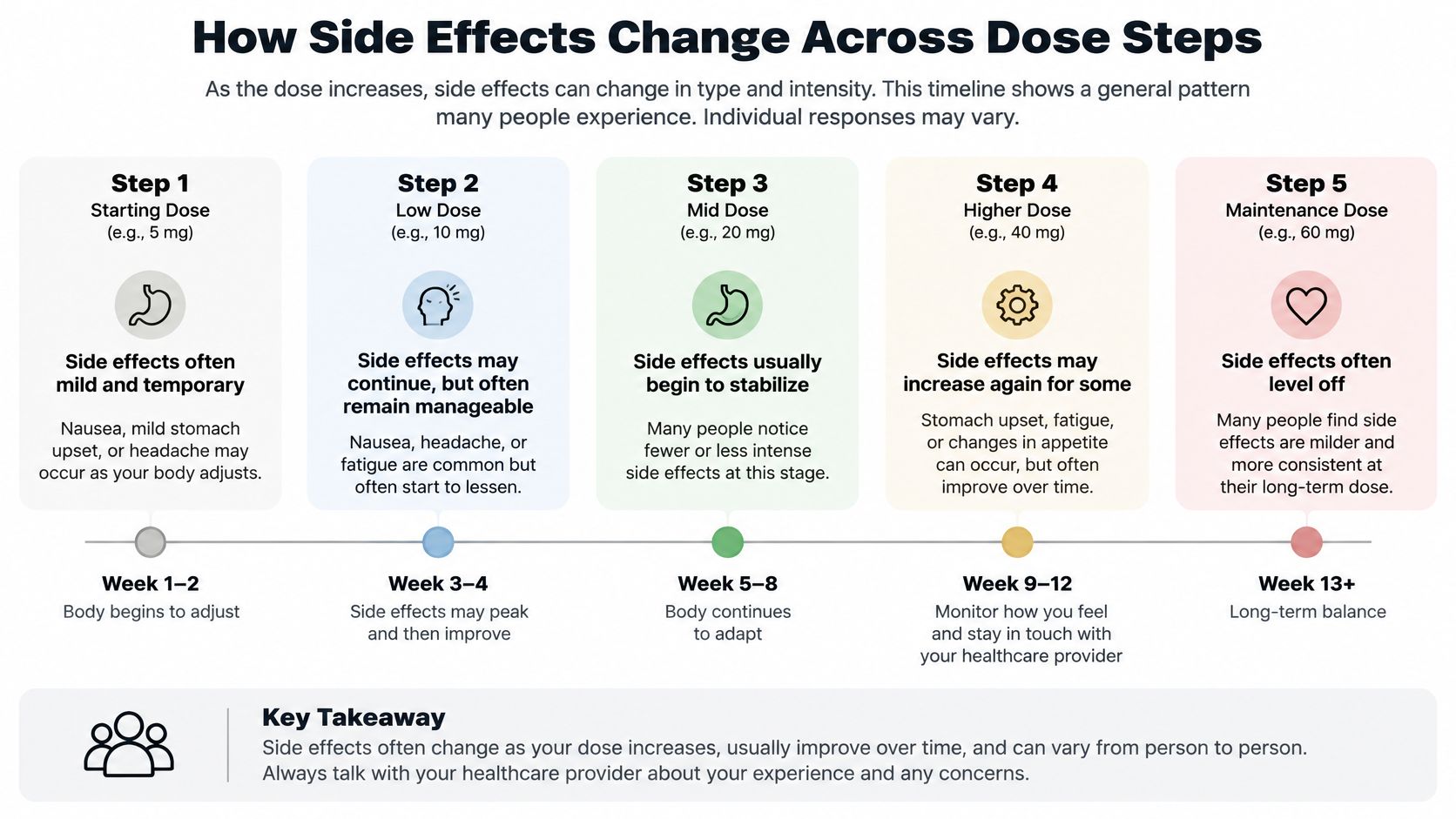
The tirzepatide prescribing information ties most nausea, vomiting and diarrhea events to dose escalation, and it sets the starting schedule that escalation follows: 2.5 mg once weekly for four weeks, with increases of 2.5 mg only after at least four weeks at the current dose. The slow start lets tolerance build before exposure climbs.
Four phases from the first injection to steady state
- Weeks 1 to 4, the starting dose. This is the smallest exposure of the whole climb, and often the mildest stretch, though a first brush of nausea or loose stools is common here.
- The escalation months. Symptoms are most likely to appear, fade, and reappear with each step up. The same labeling allows an increase to be delayed when tolerability is inadequate, so a paused titration is a legitimate clinical decision rather than a failure.
- The midpoint, when the slope changes. In pooled semaglutide data, the cumulative count of patients having a first gastrointestinal event flattens partway through treatment, and from that point the pattern shifts from new symptoms to fewer ones.
- Beyond roughly 30 weeks. A 2024 systematic review of semaglutide safety published in Medicine found that gastrointestinal side effects decreased after more than 30 weeks of treatment, with longer treatment associated with a lower incidence of gastrointestinal events (2024 systematic review in Medicine).
Each step behaves like a fresh starting dose rather than a continuation of the one before it.
A worked example from 2.5 mg to 5 mg
Say you start at 2.5 mg and feel mild nausea for the first week, mostly in the morning and after coffee. By week four it has faded and you're eating normally. The dose moves to 5 mg. Within a day or two the nausea is back, this time with loose stools, and you spend a few days on plain food and steady sips of water.
That return trip is the expected shape. Symptoms after an increase usually ease over days to several weeks as the body adapts to the new exposure, which is different from how they behaved on the first dose, when everything was new at once.
Across weight-loss trials, gastrointestinal adverse reactions occurred in 56% of participants receiving 5, 10 or 15 mg of tirzepatide versus 30% on placebo, while severe gastrointestinal reactions occurred in 1.7%, 2.5% and 3.1% at those doses respectively, against 1% for placebo, according to the same prescribing information. Most of that burden is mild and time limited. The small severe fraction is why persistent symptoms deserve a call rather than endurance.
Improvement is gradual, and severity varies widely from one person to the next. A symptom that flares after a dose change is following a titration pattern, which makes it a reason to talk to your prescriber about the pace of the climb, not evidence that the medicine has stopped working. Knowing how GLP-1 dosage for weight loss is stepped up makes that conversation easier, because you'll know which step you're on and how long you've been there.
Why Some Side Effects Outlast a Weekly Dose
A weekly injection sounds like it should produce a weekly symptom. Semaglutide doesn't behave that way, because the molecule stays active far longer than the seven days between shots and because the dose is deliberately built up in stages. Wegovy labeling starts treatment at 0.25 mg once weekly and permits delaying an escalation for four weeks when a patient doesn't tolerate the current dose (Wegovy prescribing information).
That schedule is the cause and effect in plain view. Rapid exposure increases can temporarily amplify nausea, vomiting, constipation or diarrhea, while slower escalation gives gastrointestinal physiology more time to adapt. The medication also slows gastric emptying, which is part of how GLP-1 works for weight loss, and it explains why a bigger dose can feel like a heavy meal sitting in place.
The benchmark that helps isn't a fixed number of days. It's direction: are symptoms trending downward within the current dose period? Day ten of a new dose being better than day three is the signal you want.
Practical habits support that trend. Keep fluid intake steady through the day rather than catching up at night, eat smaller portions, and stop at comfortable fullness instead of clearing the plate. Don't skip or double a dose on your own to manage symptoms. Escalation timing is a clinical decision.
Oral tablets follow the same logic with one wrinkle. Higher oral doses may cause more initial gastrointestinal effects, which typically improve with continued use, and the side effects of oral Wegovy resemble the injectable form, primarily nausea, diarrhea and constipation during dose escalation.
Bring four things to your clinician: the start date of the symptom, the dose you were on, whether it comes in separate episodes or runs continuously, and whether it's improving.
Constipation can outlast all of it, which is why it gets its own handling below.
Why Constipation Can Outlast Other Side Effects
Nausea, diarrhea, and vomiting tend to arrive as short episodes and fade. Constipation behaves differently. It can build across days, linger between doses, and remain a background problem after the first weeks of escalation. That difference matters because it changes the question you ask: not only "how long does this episode last?" but "why does it keep returning?"
Part of the answer is cumulative. The medication slows transit through the whole digestive tract, not just the stomach. Smaller meals and lower fluid intake slow it further. By the end of a week, you are handling the combined effect of several days of slower movement, not the aftermath of one dose.
Constipation timelines are not interchangeable between medications. A number from one drug's analysis should not be transplanted onto another. The safer expectation is that constipation is measured in weeks, while nausea and diarrhea are often measured in days. A dose increase can restart the clock, which is why symptoms seem to return rather than fade once for good.
A response plan that works in order
- Keep fluid steady. This is the same habit that helps nausea, and it supports bowel function more reliably than any single food.
- Note the start date and the trend. Are bowel movements getting easier within this dose period, staying flat, or getting harder?
- Ask before you buy. Your prescriber should choose the laxative or stool softener because the right class depends on what is causing the slowdown. Dosing also depends on the patient and situation, so safe softener dosing for new mothers is not a template for GLP-1 patients; your prescriber needs to match the class and dose to your cause.
- Report anything beyond the expected course, especially constipation with severe abdominal pain or vomiting. Those signs move to the urgent tier below.
Fiber timing matters too. Adding fiber quickly without enough fluid can make constipation worse for a week before it helps. A planned increase, with steady fluids, gives the gut time to adjust. These GLP-1 diet recommendations cover the fiber and fluid side in practical terms.
A long constipation episode is not automatically dangerous. It is a reason to raise the issue at your next check-in rather than waiting for the next dose change, because the answer may be a slower titration or a simple add-on.
When Side Effects Need Action or Urgent Care
Mild symptoms still matter when they interfere with your life. Real-world reviews report first-year GLP-1 discontinuation rates of roughly 20% to 50%, with gastrointestinal problems frequently contributing to stopping or to using lower-than-trial doses, and a qualitative study found that side effects were the most commonly reported challenge among people who discontinued, identified by 55% of discontinuers (review of GLP-1 adherence and side-effect burden).
That gap matters because reassurance alone doesn't keep people in treatment. A queasy week is manageable. A queasy month that ruins dinners, sleep and work is a clinical problem even when it isn't a medical emergency.
Three tests to run before you call
- Direction: is the symptom improving within this dose period, or flat and worsening?
- Function: is it stopping you from eating, sleeping, working or drinking enough?
- Avoidance: are you tempted to skip a dose or dread the next injection?
A yes to either of the last two means calling the prescriber. So does a symptom that lasts for weeks, returns harder after every increase, or pushes you toward a lower dose than the one you were prescribed.
A two-tier checklist for symptoms that need help
Seek care immediately for fainting, severe or worsening abdominal pain, or an inability to keep any fluid down.
Get medical assessment the same day for repeated vomiting, markedly reduced urination, dark urine, dizziness when standing up, or a dry mouth. Those point toward dehydration, which can escalate quickly when you can't keep fluids in.
Contact the prescriber within a day for vomiting or diarrhea that persists, worsens or fails to improve across a dose period, even if you feel basically functional.
Ordinary nausea isn't on that list, and neither is a single loose stool. Anything severe, unusual or worsening deserves a report even if it doesn't appear here. If you're unsure, call the prescriber's office and give three facts: the symptom, its start date and your current dose.
Confirm Your Next Step With Your Prescriber
Turn all of this into one decision. Record the symptom type, its start date, how long the episode ran and the dose you were on. Compare that record with the duration table and the phase timeline to see whether you're looking at a typical per-episode course or something that has drifted out of pattern.
Then choose a path: keep monitoring because the trend is downward, ask for a dose review or a delayed increase because the trend is flat, or seek urgent care because a warning sign applies. Bring your current medications, any prior GLP-1 history, pre-existing conditions and the dose timeline to that conversation, since each one changes the answer.
If you haven't started treatment yet, Weight Method's medical review begins with a detailed questionnaire covering BMI, pre-existing conditions, current medications, prior GLP-1 history and contraindications. Licensed clinicians determine eligibility from that history and a provider assessment, and a 2-minute quiz shows whether you may qualify.
Set a review date before you hang up. A plan with a date attached is the difference between tolerating a rough patch and abandoning a therapy that was starting to work.
Weight Method pairs every plan with a licensed clinician who can slow an escalation, delay an increase or adjust a dose when side effects interfere with daily life, which is exactly the flexibility a titrated drug requires. You get provider consultations, unlimited messaging, progress tracking and direct-to-door shipping, so the schedule can respond to what your gut is doing rather than a fixed calendar. Take the free two-minute quiz at Weight Method to see whether you may qualify, then bring your symptom record to your first visit.