A 2025 retrospective study published by Cureus followed 50 people after elective laparoscopic gallbladder removal. Seventeen of them, or 34%, reported persistent symptoms consistent with post-cholecystectomy syndrome, and among those with symptoms, right-upper-quadrant pain affected 48% and diarrhea 33% (Cureus study on symptoms after cholecystectomy). That's a large minority for an operation usually described as leaving no lasting effects.
Two different problems get bundled together under the phrase "no gallbladder side effects." One is gallstones, and that one cannot happen inside an organ that's been removed. The other is the way bile now reaches your intestine, and that one still can.
Keeping those apart changes what you watch for, what you can manage at home, and which symptoms mean a same-day call. Add a GLP-1 medicine and the picture gains one more layer, because these drugs change how fast weight comes off and how the gut moves.
Gallbladder Event Rates in GLP-1 Trials
Many people who take a GLP-1 medicine never have a gallbladder event. That holds whether the gallbladder is still in place or long gone. But "many" isn't "all," and the rates are measured precisely enough to be useful. Start with the drug you take or are considering, because the numbers differ by product.
| Source or medication | Event | Reported rate | Comparison group |
|---|---|---|---|
| Ozempic trials, 0.5 mg | Cholelithiasis (gallstones) | 1.5% | 0% placebo |
| Ozempic trials, 1 mg | Cholelithiasis (gallstones) | 0.4% | 0% placebo |
| Mounjaro trials | Acute gallbladder disease, including cholelithiasis, biliary colic and cholecystectomy | 0.6% | 0% placebo |
| Meta-analysis of 76 RCTs | Gallbladder or biliary disease | Relative risk 1.37 (95% CI 1.23-1.52) | Control treatments |
| Meta-analysis of 76 RCTs | Cholelithiasis | Relative risk 1.27 | Control treatments |
| Meta-analysis of 76 RCTs | Cholecystitis | Relative risk 1.36 | Control treatments |
| Meta-analysis of 76 RCTs | Broader biliary disease | Relative risk 1.55 | Control treatments |
The first three rows come from FDA prescribing information for these GLP-1 therapies. In placebo-controlled Ozempic trials, cholelithiasis was reported in 1.5% of patients on the 0.5 mg dose and 0.4% on the 1 mg dose, with no cases among placebo-treated patients. For tirzepatide, the Mounjaro label reports acute gallbladder disease in 0.6% of treated patients versus 0% of placebo recipients.
Reading a relative risk correctly matters more than the decimal place. A figure of 1.37 means about 37% higher risk than control treatments, not a 37% chance that you'll have an event. The absolute numbers in the trial rows stay in single digits.
Then there's the limit that shapes everything else. The people enrolled in those trials mostly still had their gallbladder, so these figures are a risk signal rather than a forecast for anyone living without one. They tell you the drug class nudges biliary trouble upward. They don't tell you what your own anatomy will do.
What the label does give you is an instruction. The FDA labeling states that acute gallbladder events, including cholelithiasis and cholecystitis, have been reported after marketing authorization, and it recommends gallbladder evaluation with appropriate follow-up when the condition is suspected.
Symptoms that trigger that evaluation: persistent upper-right abdominal pain, fever, jaundice, vomiting, or pain after fatty meals. During dose escalation and rapid weight loss, treat any of these as a reason to call rather than a reason to wait.
Find your medication in the table and note its row. That row is your reference point for everything else, including the broader picture of weight loss injection side effects beyond the biliary tract.
How Dose and Treatment Length Change the Risk
Gallbladder risk on these medicines isn't a fixed property of the drug. It moves with dose, and it moves with time on treatment. A 2022 systematic review and meta-analysis in JAMA Internal Medicine, covering 76 randomized clinical trials of GLP-1 receptor agonists, split the data both ways (JAMA Internal Medicine meta-analysis of GLP-1 trials).
At higher doses, the relative risk was 1.56. At lower doses it was 0.99, which is effectively no difference from control treatment. Duration tells a similar story: longer treatment carried a relative risk of 1.40, while shorter treatment sat at 0.79.
Both splits point at the same underlying variable, which is exposure. A higher dose puts more drug into the system at each step. A longer course stacks more weeks of that exposure. The trial averages reflect that arithmetic, and they're the reason escalation schedules exist at all.
What the numbers can't do: they can't predict which individual will develop a problem. The trial data describe groups, and causality for any one person's gallbladder event remains uncertain.
The mechanism the authors highlight runs through weight loss itself. The association was particularly relevant in weight-loss trials, where higher doses and substantial weight reduction may increase gallstone formation. That's a hypothesis with real support behind it, not a certainty, and it matters because it means the pace of loss is part of the conversation alongside the drug.
Three practical implications follow from that:
- Escalation is the risk window. Risk climbs with dose, so the weeks after each step up deserve more attention than the stable weeks in between.
- Duration is cumulative. A longer course means more total exposure, which is exactly why symptoms should be reviewed at each dose step rather than only when they become severe.
- Individual outcomes resist prediction. Averages from 76 trials describe populations. Your own history, weight trajectory and digestive baseline aren't in that average.
Look back at the event-rate table rather than trying to translate relative risks into a personal percentage. The useful move is behavioral: keep hydration steady, keep the escalation pace deliberate, and don't change or stop a dose on your own. Raise the timing and pace of increases with your prescriber, and use a clear GLP-1 titration schedule as the basis for that conversation.
Everyday GLP-1 Digestive Effects Without a Gallbladder
Set the biliary question aside for a moment. The medicine has its own digestive effects, and they show up whether or not you still have a gallbladder. The most reported ones are nausea, vomiting, constipation and diarrhea. Nausea tends to be strongest during dose escalation and eases as the body adapts.
The trap is that similar symptoms come from two different sources, and the response differs.
Nausea, early fullness and constipation usually reflect slowed stomach emptying and changed appetite signals from the drug. Watery, urgent diarrhea after a fatty meal points somewhere else entirely, toward bile acids reaching the colon. Same body, different plumbing, different fix.
Here's how that distinction looks in practice. A reader who feels queasy in the first week of each new dose and slightly constipated in between is describing a drug effect that usually settles. A reader who has an urgent, watery stool a few hours after a fatty dinner, weeks after surgery, is describing bile flow, and diet tweaks alone may not be enough.
One rule that covers both: repeated vomiting or diarrhea causes dehydration, and dehydration hits harder at higher doses. Report any stretch where you can't keep fluids down.
Three steps handle most everyday nausea without much fuss:
- Eat smaller portions. A half-portion eaten slowly asks less of a stomach that's emptying slowly.
- Stay upright after eating. Lying down within an hour of a meal makes reflux and nausea worse.
- Call about vomiting that blocks fluids. If water won't stay down, that's a clinical question, not a dietary one.
When the pattern is watery stools after fatty food rather than queasiness after a dose, the next section explains what's happening.
Digestive Changes After Gallbladder Removal
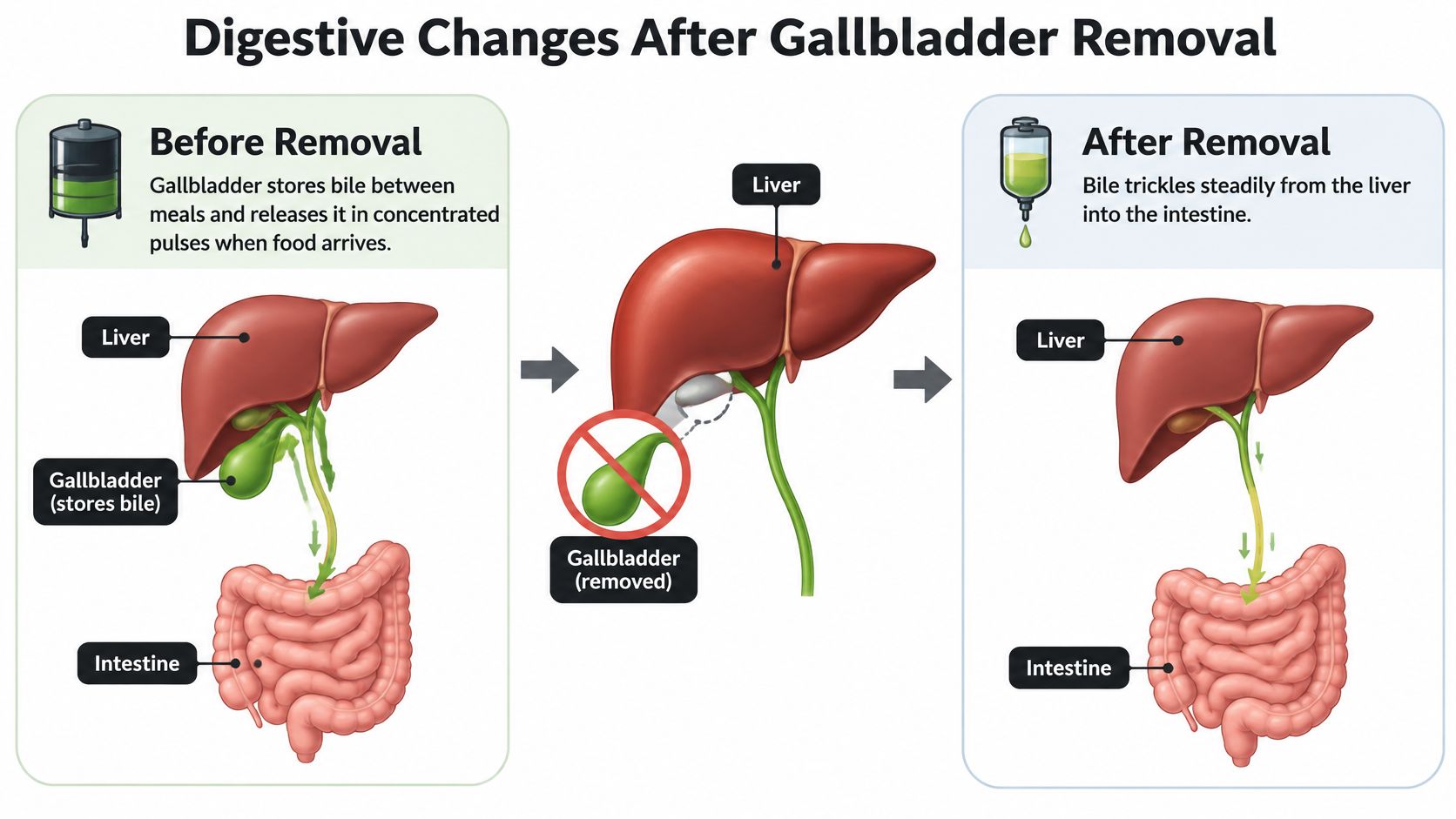
Picture a reservoir on a roof. The gallbladder stores bile between meals, concentrates it, and releases a strong pulse when fat arrives. Remove the reservoir and the liver keeps producing the same fluid, but it now trickles steadily into the intestine around the clock instead of arriving in bursts.
That single mechanical change explains most of what follows.
What the steady trickle does to digestion
Many people digest normally after surgery because the body adapts to continuous delivery. In some, the altered bile-acid delivery overwhelms reabsorption in the terminal ileum. Excess bile acids then reach the colon, where they draw in fluid and speed motility, producing watery diarrhea, urgency, bloating or cramping (BMJ Open systematic review of post-cholecystectomy diarrhea).
The scale of that is measured. A systematic review pooling 3,476 patients found post-cholecystectomy diarrhea in 462 patients, a rate of 13.3%. Among the patients who developed diarrhea, approximately 63.5% were estimated to have bile-acid diarrhea.
| Measure | Reported figure | Source context |
|---|---|---|
| Post-cholecystectomy diarrhea | 13.3% (462 of 3,476 patients) | Systematic review pooling 3,476 patients |
| Diarrhea attributed to bile acids | About 63.5% of patients with diarrhea | Estimate within the same systematic review |
| Ongoing diarrhea or excessive gas | Roughly 5-10% | Oxford University Hospitals patient guide |
| Persistent post-cholecystectomy symptoms | 5% to 47% | Range across published estimates |
| Persistent symptoms after elective removal | 34% (17 of 50) | 2025 Cureus retrospective study; right-upper-quadrant pain 48%, diarrhea 33% of symptomatic patients |
What settles on its own and what doesn't
NHS clinical information describes post-operative nausea, indigestion, abdominal pain and diarrhea as possible symptoms that often improve soon after surgery. An Oxford University Hospitals patient guide puts ongoing diarrhea or excessive gas at roughly 5-10% of patients (NHS guidance on gallbladder removal complications).
The wider range of published estimates for persistent symptoms runs from 5% to 47%, and symptoms may appear immediately or months to years later (Merck Manual entry on postcholecystectomy syndrome). That spread looks contradictory until you notice it measures different things: a single bothersome symptom versus a defined syndrome.
Two readers make the distinction concrete. The first has loose stools two weeks after surgery that ease when meals get smaller and settle by week six. That's adaptation. The second has diarrhea that persists for months, wakes them at night, and doesn't respond to cutting fat. That's a pattern worth investigating.
Signs that fit ordinary adaptation:
- Mild and improving. Symptoms that ease week by week, even slowly.
- Meal-linked. Trouble arrives after large or fatty meals, not at random.
- Weight is stable. No unintended loss alongside the bowel changes.
- No red flags. No fever, jaundice, blood or worsening pain.
Why the gallstone warning doesn't transfer
Here's where the term "no gallbladder side effects" gets confusing. Gallstones form in a gallbladder. Without one, that specific event is off the table, so the cholelithiasis signal from the trial data doesn't apply to you in the same way.
Bile-flow changes do apply. So does the fact that removal doesn't eliminate all biliary anatomy or digestive concerns, which is why bile-duct problems and worsening diarrhea still need clinical assessment rather than reassurance.
Persistent symptoms warrant evaluation rather than being assumed to be a permanent or unavoidable consequence. Practical steps include temporarily reducing very fatty meals, maintaining hydration, and discussing bile-acid testing or a therapeutic trial of a bile-acid sequestrant such as cholestyramine with a clinician.
Start a symptom diary today, even a rough one. Note meals, stool timing and consistency, and injection dates. Two weeks of entries turns a vague sense that something is off into a pattern a clinician can read.
How to Manage Digestive Symptoms Day to Day
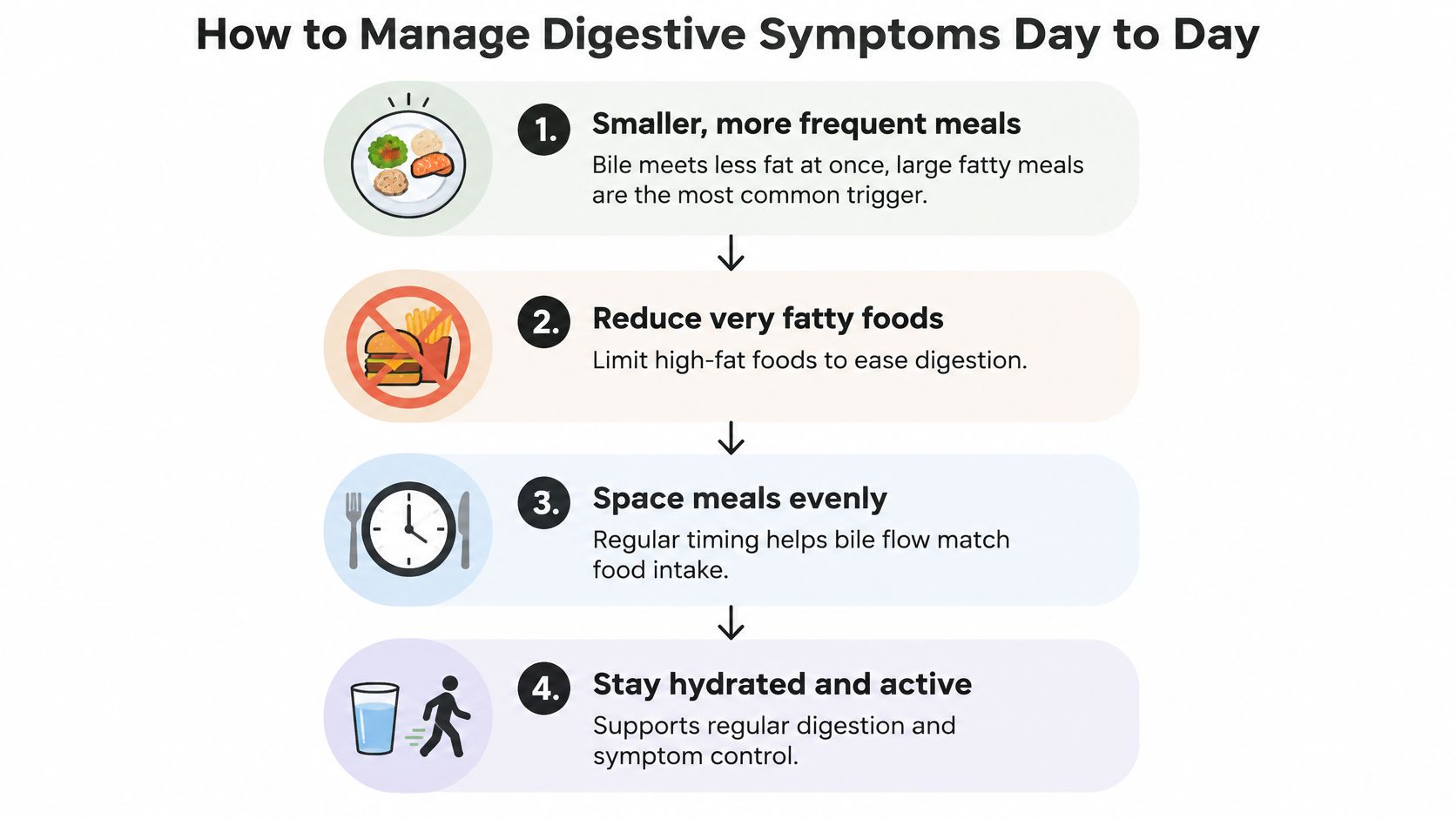
A routine beats guesswork. These six steps cover common needs, in the order worth trying, and each one has a reason behind it.
-
Shrink the meals and raise the frequency. Large fatty meals are the most common trigger because they deliver more fat at once than a steady bile trickle can emulsify. Splitting the same food across two sittings often removes the symptom entirely. For a fuller framework on meal structure during treatment, these GLP-1 diet recommendations are a sensible companion.
-
Cut very fatty food temporarily, not forever. The goal is a few weeks of lower load while the gut recalibrates. Indefinite severe fat restriction isn't the target, and it can shortchange fat-soluble vitamins.
-
Add soluble fiber slowly. Oats, bananas, psyllium and barley absorb water and firm loose stool. Increase over a week or two, because jumping straight in worsens gas and cramping before it helps.
-
Drink to replace what you lose. Water through the day, and an oral rehydration solution when diarrhea is frequent. Thirst lags behind loss more than people expect.
-
Log for two weeks. Meals, injection dates, doses and stools. Patterns show up fast: a specific food, a specific day after the shot, a specific time of morning.
-
Ask about bile-acid testing. If stools stay watery and urgent, a clinician can assess whether a bile-acid sequestrant such as cholestyramine fits. That's targeted treatment, and it works better than broad dietary avoidance alone.
The caution that matters with sequestrants: these medicines bind bile acids in the gut, which means they can also bind other medicines and fat-soluble vitamins. Dosing needs to be separated and supervised by a clinician.
Gentler support has a place alongside the routine. If your gut feels irritated on rough days, some people find aloe-based remedies for stomach balance worth reading about as a comfort measure, though nothing here replaces a proper clinical workup for persistent diarrhea.
Progress looks modest and specific. Fewer urgent episodes within a few weeks, stools that gradually firm up, and a shorter list of foods that cause trouble rather than a longer one.
Symptoms That Need a Provider Right Away
Most post-surgical digestive symptoms are manageable at home. A smaller set needs a call, and some need one today. Use this table as a triage guide, not a diagnosis.
| Symptom | Possible cause | Action | Timing |
|---|---|---|---|
| Persistent upper-right abdominal pain | Biliary or other digestive cause | Medical assessment | Prompt |
| Fever or jaundice | Infection or bile-duct blockage | Urgent medical care | Same day |
| Vomiting that does not stop | Obstruction or pancreatitis | Urgent medical care | Same day |
| Pain after fatty meals that worsens | Gallbladder or bile-duct disease | Medical assessment | Prompt |
| Blood in stool or black stools | Bleeding in the digestive tract | Urgent medical care | Same day |
| Unintended weight loss | Other conditions or treatment effects | Prescriber review | Within days |
| Persistent or severe diarrhea | Bile-acid diarrhea, infection or inflammatory bowel disease | Prescriber review | Within days |
| Nocturnal stools | Bile-acid diarrhea or other digestive cause | Prescriber review | Within days |
Many of these symptoms mimic each other. Retained bile-duct stones, pancreatitis, peptic disease, inflammatory bowel disease, infection and irritable bowel syndrome can all produce complaints that get filed under "no gallbladder" without investigation.
That's why the table lists possible causes rather than answers. A diagnosis belongs to someone who can order the right test.
The GLP-1 layer adds two reasons to call sooner. Rapid weight loss and dose escalation both raise biliary risk, so a symptom that appears right after a dose step deserves a report with its date and dose attached. Your prescriber can then judge whether the next step should wait.
The rule to remember: if any same-day symptom on that table appears, call your provider or emergency services immediately. Don't wait for the next scheduled visit.
Talk With Your Prescriber Before Your Next Dose
Bring specifics, not a general sense that something's off. A short checklist turns a rushed appointment into a useful one:
- Medication and dose. The drug name, current dose, and the date of every dose step so far.
- Surgical history. The date and type of your gallbladder removal, keyhole or open.
- The diary. Two weeks of meals, doses and stools, in whatever form you kept it.
- Everything else you take. Other prescriptions, over-the-counter medicines and supplements, including fiber.
- Prior biliary history. Any past pancreatitis, bile-duct stone or procedure on the bile ducts.
Then ask the questions that shape the plan. Would slowing the escalation help here? Is bile-acid testing reasonable? Should the pace of weight loss be adjusted, and does the current rate match the plan? Are labs worth checking?
A gallbladder-free history doesn't settle those questions on its own. Treatment decisions belong with a licensed prescriber who knows your full history rather than being inferred from the absence of an organ (review of GLP-1 biliary risk and monitoring).
Programs that manage escalation for you keep that review on schedule. Weight Method's providers set and adjust the dose ladder for exactly this reason, step by step rather than on a fixed calendar.
This article is educational and doesn't constitute medical advice. If a red-flag symptom from the table above shows up before your appointment, that visit stops being routine.
Weight Method pairs you with a licensed provider who reviews your full history, including gallbladder removal, before setting an escalation pace and stays reachable through unlimited messaging between visits. If you're living without a gallbladder and want a plan built around that rather than a standard script, take the two-minute quiz and meet your provider by video before anything ships. Plans start at $149 a month, and every dose step is managed by your provider instead of being auto-refilled.