You've filled out three online forms, watched a few convincing videos, and found a site promising prescription weight loss medication online with delivery to your door. The hard part isn't finding a checkout page. It's determining whether a qualified clinician will evaluate you, whether a legitimate pharmacy will dispense the medication, and whether the program will still be supporting you after the first few injections.
My advice is straightforward: judge an online weight-management service by its verification process and persistence support, not by its introductory price or medication promise. The modern treatment options can be clinically meaningful. Semaglutide 2.4 mg produced 14.9% mean weight loss at 68 weeks, while tirzepatide 15 mg produced 20.9% mean weight loss at 72 weeks in trials reviewed in the clinical literature (clinical review of obesity pharmacotherapy). But those results require appropriate prescribing, gradual dose management, and continued participation.
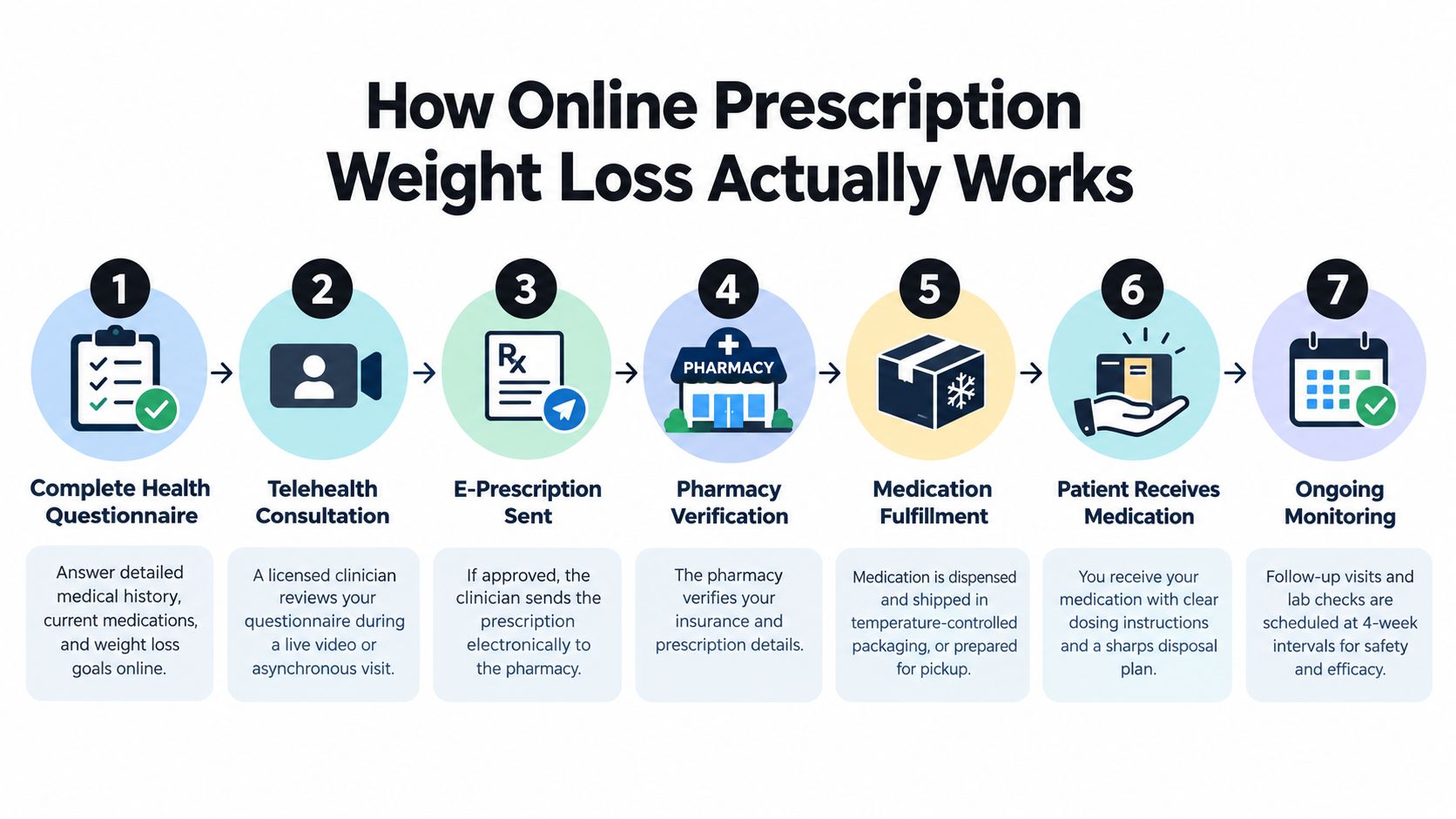
How Online Prescription Weight Loss Actually Works
A legitimate online program follows a recognizable clinical pipeline. If the process skips important checkpoints, don't proceed because the site looks polished.
The seven checkpoints
-
Online health questionnaire. You provide medical history, current medications, allergies, weight history, goals, and relevant conditions. A careful form takes enough time to identify risks rather than asking only for height and weight. You complete it, usually in one sitting.
-
Telehealth consultation. A licensed U.S. clinician reviews the information through a live video appointment or an asynchronous consultation. The clinician, not a sales representative or automated quiz, decides whether treatment is appropriate. This review may take place quickly, but speed shouldn't replace clinical judgment.
-
Electronic prescription routing. If the clinician approves treatment, they send a patient-specific electronic prescription to a pharmacy. Ask which clinician issued it and confirm that the clinician is licensed in your state.
-
Pharmacy verification. The pharmacy checks the prescription, patient details, and payment or insurance information. The pharmacy must be licensed in the relevant state, and the program should identify it clearly.
-
Medication fulfillment. The pharmacy dispenses the prescribed product and prepares it for shipping or pickup. Temperature-sensitive products require appropriate packaging and handling instructions.
-
Home delivery. You receive the medication with directions for storage, administration, missed doses, disposal of needles, and contact information for questions. A package without clear labeling is a reason to stop and call the pharmacy.
-
Monthly follow-up and dose titration. The clinician reviews side effects, weight trends, health changes, and adherence before increasing the dose. Online care should provide a continuing treatment relationship, not a one-time prescription.
This is the practical journey described in more detail in how online GLP-1 prescriptions work. The two weak points are easy to identify. Verification fails when the provider's credentials or pharmacy license remain vague. Persistence fails when patients stop responding or receiving follow-up after the early treatment period.
Practical rule: If a site won't name the prescribing organization, licensed clinician, and dispensing pharmacy before payment, treat the omission as a safety problem.
Who Qualifies for Prescription Weight Loss Medication
Eligibility isn't determined by enthusiasm, urgency, or a flattering before-and-after gallery. It begins with your BMI, weight-related health conditions, medical history, and current medications.
For adults, semaglutide under the brand Wegovy and tirzepatide under the brand Zepbound are indicated for people with a BMI of 30 or greater, or a BMI of 27 or greater with at least one weight-related condition. Relevant conditions include hypertension, type 2 diabetes, dyslipidemia, and obstructive sleep apnea. A clinician still has to decide whether the medication fits your specific history.
A useful self-screen
Before booking, gather:
- Your current height and weight: Use these to estimate BMI, but don't treat an online calculator as a diagnosis.
- Your health conditions: Document high blood pressure, type 2 diabetes, abnormal cholesterol, sleep apnea, and other weight-related concerns.
- Your medication list: Include diabetes drugs, insulin, opioids, psychiatric medications, supplements, and any GLP-1 medication.
- Your reproductive status: Weight-loss medications aren't appropriate during pregnancy, and pregnancy planning requires a direct discussion with the prescriber.
- Your family history: Tell the clinician about medullary thyroid carcinoma and multiple endocrine neoplasia type 2, commonly called MEN 2.
The usual second-line candidates include adults with a BMI from 27 to 29.9 and a weight-related comorbidity, as well as adults with a BMI of 30 or above. A program that approves everyone without reviewing these criteria isn't offering meaningful medical screening.
What a serious intake requests
A legitimate evaluation may request recent A1c, fasting glucose, lipid panel, TSH, and a pregnancy test when applicable. It should also ask about pancreatitis, gallbladder problems, kidney or liver disease, eating disorders, and prior medication reactions.
A personal or family history of medullary thyroid carcinoma, MEN 2, pregnancy, active pancreatitis, or current use of another GLP-1 agonist requires careful clinical handling and may rule out treatment. Don't conceal any of these details to get approved.
For broader context on lifestyle support and managing weight with supplements, use sources that distinguish supplements from prescription therapy. Supplements aren't a substitute for a clinician's assessment, prescription, or monitoring plan.
Semaglutide vs Tirzepatide and the Other Options
Semaglutide and tirzepatide lead online weight-management programs, but they are different medicines. Semaglutide is a GLP-1 receptor agonist. Tirzepatide acts on both GIP and GLP-1 pathways. Both are usually taken once weekly, increased gradually, and paired with nutrition and activity changes.
Clinical averages guide the discussion, not the individual prescription. Semaglutide 2.4 mg produced 14.9% mean weight loss at 68 weeks, while tirzepatide 15 mg produced 20.9% mean weight loss at 72 weeks (review of approval milestones and trial outcomes). Use the comparison below, then check whether the online provider explains its medication choice and follow-up plan.
| Medication | Mechanism | Weekly dose range | Trial weight loss | Common side effects | Typical monthly cost |
|---|---|---|---|---|---|
| Semaglutide, Wegovy | GLP-1 receptor agonist | 0.25 mg to 2.4 mg | 14.9% mean loss at 68 weeks | Nausea, vomiting, constipation, fatigue | Varies by insurance, pharmacy, and program |
| Tirzepatide, Zepbound | Dual GIP and GLP-1 agonist | 2.5 mg to 15 mg | 20.9% mean loss at 72 weeks | Nausea, vomiting, constipation, fatigue | Varies by insurance, pharmacy, and program |
| Older options, including phentermine, naltrexone-bupropion, and orlistat | Stimulant, appetite and reward pathway, or fat-absorption inhibition | Not applicable | Varies by medication and patient | Drug-specific gastrointestinal, cardiovascular, neurologic, or sleep effects | Varies by generic availability and coverage |
Gastrointestinal effects are common with GLP-1 medicines. Ask for a plan for nausea, vomiting, constipation, and fatigue before the first dose. Severe abdominal pain, persistent vomiting, or symptoms suggesting pancreatitis or gallbladder disease need urgent medical assessment.
Older medicines still have a role. Phentermine may suit a carefully selected patient seeking a lower-cost option, but stimulant-related risks need review. Naltrexone-bupropion may help with cravings, yet it is unsuitable for people taking opioids or those with certain seizure risks. Orlistat works in the gut and can cause unpleasant bowel effects.
Check the program's operational details before choosing. It should name the prescriber, medication, pharmacy, dose-escalation process, and route for reporting side effects. A low price does not compensate for unclear sourcing or weak follow-up. For a practical comparison, read how to choose between semaglutide and tirzepatide.
My decision rule is direct: Discuss tirzepatide when higher average efficacy matters and you can manage gastrointestinal effects. Discuss semaglutide when coverage, familiarity, and the established treatment record matter more. Then commit to the follow-up required to adjust treatment safely.
What the Telehealth Intake and First Month Look Like
A representative patient, call her Maya, starts with an online questionnaire rather than a prescription button. She enters her medical history, uploads identification, lists every medication and supplement, and provides recent laboratory results. If results aren't available, a responsible program may arrange lab testing or ask the clinician to determine what is needed.
From approval to first injection
Maya then meets a licensed provider by video, or completes an asynchronous review if the service uses that model. The provider checks eligibility, reviews contraindications, discusses side effects, and sends the prescription to a named partner pharmacy. The pharmacy confirms the order and ships the medication using packaging appropriate for a temperature-sensitive product.
The friction usually appears here:
- Delayed clinician response: A legitimate service gives Maya a clear route for follow-up rather than leaving her with a generic support inbox.
- Insurance authorization: The pharmacy or clinical team explains whether prior authorization is required and what documentation is missing.
- Dose confusion: The prescription and packaging must state the dose, timing, storage instructions, and escalation plan.
- Early side effects: Maya needs an accessible clinician or nurse who can advise her before the next dose, not after symptoms become severe.
The first injection should be accompanied by written directions or a demonstration. Maya records the date, dose, appetite changes, nausea, bowel symptoms, hydration, and any unusual pain. She shouldn't increase the dose because weight loss seems slow or because another patient is using a higher strength.
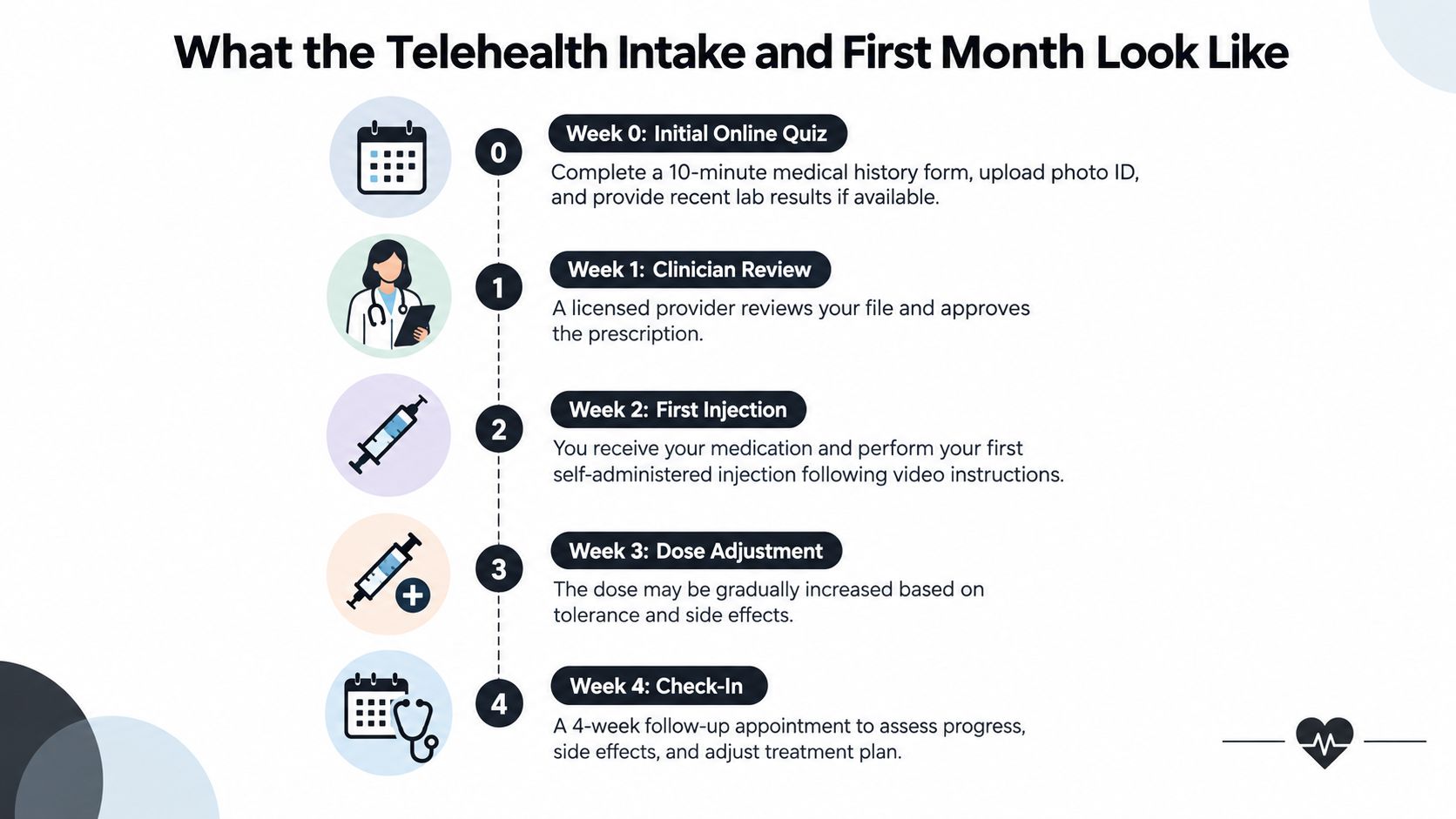
At the four-week check-in, the clinician reviews tolerance and adherence before deciding whether titration is appropriate. Early success means tolerating the starting dose, establishing a weekly routine, maintaining a symptom log, and completing requested monitoring, not chasing an immediate dramatic change on the scale.
Real Costs Pricing and Insurance Coverage
Online prices are hard to compare because programs may separate the medication, clinician access, laboratory work, supplies, and shipping. A low monthly headline may cover only the subscription, with pharmacy charges and follow-up fees billed separately. Get the full payment schedule before you enroll.
| Channel | With insurance | Cash pay range | What's bundled |
|---|---|---|---|
| Brand-name Wegovy or Zepbound through a retail pharmacy | Depends on the commercial plan, prior authorization, formulary, and eligibility | Manufacturer and pharmacy prices vary | Usually the medication only, with clinical care billed separately |
| Compounded GLP-1 through telehealth | Coverage is often limited and depends on the plan | Set by the program. Verify the current price on its pricing page | May include evaluation, prescription handling, medication, supplies, messaging, and delivery |
| Cash-pay telehealth bundle | Insurance may not apply to the bundle | Set by the program. Confirm the recurring charge before checkout | Often combines clinician visits, medication fulfillment, monitoring, and support |
Treat any advertised introductory rate as a starting price, not the treatment cost. Dose titration can change medication charges, while separate labs, supplies, shipping, and missed-appointment fees can raise the total. Ask for the complete recurring cost at the maintenance phase, cancellation terms, refill conditions, and the price of additional clinical support.
Write down each charge before paying. A trustworthy program should state whether medication, visits, laboratory work, delivery, and messaging are included. If the pricing page leaves any of those unclear, stop and request a written breakdown.
Commercial insurance may require prior authorization. Ask who submits it, what happens after a denial, and whether the team prepares an appeal letter. Medicare Part D and Medicaid coverage depend on applicable rules, eligibility, and plan policy. Manufacturer savings programs may help eligible commercially insured or cash-paying patients, but restrictions apply.
HSA and FSA funds may cover eligible medical expenses, subject to your plan administrator's rules. Before checkout, review this GLP-1 insurance coverage guide, then compare the listed charges with the program's written billing terms. That worksheet exposes the common pricing trap: comparing a teaser fee with the actual care pathway.
Red Flags Safety and How to Verify a Provider
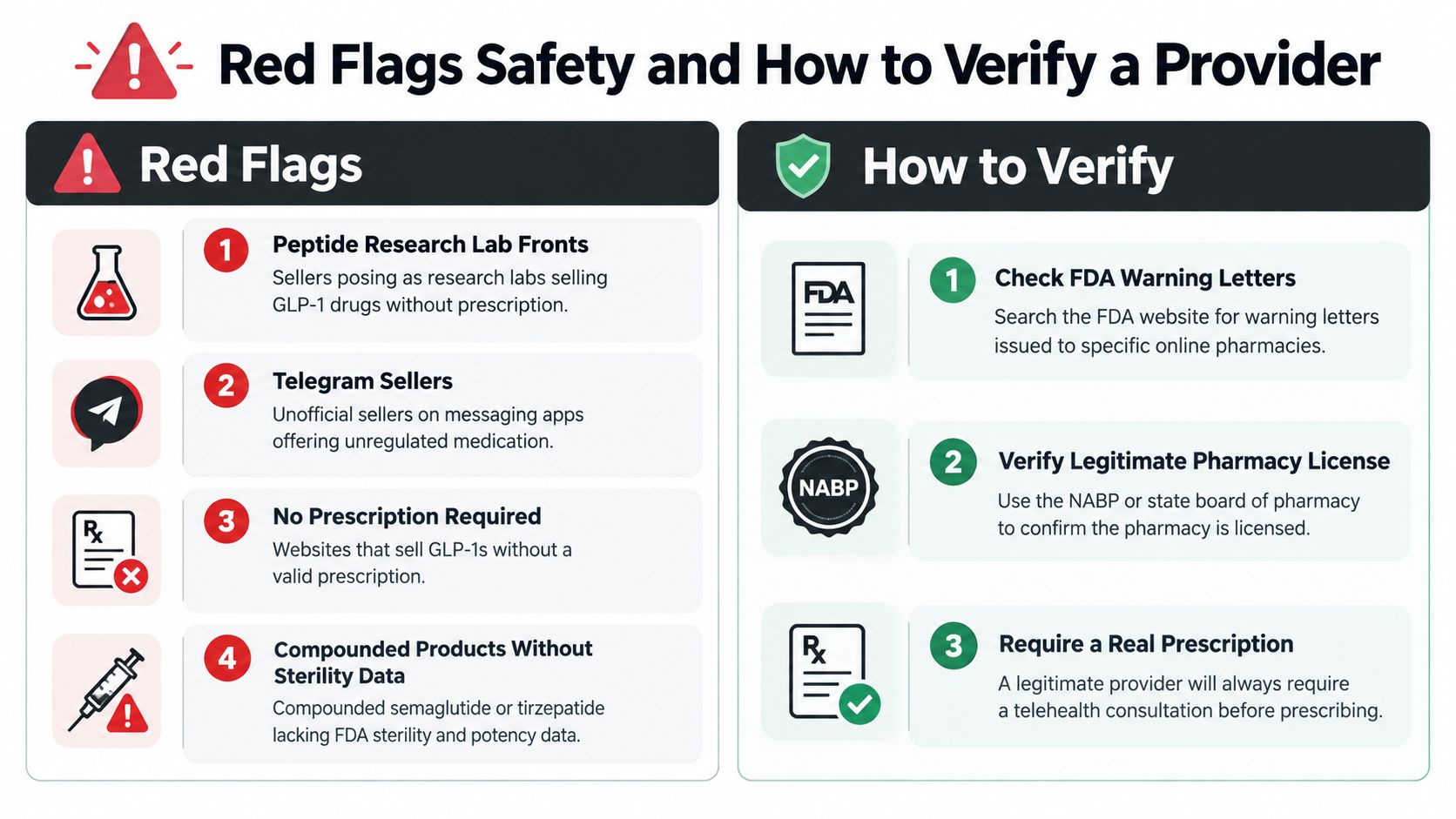
The most dangerous assumption is that a professional website represents a professional supply chain. It doesn't. Online sellers have marketed substances as semaglutide, tirzepatide, and experimental retatrutide from foreign factories not registered with the FDA, while consumer warnings identify deep discounts, no prescription requirement, and nonregistered pharmacies as major red flags (consumer safety guidance on online GLP-1 sourcing).
FDA-related actions have also tightened the environment around compounded semaglutide and tirzepatide, while counterfeit products and unsafe websites remain active concerns (reporting on FDA action around compounded GLP-1 products). That makes verification more important, not less.
Stop before checkout if you see these signs
- No clinician visit: A quiz that automatically approves medication isn't a clinical evaluation.
- No state license disclosure: The site won't identify the prescribing organization or explain where its clinicians are licensed.
- No pharmacy partner: You can't determine who dispenses the medication.
- Pressure tactics: A countdown clock, urgency pop-up, or “buy now before access disappears” flow is inappropriate for a prescription decision.
- Offshore shipping: Foreign fulfillment creates uncertainty about storage, labeling, authenticity, and legal supply.
- Research-lab language: “For research use only” products aren't a substitute for prescribed medication.
- No quality information: A compounded product without clear pharmacy details, labeling, lot information, and instructions should be rejected.
503A and 503B are not interchangeable labels. A 503A pharmacy generally compounds for an identified patient under a prescription, while a 503B outsourcing facility compounds in a different regulatory framework and is registered with the FDA. Neither label gives you permission to buy from an anonymous seller, and compounded medication isn't the same as an FDA-approved branded product.
Run this verification sequence
- Search the prescriber's name through the state medical board.
- Ask the service to identify the dispensing pharmacy and check its license with the state board of pharmacy.
- Use the NABP pharmacy verification resources to assess the pharmacy's credentials.
- Ask for a real prescription and written medication label before shipment.
- Reverse-image-search the clinician's photograph. A stolen profile image is a strong warning.
- Check whether the product name, concentration, storage instructions, lot information, and pharmacy contact details are present.
General supplement advice can also mislead consumers, so compare it with a practical guide on how to spot fake weight loss supplements. The same discipline applies here: verify the source before believing the claim.
Stop the medication and seek emergency care for severe or persistent abdominal pain, repeated vomiting with inability to keep fluids down, trouble breathing, facial or throat swelling, fainting, confusion, or signs of a serious allergic reaction. For less severe nausea or constipation, contact the prescribing clinician promptly rather than changing the dose yourself.
Staying on Track and Getting Real Results
A prescription starts treatment. It does not create lasting results. Retention deserves the same scrutiny as approval: one virtual obesity clinic reported retention of 22.16% at 18 months and 14.45% at 24 months, while engaged participants showed strong refill adherence. The same analysis also found that one remotely delivered GLP-1 program had 39.6% of users active at 12 months, with 60.4% inactive, and users engaged about 1.7 days per week and logged weight 2.6 times per month (24-month virtual obesity clinic analysis). Treat those figures as an operational warning: choose a service that gives you reasons and tools to stay involved.
A program that ships medication without building routines is incomplete. Make your participation measurable from the first week.
Build a weekly operating routine
- Log weight weekly: Record the date, weight, and trend. Do not overreact to one reading.
- Prioritize protein: Discuss a target near 1.2 grams per kilogram of body weight with your clinician, especially if rapid loss or low appetite makes adequate nutrition difficult.
- Train for strength: Perform resistance training two to three times weekly when medically appropriate to support lean mass.
- Track symptoms: Record nausea, vomiting, constipation, diarrhea, fatigue, hydration, appetite, and injection timing before each titration discussion.
- Measure more than weight: Track waist circumference, blood pressure if you have hypertension, energy, mood, and daily function.
Before enrolling, ask the clinician to define contact points at weeks 2, 8, and 16. Confirm that on-demand messaging covers dose questions and side-effect management. These checkpoints let the team slow titration, review nutrition, address missed doses, and identify problems before you vanish from care.
Your verification checklist should include month-one persistence, refill intervals, response time, and engagement depth. A prescription issued without follow-up is not a monitoring plan.
The off-ramp matters: Ask early whether the plan involves long-term maintenance, a gradual transition to lifestyle-only care, or escalation to in-person obesity or endocrine evaluation.
Do not stop treatment abruptly because the scale has plateaued. Discuss a maintenance dose, an alternative medication, nutrition support, and the conditions that would trigger in-person care. Weight Method is one telehealth option offering an online intake, licensed-provider review, prescription coordination, home delivery, messaging, progress tracking, and dose adjustments, with pricing information presented by the program itself. Review the evaluation process at Weight Method and check whether its monitoring model matches the level of follow-up you will use.