Dose titration is the planned, stepwise adjustment of a medication dose that starts below the target and rises at set intervals to balance benefit against side effects.
If a lower dose is already helping, why increase it just because the calendar says it's time? That question gets to the heart of titration: the schedule provides a starting framework, but your response determines whether the next step makes clinical sense.
For weight-management medicines such as semaglutide and tirzepatide, understanding that distinction can make a dose increase, a delay, or a reduction feel less confusing. Progress means finding an effective, tolerable treatment, not just reaching the highest dose.
What Dose Titration Means in Plain Terms
Titration means adjusting medication deliberately rather than guessing at the dose. In an upward titration schedule, your clinician starts below the intended treatment dose, checks your response, and increases exposure gradually.
Think of a dimmer switch. You raise the light until you can see comfortably, rather than turning it straight to its brightest setting. With medication, however, the prescriber makes those adjustments using clinical information, not comfort alone.

The parts of a titration plan
- Starting dose: The initial amount introduces treatment without immediately exposing you to the intended maintenance dose.
- Interval between steps: Time at each dose lets the clinician assess benefit, side effects, and whether you're taking the medicine consistently.
- Maintenance dose: This is the dose intended for ongoing treatment, selected within the medicine's prescribing guidance.
For example, the FDA's Wegovy prescribing information describes a 16-week escalation pathway and explicitly identifies reducing gastrointestinal adverse reactions as the reason for gradual escalation. The prescription therefore includes more than an amount to take: it includes a process for deciding what happens next.
Practical rule: A scheduled increase is a checkpoint, not permission to ignore new symptoms.
The word describes a process, not a drug
Clinicians also adjust blood pressure medicines, antidepressants, insulin, and blood thinners according to response. Their monitoring requirements differ, so a schedule for one medicine shouldn't be borrowed for another.
Medication-specific warnings matter, too. Someone prescribed lamotrigine needs different safety information from someone prescribed semaglutide; Total Mental Wellness's guide to Lamictal rash warning signs is a relevant resource for that separate treatment.
When someone asks, “What is dose titration?” the useful answer is a supervised adjustment process with repeated checks, not a particular prescription or an instruction to keep increasing indefinitely.
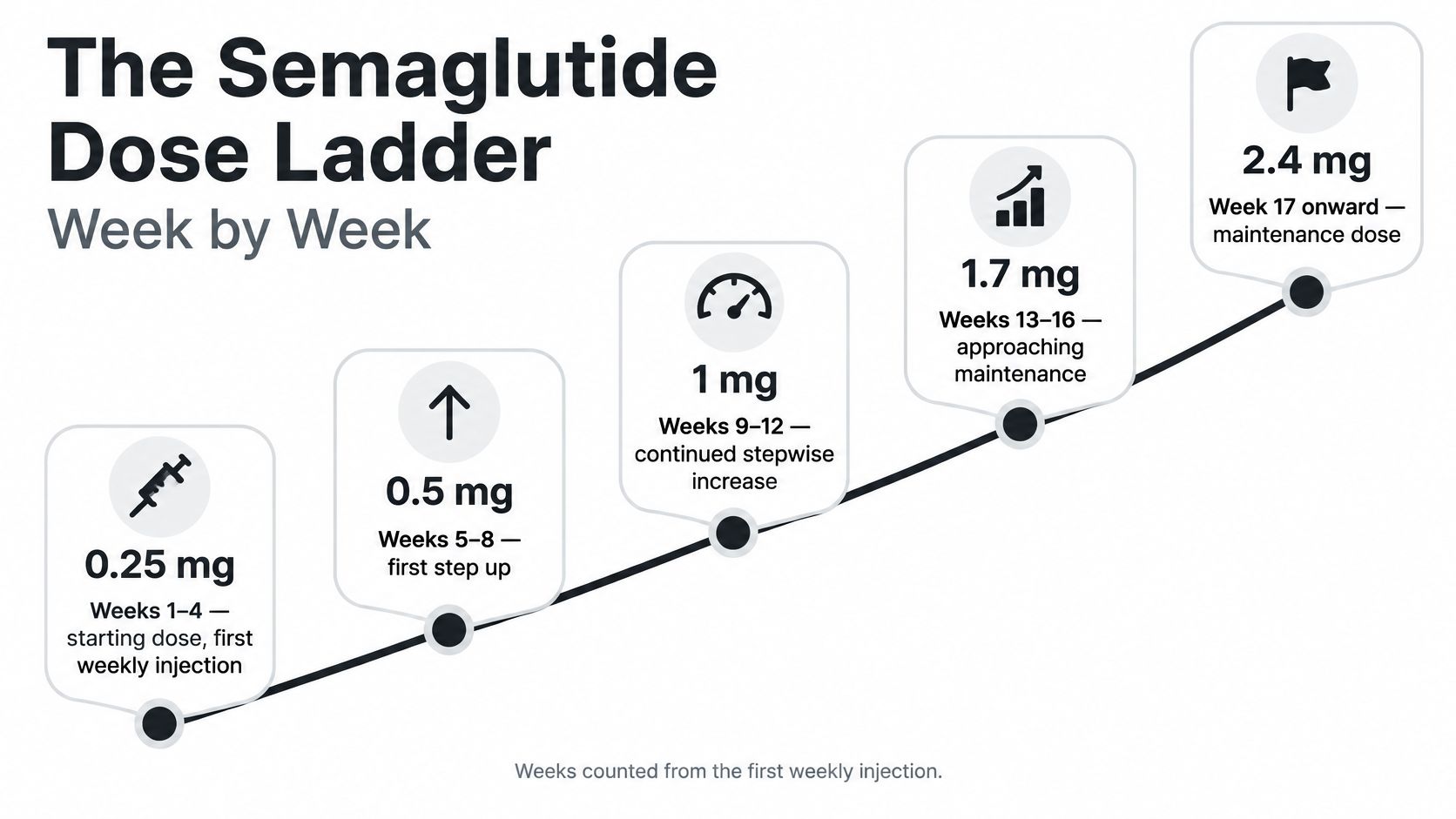
The Semaglutide Dose Ladder Week by Week
| Weeks on treatment | Weekly semaglutide dose | What happens next |
|---|---|---|
| Weeks 1–4 | 0.25 mg | Step up at week 5 if tolerated; delay 4 weeks if not |
| Weeks 5–8 | 0.5 mg | Step up at week 9 if tolerated; delay 4 weeks if not |
| Weeks 9–12 | 1 mg | Step up at week 13 if tolerated; delay 4 weeks if not |
| Weeks 13–16 | 1.7 mg | Step up to maintenance at week 17 if tolerated |
| Week 17 onward | 2.4 mg maintenance | Prescriber may step down to 1.7 mg if 2.4 mg isn't tolerated |
The adult weekly injection schedule above follows the FDA-referenced semaglutide pathway described in the Wegovy prescribing information: 0.25 mg, 0.5 mg, 1 mg, and 1.7 mg in successive four-week blocks, followed by the usual 2.4 mg maintenance dose from week 17. The labeling allows a four-week escalation delay for intolerance; the supplied prescribing guidance also identifies 1.7 mg as an alternative maintenance dose in appropriate circumstances.
Read the ladder as a conditional schedule
Count treatment weeks from your first injection, not from the day your prescription was written or the parcel arrived. If your prescriber delays an increase, the original calendar no longer tells you which dose to take.
The table describes weekly injectable semaglutide for weight management. It isn't a universal semaglutide schedule, an oral-medication schedule, or a conversion chart for another product.
The dose in milligrams also isn't interchangeable with a syringe marking. If your dispensing instructions use a volume or syringe units, follow the instructions for that specific prescription rather than converting from an online chart yourself.
Other medicines have their own ladders
Tirzepatide follows the same broad approach of a low starting dose followed by measured increases, but its dose amounts aren't interchangeable with semaglutide's. Switching medicines therefore requires a new prescribing decision, not matching the nearest-looking number.
Real-world prescribing also needs careful interpretation. In an Italian obesity-clinic study, 81.1% of patients began semaglutide at 0.25 mg, while 72.1% were receiving 1 mg after three months.
Those findings show that the early ladder steps were commonly used in that clinic population. They don't prove that every participant followed an uninterrupted calendar or that another patient should copy their pace.
To use your own schedule safely, identify your starting date, record the dose prescribed, and confirm the next planned review. If an increase is postponed, have the revised dates written down, so an old reminder doesn't become an accidental instruction.
Why Doctors Start Low and Climb Slowly
Gastrointestinal symptoms can determine whether someone continues treatment. In the 68-week STEP 1 trial of semaglutide for adults with overweight or obesity, gastrointestinal adverse events led to permanent discontinuation in 4.5% of semaglutide recipients versus 0.8% of placebo recipients, according to the trial figures accompanying the prescribing-information evidence; gastrointestinal events occurred in 74.2% versus 47.9%, respectively.
These figures don't predict your personal experience. They explain why tolerability deserves attention alongside weight change: a patient who stops because treatment feels unbearable can't continue receiving its intended benefit.
Why gradual exposure matters
Semaglutide affects appetite and digestion, including how quickly food leaves the stomach. Our explanation of how semaglutide works gives more context for why changes in fullness can accompany digestive symptoms.
Starting low gives the clinician an opportunity to identify problems before adding more medication exposure. It also creates time to discuss practical adjustments, such as eating smaller portions, stopping when comfortably full, and maintaining fluid intake.
A useful comparison is easing into a cold swimming pool. Taking gradual steps may make staying in the water more manageable than jumping straight in, although medication tolerance still requires clinical assessment rather than determination alone.
Tolerating treatment doesn't mean enduring symptoms that prevent you from eating, drinking, or functioning normally.
Continuity matters more than speed
At a check-in, describe what symptoms prevent you from doing. “I feel nauseated” is useful, but “I'm skipping meals because I feel sick” gives the clinician a clearer reason to reconsider the next increase.
A slower approach isn't automatically less effective, and completing the calendar quickly isn't evidence of better care. The practical objective is sustained treatment at an appropriate dose, with enough monitoring to recognize when the current approach needs to change.
How Each Dose Increase Gets Decided
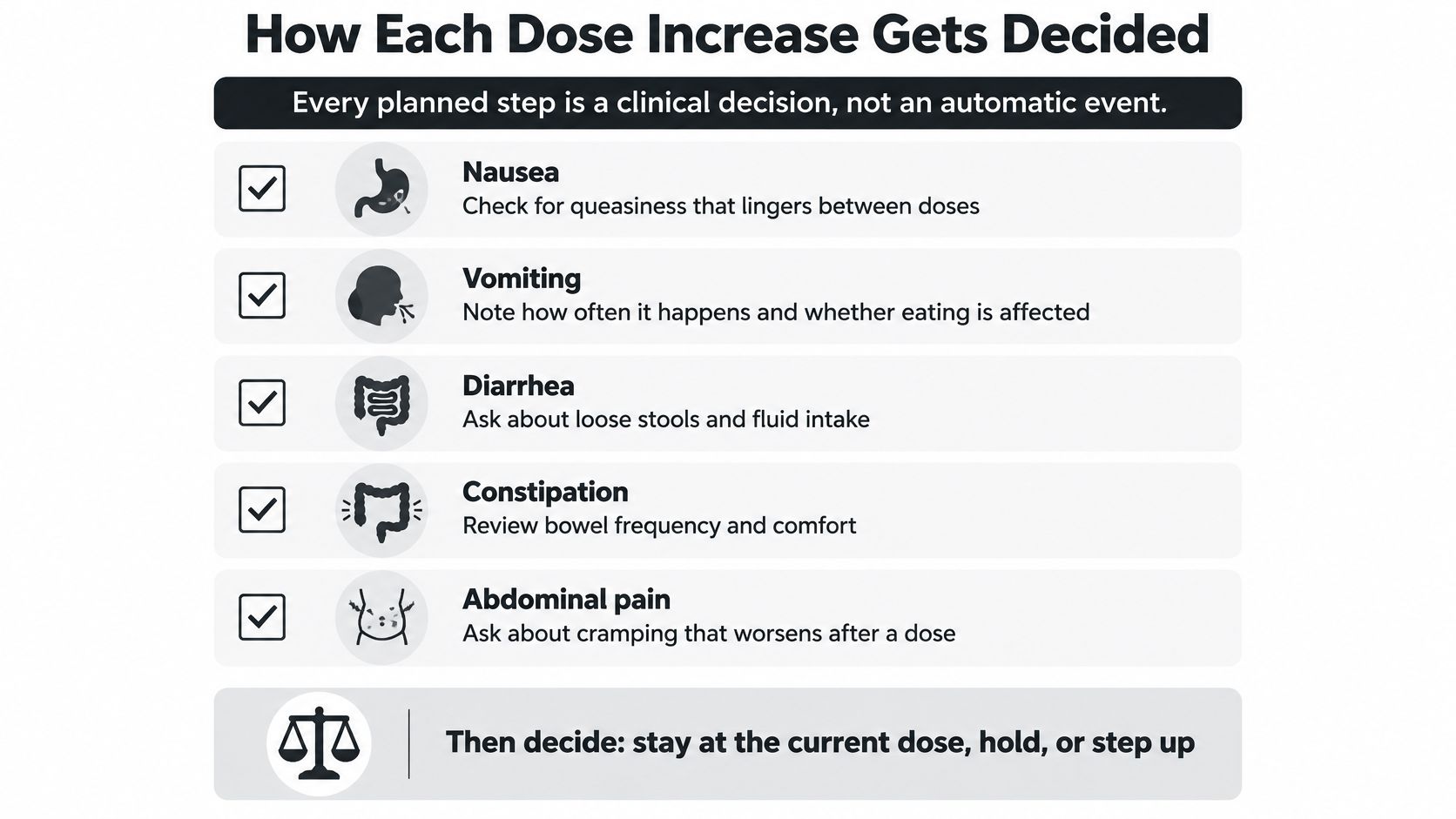
Every planned step is a clinical decision, not an automatic event. Before increasing a dose, the clinician needs to know both whether treatment is helping and what it's costing you in symptoms or disrupted eating.
That review should cover nausea, vomiting, diarrhea, constipation, and abdominal pain, alongside food intake, hydration, appetite, weight trajectory, and other medicines. A single weigh-in is less useful than a trend during consistent dosing.
What changes the pace
The FDA's Wegovy labeling permits delaying escalation for four weeks when the current dose isn't tolerated. That is a specific prescribing option, not a reason to improvise a different schedule independently.
| Factor | Effect on pace | Why it matters |
|---|---|---|
| Persistent nausea or vomiting | Hold or delay the next increase pending review | Poor intake and fluid losses can make continued escalation inappropriate |
| Weight loss already meeting the treatment goal | Escalation may be deferred after clinical review | More medication may not be necessary at that point |
| Diabetes medicines or insulin | Review glucose monitoring and accompanying treatment before increasing | Combined glucose-lowering effects may require adjustments |
| Dehydration or poor oral intake | Pause escalation and address the problem | Increasing exposure while unwell may worsen tolerability |
| History of gastrointestinal disease | Consider closer review or a slower approach | Existing symptoms can complicate assessment |
| Transfer from another prescriber | Verify dose history and select the appropriate starting step | A reported dose alone doesn't establish product equivalence |
The result may be to increase, remain at the current dose, or reduce the dose. Remaining at a dose means continuing that prescribed amount, not skipping injections; if treatment itself needs to be interrupted, obtain explicit instructions.
What the evidence can and cannot tell you
In a real-world semaglutide cohort published in Diabetes Therapy, gastrointestinal adverse events occurred in 20.3% of patients during escalation, and 12.5% required dose reduction. No serious drug-related adverse events were recorded in that cohort.
These observations support treating dose reduction as a legitimate clinical response. They don't establish how much additional weight any individual will lose after the next increase, nor do they prove that increasing is unnecessary.
The right question is: What benefit do we expect from increasing now, and what might make that increase difficult to tolerate? Stronger appetite suppression alone isn't a sufficient answer, especially if you're already struggling to eat adequately.
Our providers guide each increase according to tolerance and response. We usually assess weight change over a course of consistent dosing, with periodic check-ins to review symptoms and adjust the approach.
Separate manageable symptoms from warning signs
Mild early nausea may improve, but persistent vomiting, worsening pain, or difficulty maintaining fluid intake needs review. Don't dismiss a symptom as expected because it started after an injection.
Keep a short record of what happened, when it began relative to your dose, whether you could eat and drink, and what changed in your bowel habits. That information helps your clinician distinguish a tolerable adjustment from a problem requiring evaluation.
For patients transferring to our care, our general clinical policy is to begin one step below the reported dose on the dosing ladder. This is a transfer policy, not a general instruction for readers to reduce medication themselves.
A GLP-1 maintenance dose should support ongoing treatment, rather than serve as a badge of how far you've climbed. Never change your own dose between check-ins to chase faster loss or compensate for a disappointing weigh-in.
Common Misconceptions About Dose Titration
Mistaking a higher dose for better treatment
The highest dose is always the best dose.
A high labeled dose isn't automatically the appropriate choice for every patient. The relevant question is whether the selected dose provides sufficient benefit with acceptable tolerability within prescribing guidance.
Titration is only paperwork.
Dose reviews are clinical assessments. Reporting symptoms, reviewing other medicines, and checking intake can change what the prescriber recommends, even when the next prescription was tentatively planned.
Titration is a schedule that responds to the patient, not a countdown to the maximum.
Mistaking symptoms or dates for instructions
Nausea means treatment has failed.
Nausea doesn't by itself establish that the medicine is unsuitable, but it shouldn't be ignored. Describe its severity and effect on daily life; our guide to GLP-1 medication side effects can help you organize that conversation.
Patients can speed up if they feel fine.
Feeling well isn't permission to compress the prescribed intervals. The absence of symptoms doesn't replace a review of the treatment instructions, other medicines, and response.
The calendar sets the dose.
A reminder tells you when a planned review or change is due. It can't determine whether your current symptoms make that change appropriate.
These misconceptions share a common mistake: treating the dose as a score. A good treatment decision may leave the number unchanged, particularly when the clinician is still assessing the response or resolving a tolerability problem.
Confirm Your Dose Plan With Your Prescriber
Leave your appointment knowing what to take now and what would change that instruction. Semaglutide and tirzepatide are prescription medications, and a licensed provider selects and manages the dose.
Bring these questions to your review:
- Next date: When is my next planned increase or dose assessment?
- Intolerance: What should I do if I can't tolerate the current step?
- Earlier contact: Which symptoms mean I should call before my next appointment?
- Maintenance: Could a lower maintenance dose be appropriate for me?
- Monitoring: How will we review my weight trend, food intake, and side effects?
Know when not to wait
Seek prompt medical care for severe or persistent abdominal pain, vomiting that prevents you from keeping fluids down, or signs of dehydration such as dizziness or very low urine output. An allergic reaction, particularly difficulty breathing or swelling of the face or throat, requires emergency care rather than a routine dosing message.
Safety reminder: A scheduled follow-up isn't a reason to delay urgent evaluation.
If you're transferring to our care, an outside dose isn't treated as equivalent to a Weight Method dose. We can't verify the strength, purity, or compounding of products we didn't dispense, so follow the dosing instructions our provider gives you rather than carrying over an outside regimen yourself.
Our ongoing monitoring includes progress tracking, dosing adjustments, and continuous support. Write your prescribed dose and planned ladder dates on a calendar, mark any changes your clinician makes, and bring your symptom notes and medication list to the next visit.
Weight Method offers provider-guided weight-management care with individualized dosing, progress tracking, and ongoing support. Visit Weight Method to explore care in which medication adjustments are guided by your tolerance and response, not just the next date on a calendar.