You've been injecting semaglutide for a few weeks, stepping on the scale the same morning, and the number barely moves. You might feel a little less hungry. You might mostly feel queasy and still see the same clothes fit. That gap is why people type why am I not losing weight on semaglutide into a search bar before they call anyone.
Most of the time the answer isn't willpower, and it isn't an automatic reason to switch drugs. Treat a stall as a checklist. Start with how long you've been on treatment and whether the dose has risen. Then look at missed injections, other medicines, medical conditions, and the habits that put calories back. Some of this is a matter of time. Some of it you can sort out before the next visit, if you know what to bring.
Give Early Progress More Time Than You Think
Semaglutide isn't expected to produce the same rate of weight loss in every patient. Early treatment often shows limited change because the medicine is introduced through a gradual dose-escalation schedule, not at the maintenance dose on day one. A few quiet weeks don't prove the prescription has failed.
Someone who has only been injecting for a short stretch, or who hasn't reached the prescribed maintenance dose, shouldn't read a modest early loss as a final result. Interruptions, delayed increases, or staying lower because of nausea, vomiting, or other side effects can reduce how much medicine you receive and push meaningful loss later. That's a timing issue, not a character flaw.
What the opening month tends to look like
Week one often feels ordinary. You pick an injection day, appetite may shift only a little, and the scale can bounce from water, a salty dinner, or a late meal. By week three or four you may notice smaller portions, yet many people are still below the dose their prescriber plans to maintain. Searching this question while you're still climbing that schedule is common.
Confirm three facts before you judge the medicine:
- Current dose: Write the strength on the pen or vial and the dose your clinician last told you to use. Don't guess from memory if the box has changed.
- Date of the last increase: Note when the dose last went up, not the day the prescription was written.
- Weeks on treatment: Count from the first injection, including any week you held the same dose on purpose.
A flat week inside that window is easy to overread. One heavy weekend, a menstrual cycle, or constipation can hide a small loss that would show up if you looked at the month instead of a single morning.
Separate normal slowness from a real stall
Normal early slowness looks like this. You're still escalating, side effects are mild, injections have stayed on schedule, and the month shows a small downward drift or a flat line with slightly looser clothes. A closer look is justified when the dose has been held for a long stretch because you feel too sick to eat or drink, when several injections were missed, or when nothing has changed after real time at the maintenance dose.
Practical rule: Don't change the dose yourself because the first month looks slow. Confirm where you are on the schedule, then decide with your prescriber whether more time is the right move.
The first month on semaglutide is the window for learning your pattern, not for declaring failure. Weigh once a week at the same time of day, and jot how hungry you felt and whether you finished meals. That short log is what you hand a clinician. It separates "still early" from "something else is in the way."
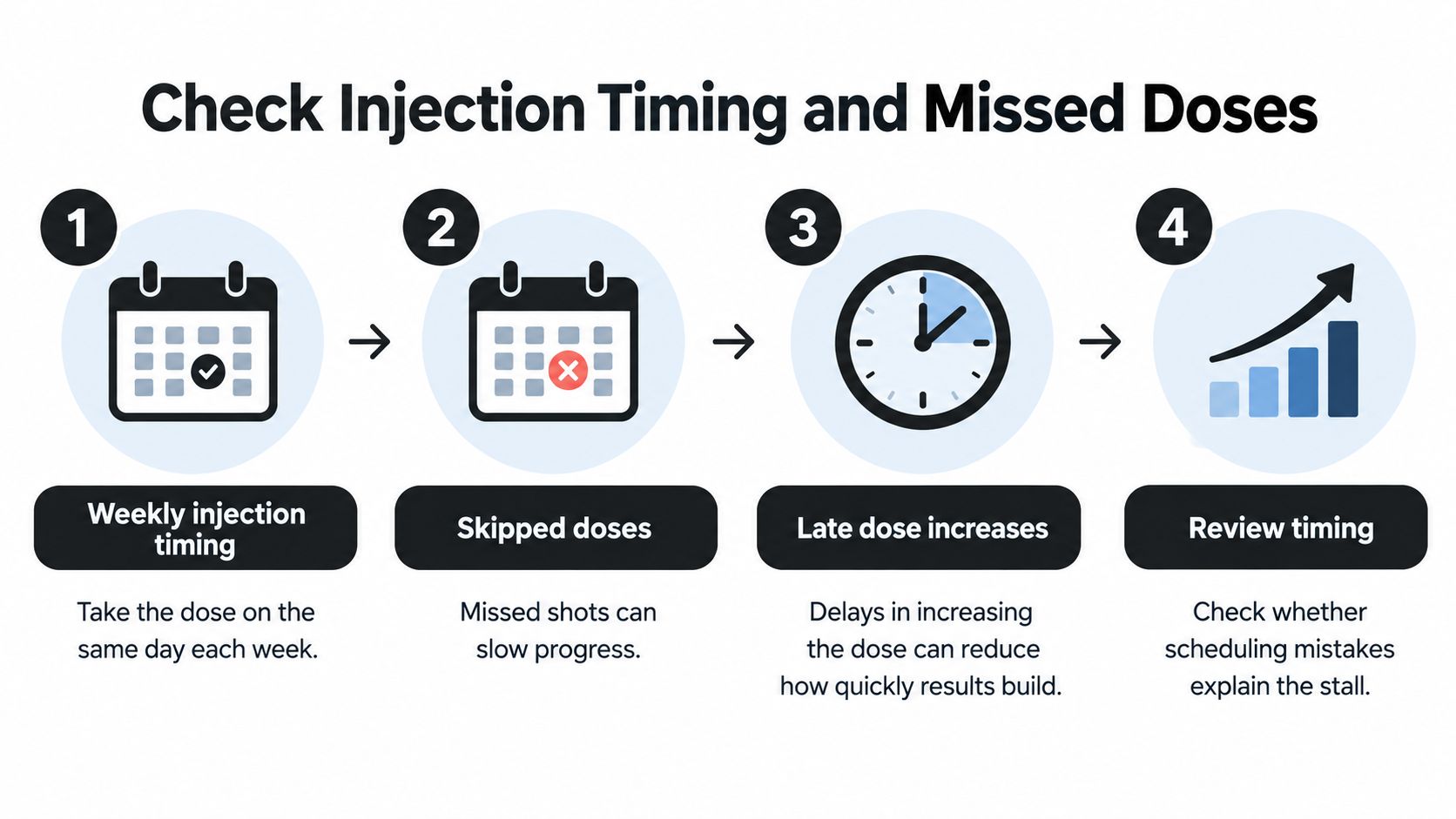
Check Injection Timing and Missed Doses
If early timing checks out and the scale is still stuck, the injection log is the first thing that can be fixed. Weekly timing, skipped doses, and late increases all change how much medicine you receive over a month. Appetite control fades when doses are late or missing, even if you feel like you've "mostly" stayed on track.
Pick one injection day and keep it. Sunday night and Thursday morning are not the same plan. A dose taken three days late, then another taken early to "get back on Sunday," scrambles the week. People do this when travel, a shipment delay, or a rough side-effect day gets in the way. The cost shows up later as a stall that looks mysterious.
Use the labeled missed-dose rules
The FDA-approved prescribing information for Wegovy is specific, and it is there to limit stomach side effects after a restart, not to punish a missed week.
- One missed injection, next dose more than 48 hours away: You may take the missed injection, then return to your usual day.
- One missed injection, next dose closer than 48 hours: Skip the missed one. Don't stack two doses close together.
- Two or more consecutive injections missed: Treatment may need to be reinitiated, and the escalation schedule followed again. That restart is a clinician decision.
Taking an extra dose to catch up is not the fix. Extra medicine raises the chance of nausea and vomiting, and it doesn't reliably "make up" the weeks you missed. If side effects already made you delay an increase, say that plainly. Staying low on purpose for a week or two can be reasonable. Staying low for months without a plan usually postpones the loss you were hoping to see.
Walk the log before you call
Open your calendar or the notes app and mark every injection for the last month. For each one, write the day, whether it was on time, and whether you held the dose because you felt sick. Then mark any week with no injection at all.
Call the clinic instead of guessing when you see two missed doses in a row, when you're unsure whether a late pen still counts, or when you've been inventing your own schedule. A coordinator can usually tell you whether to wait for the next planned day or whether the prescriber needs to reset the escalation. If the technique itself is fuzzy, the semaglutide injection instructions cover storage, priming, and site rotation so a "miss" isn't just a dose that never went in.
Bring the log to the visit. A clinician can restart a schedule. They can't reconstruct four unlabeled weeks from a shrug.
Review Medications and Lifestyle Habits
Once the injection record is clean, look at everything happening around the shot. Side effects are the usual first leak. Persistent nausea, vomiting, or diarrhea pushes people to stay on a lower dose or to skip the next increase. That choice feels protective in the moment. Over a month it can mean you never reach the dose that was supposed to quiet appetite. Tell your prescriber how many days you couldn't finish a meal or keep fluids down. A planned hold is different from an accidental pause in progress.

Medicines that can work against the scale
Other prescriptions can pull in the opposite direction. Some diabetes drugs, corticosteroids, and medicines that change appetite, fluid balance, or mood are common examples. A steroid burst for asthma, a new antidepressant, or a drug that causes swelling can add pounds even while semaglutide is doing its job on hunger. Don't stop or adjust those medicines on your own. Bring the full list, including recent short courses, and ask which ones are worth reviewing.
A realistic week looks like this. You feel too sick to eat much on injection day, then you graze crackers and sweet drinks for three days because solid food won't stay down. The weekly calorie total isn't as low as you think, and the dose never rises. That's a side-effect pattern, not a failure of effort. Your clinician may slow the increase, treat the nausea, or change timing. You shouldn't make that call from a group chat.
Habits that erase a smaller appetite
Semaglutide can shrink portions and still lose the week to ordinary habits.
- All-day grazing: Three small snacks between meals add up when each one "doesn't count."
- Very low protein: A day of toast and coffee leaves you hungry later and makes fatigue worse.
- Short, broken sleep: Late nights make the next day's portions harder to keep steady.
- Alcohol: A few drinks restore calories and loosen the plan you had at dinner.
Picture a month where lunch is a protein-light pastry, evenings include two glasses of wine, and weekends are unstructured. The injection is consistent. The scale isn't. That pattern is worth naming out loud at a visit, along with any medicine you suspect is fighting you.
If you want a plain walk-through of how intake, movement, and recovery fit together while appetite is changing, this guide to losing body fat from Navilo Health is a useful companion to the medication talk, not a replacement for it. Write down one week of meals, drinks, sleep, and side effects before you go. Specifics beat "I eat pretty healthy."
Ask About Medical Conditions and Tests
Some stalls have a medical explanation that tighter eating won't solve. Thyroid problems, polycystic ovary syndrome, sleep apnea, depression, and significant fluid retention can all change how the body responds to weight-loss treatment. You don't need to diagnose yourself. You do need language that gets the right questions on the table.
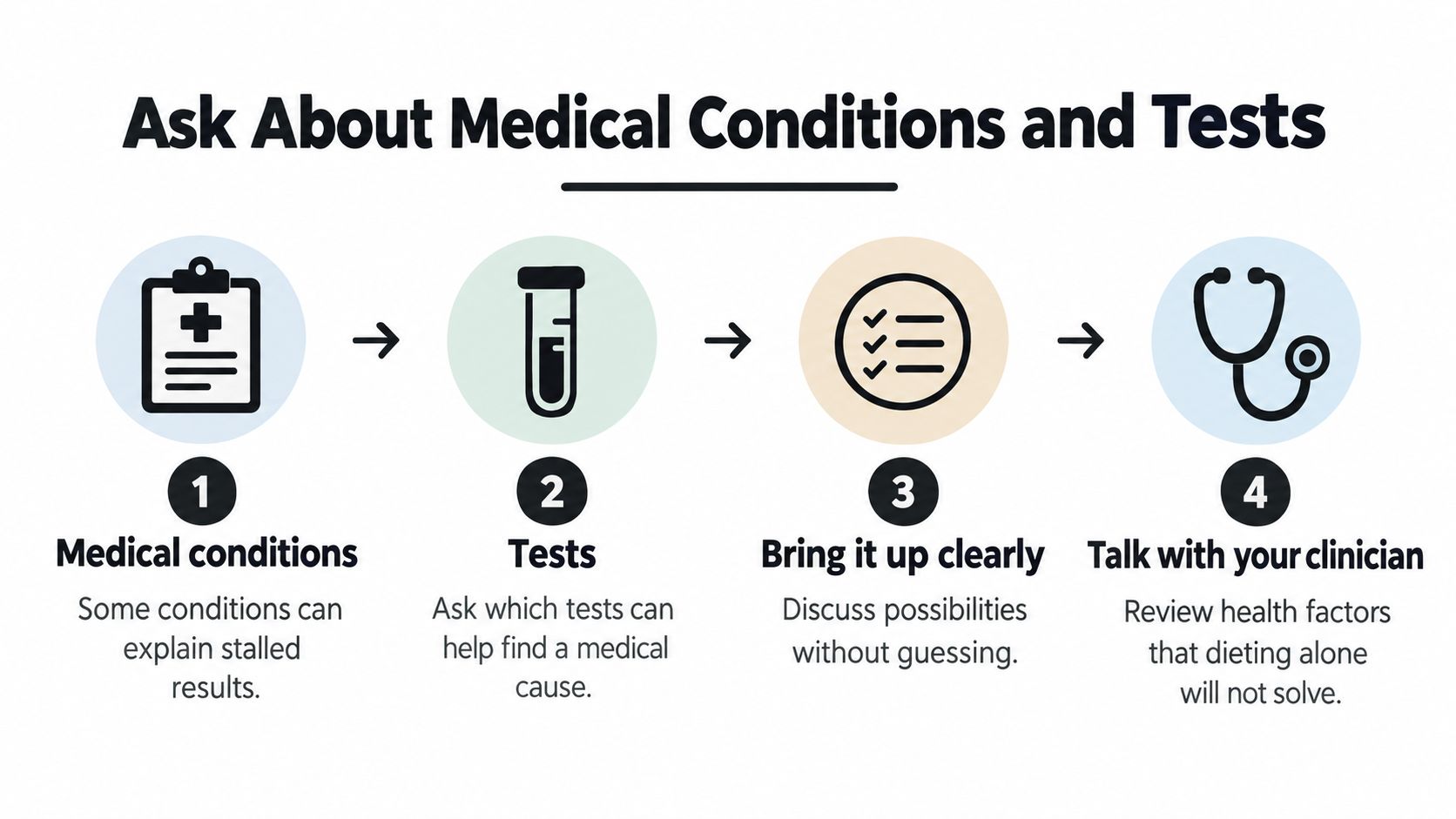
What a clinician may review, and why
These checks are a conversation starter. Your prescriber decides what is needed.
- Recent blood work. Old labs can miss a change. Ask whether anything on file is stale.
- Thyroid function. An underactive thyroid can make loss slower no matter how carefully you eat. A simple panel can rule that in or out.
- Blood sugar markers. If you live with diabetes or prediabetes, glucose patterns affect how the whole plan feels. Semaglutide is also used in diabetes care, so the two goals need one plan, not two competing ones.
- A full medication review. Overlaps from section-style thinking belong here as a list, not a second explanation. Name every prescription, including ones from another clinician.
- Sleep and mood. Loud snoring, daytime sleepiness, or a low mood can stall progress even when the dose is right. Poor sleep and untreated apnea are worth raising directly.
Fluid retention is the quiet one. Ankles that swell, a ring that suddenly fits tight, or a jump of several pounds in two days is often water, not fat. That pattern belongs in the visit note so nobody chases a food problem that isn't there.
Sleep apnea deserves its own mention if you gasp at night or wake unrefreshed. Reading about exploring Ozempic for sleep apnea from The Sleep Consultant can help you frame questions, while your own clinician decides whether a sleep study or a different evaluation fits. A look at medical reasons for not losing weight is a reasonable primer before that appointment so you aren't starting from a blank page.
Questions worth writing down
Bring these, and leave room for the answers:
- Which of my conditions could blunt weight loss even if the dose is correct?
- Do I need updated thyroid, glucose, or other labs, or are current results enough?
- Could fluid retention explain a sudden gain?
- Should sleep or mood be evaluated before we change the weight-loss plan?
- If tests are normal, what is the next step on dose and follow-up?
You are not asking for a stack of tests. You are asking which single check would change the plan.
Compare Support Options That Track Progress
After the basic checks, the practical question is who reviews the dose and who keeps the record. Three paths cover most adults: tracking alone at home, occasional in-person clinic visits, and a telehealth program with ongoing provider access. None of them removes the need for the checklist above. They differ in how fast a question gets an answer.

Three ways people actually follow a stall
| Path | How dose changes get reviewed | How fast questions get answered | How progress is recorded |
|---|---|---|---|
| Self-tracking at home | You notice the stall and request a visit | Depends on whether you book | A scale app or notebook you maintain |
| In-person clinic visits | Reviewed when you are in the room | Often days to weeks for a slot | Chart notes plus whatever you bring |
| Telehealth with ongoing access | A licensed provider adjusts between visits | Messaging can be faster than a new appointment | In-app tracking tied to the care team |
Home tracking is cheap and honest if you weigh weekly and keep the injection log. It fails when a missed dose or a rough side-effect week sits in a notes app for a month because you don't want to "bother" anyone. The data exists. Nobody acts on it.
In-person follow-up works well if you already have a clinician nearby and can get on the schedule. You leave with a dose decision and labs when they're needed. The trade-off is friction. A busy clinic may not see you until the stall is already several weeks old, and a short visit can skip the food and sleep details unless you bring them written down.
Telehealth support fits people who want the same licensed review without a waiting room. Questions about a late pen or a wave of nausea can go to the care team between formal visits. You still need a real prescriber, not a chat thread that tells you to take extra medicine.
Weight Method sits in that third path. The program includes provider consultations by video, unlimited messaging with the care team, progress tracking, and dosage adjustments monitored by a licensed provider. That is one way to keep dose review and the weekly record in the same place. It isn't the only workable choice. Access, budget, and how much contact you want should decide it. If you already have a responsive local clinician, staying there can be the simpler route. If visits are hard to get and the log keeps piling up unanswered, a telehealth plan with messaging is the option built for that gap.
Whichever path you pick, ask one concrete question at the next touchpoint: who looks at my dose and my four-week trend, and how soon? If the answer is "you do, until something feels urgent," the stall will keep being your problem alone.
When to Seek Medical Review and Next Steps
Waiting is reasonable while you are still early and the injections are on time. Waiting is the wrong move when the checklist already shows a problem a clinician should own. Prompt review beats another month of guessing.
Seek care promptly, including urgent care if you feel unsafe, when any of these show up:
- Two or more missed doses in a row. As covered earlier, that may mean a supervised restart, not a homemade catch-up.
- Severe or persistent gastrointestinal symptoms. Vomiting you can't shake, diarrhea that doesn't ease, or pain that worries you.
- Dizziness or signs of dehydration. Dark urine, very little urine, or lightheadedness when you stand.
- No change after a reasonable stretch at the maintenance dose, once timing and the other checks are already documented.
- Any symptom that scares you. You don't need a perfect label before you call.
Don't stop the medicine abruptly because a forum said it "stopped working," and don't double a dose to force the scale. Both moves create new problems. A nonresponse is a clinical conversation after the basics are ruled out, not a conclusion you reach on a bad weigh-in.
What to do in the next seven days
- Confirm the current dose and the injection log. One page, every shot, on time or not.
- Write side effects and habits. Nausea days, medicines, alcohol, protein, sleep. Short notes beat a perfect diary.
- Gather the questions from the medical checklist. Thyroid, glucose, fluid, sleep, mood.
- Book the review. Tell the scheduler you are not losing weight and you have a log ready. That gets you a useful visit instead of a vague one.
If the only thing you do this week is put the log and the question list in one place, the next appointment will be shorter and clearer.
A stall on semaglutide is usually explainable. Time on a rising dose, missed injections, medicines and habits, or a condition that needs a test each leave a trace. You don't have to fix all of them yourself. You do have to show up with the trace instead of a single frustrating number.
If you want a licensed provider to review your semaglutide dosing and the progress log you've been keeping, Weight Method offers video consultations, messaging with the care team, and monitored dose adjustments. That kind of follow-up is built for the exact question of why the scale isn't moving. Visit Weight Method to start a consultation and bring the checklist with you.