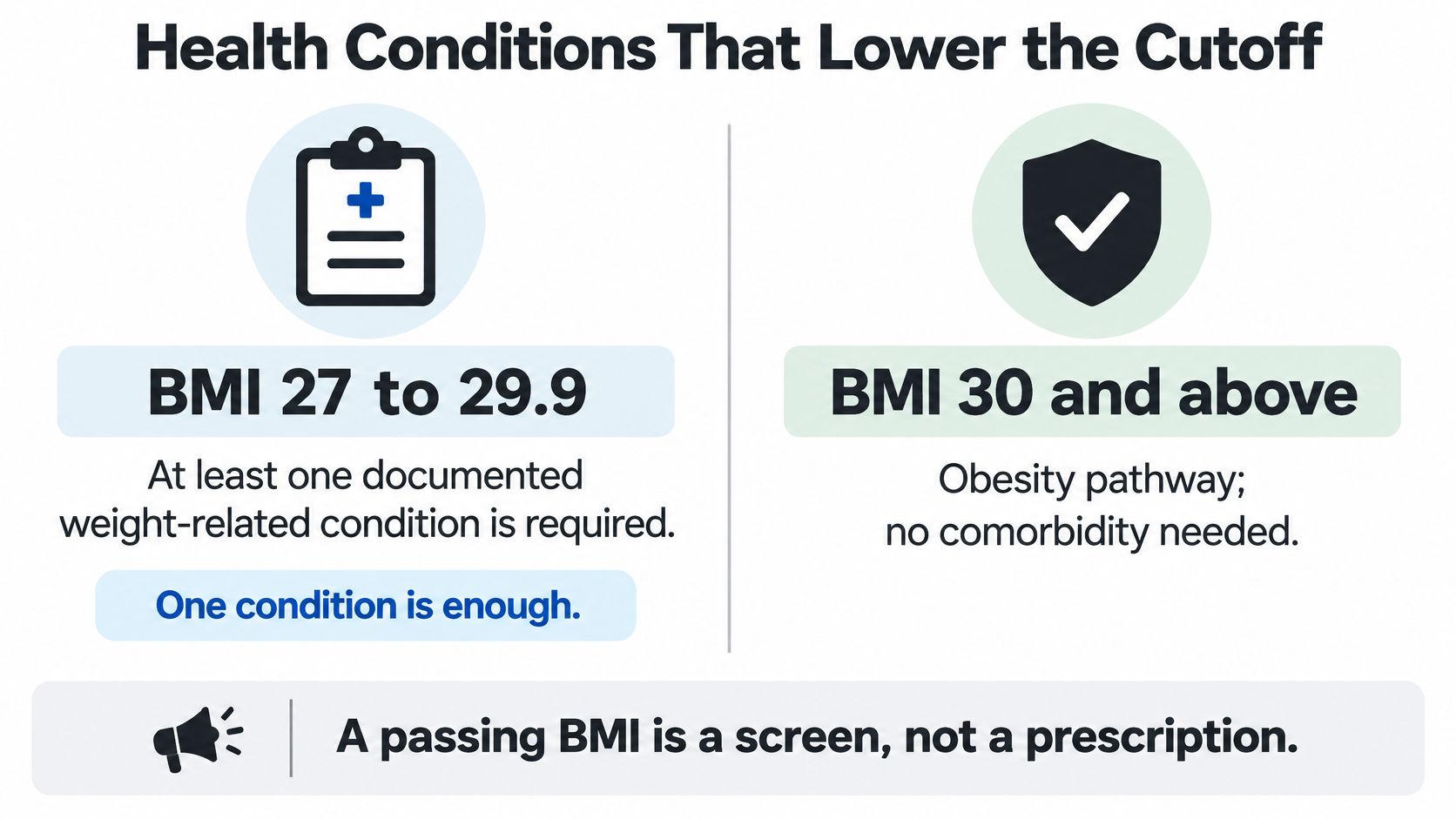
U.S. labeled chronic weight-management use generally requires a BMI of at least 30, or at least 27 with one weight-related condition, and a clinician must still approve treatment. Meeting that cutoff means you may be considered for medication, not that you're guaranteed a prescription or insurance coverage.
The distinction matters because medical eligibility, prescribing, and payment are separate decisions. A diagnosed condition can change which pathway applies, while your health history or your insurer's policy can change what happens next. Understanding GLP-1 BMI requirements is therefore less about finding a single qualifying number and more about knowing what that number allows a clinician to evaluate.
GLP-1 BMI Cutoffs at a Glance
The adult framework described in the FDA prescribing information for Zepbound uses an initial BMI of at least 30 kg/m², or at least 27 kg/m² with a weight-related condition, for chronic weight management. The following table summarizes those pathways for the semaglutide and tirzepatide weight-management indications discussed here.
U.S. labeled BMI pathways for chronic weight management
| Pathway | Initial BMI | Extra requirement | What it means |
|---|---|---|---|
| Obesity | 30 kg/m² or higher | None on the BMI line | Meets the labeled weight-management screen |
| Overweight with a condition | 27 to 29.9 kg/m² | At least one weight-related condition | Condition must be documented |
| Below the labeled screen | Under 27 kg/m² | Not met by BMI alone | Generally outside these chronic weight-management labels |
The important difference is the extra diagnosis requirement, not whether someone feels they have enough weight to lose. On the obesity pathway, an additional weight-related diagnosis isn't required to satisfy the BMI criterion. On the overweight pathway, the clinician must establish that a qualifying condition is present.
That doesn't make either pathway an automatic approval. A prescriber still needs to determine whether the particular medication is appropriate, whether another treatment makes more sense, and whether the patient can use it safely.
What the labels do and don't establish
These weight-management medicines are intended to accompany a reduced-calorie diet and increased physical activity. They aren't labeled as replacements for nutrition, movement, or clinical follow-up.
For day-to-day planning, focus on foods you can fit into an individualized eating plan rather than assuming you need products marketed specifically for medication users. If you're comparing convenient foods, you can browse savory GLP-1 snack options from Gym Snack and review the ingredients, portion sizes, and nutrition information against your clinician's recommendations. A snack choice doesn't influence medical eligibility.
The medication's indication also matters. A diabetes indication for a related product is a separate prescribing pathway from chronic weight management. Sharing an active ingredient or a familiar brand association doesn't make different products interchangeable for eligibility purposes.
Practical rule: Identify the exact medication and the reason it would be prescribed before deciding which eligibility criteria apply.
Finally, the label refers to initial BMI. Keep a reliable record of the measurements used at the beginning of treatment rather than trying to reconstruct them later from memory or an unrelated appointment.
How the BMI Number Is Calculated
Say you enter your weight into an online calculator and get a different result from the BMI in your medical chart. Before interpreting either result, check the height, weight, and units entered. A typing error or an outdated measurement can change the answer without reflecting any actual change in your health.
BMI is weight in kilograms divided by height in meters squared. Square the height first, then divide the weight by that result. If you're using pounds and feet, use a calculator that accepts those units rather than placing them directly into the metric formula.
Why the scale alone can't tell you
A taller adult and a shorter adult can have the same BMI at different body weights. That's why there isn't a universal qualifying weight in pounds for GLP-1 treatment.
Think of BMI as the height sticker at a doorway: it helps identify who may enter for consideration, but it doesn't describe the full assessment inside. BMI doesn't directly measure body fat, explain where fat is distributed, or establish how weight affects your health.
Our BMI and obesity guide provides additional context for interpreting the result without treating it as a complete diagnosis.
To understand the number you bring to an appointment:
- Check your height. Don't assume an old chart entry or a remembered measurement is accurate.
- Record a current weight. Note whether the measurement was taken with shoes or heavy clothing.
- Explain unusual circumstances. Recent fluid changes, pregnancy, or very high muscle mass can make a straightforward interpretation less useful.
- Save the measurement details. Bring the height and weight themselves, not just a calculator's final result.
The distinction between a BMI screen and a prescribing decision is illustrated below.
Don't chase a borderline reading
A small change near an eligibility boundary may change the administrative pathway without meaning your health has suddenly changed. Don't deliberately gain weight, manipulate hydration, or repeatedly weigh yourself looking for a qualifying result.
Bring honest measurements and explain any uncertainty. A clinician can recalculate BMI and interpret it alongside your history, rather than relying on a rounded number from an app.
Health Conditions That Lower the Cutoff
Conditions that can open the BMI 27 pathway
| Condition | Wegovy examples | Zepbound examples | Practical note |
|---|---|---|---|
| Hypertension | Listed | Listed | A recorded diagnosis is stronger than a home reading |
| Type 2 diabetes | Listed | Listed | Separate from a diabetes-only prescribing reason |
| Dyslipidemia | Listed | Listed | Includes abnormal cholesterol or triglycerides |
| Obstructive sleep apnea | Not in the short example list | Named on the label | Still a common weight-related condition in practice |
| Cardiovascular disease | Not in the short example list | Named on the label | Clinician confirms it is weight-related |
| Prediabetes or fatty liver disease | Not an automatic label example | Not an automatic label example | May be discussed but doesn't guarantee the pathway |
Comorbidity means another medical condition that exists alongside the condition being treated. For weight-management eligibility, the relevant question is whether that diagnosis qualifies as a weight-related condition for the specific medication.
The examples in a label help guide that judgment, but a shorter example list shouldn't be mistaken for a complete account of every clinical situation. Conversely, a condition that sounds metabolic isn't automatically sufficient. Prediabetes, fatty liver disease, or weight-bearing joint problems deserve discussion, not a promise of approval.
Documentation makes the difference
A clinician needs more than a suspicion that you might have a condition. An isolated high blood-pressure reading isn't the same as an established hypertension diagnosis, and snoring alone doesn't establish obstructive sleep apnea.
Bring useful records rather than trying to choose the diagnosis most likely to qualify:
- Condition name. Use the diagnosis recorded by your treating clinician.
- Diagnosis history. Note when it was identified and where supporting records can be found.
- Current management. List the medication, device, or other treatment you use.
- Relevant results. Include available laboratory reports, sleep-study findings, or specialist notes.
If sleep apnea is part of your history, our guide to GLP-1 treatment and sleep apnea can help you prepare for that conversation. Keep the sleep diagnosis and the proposed reason for prescribing clear, rather than assuming every sleep-related symptom establishes eligibility.
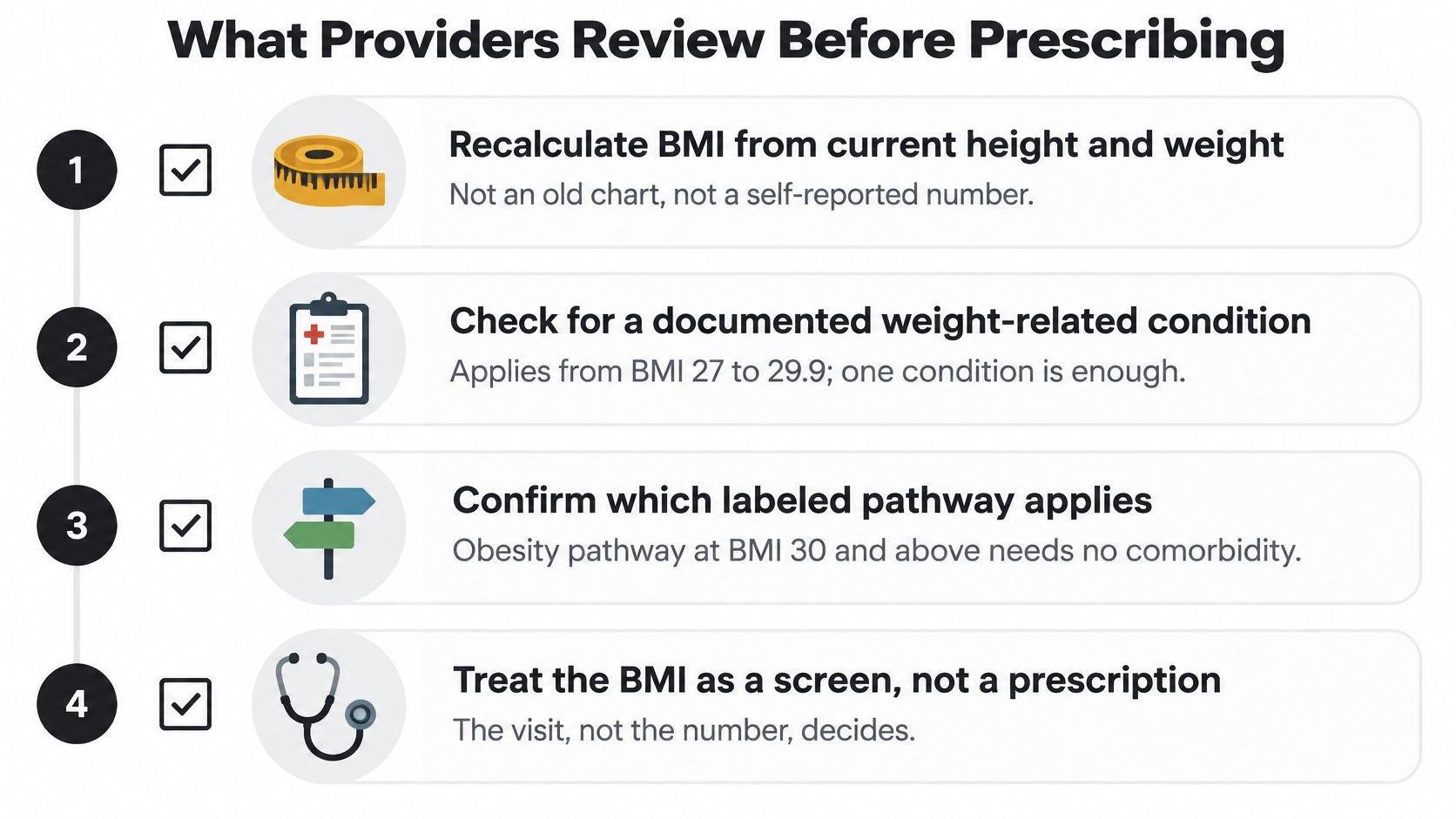
This checklist shows how condition verification fits into the broader assessment.
A diagnosis isn't the whole treatment plan
The purpose of documenting a condition is to clarify your health needs, not to obtain medication. Its severity, current treatment, and relationship to your weight help a prescriber decide what care is appropriate.
For broader context, ProMD Health Columbia's explanation of what medical weight loss involves can help distinguish a medically supervised assessment from a stand-alone diet program. Your own evaluation still needs to address your diagnoses, medication history, and goals.
What Providers Review Before Prescribing
The FDA prescribing information for injectable Wegovy illustrates why the clinical context matters: an adult with BMI 28 and a qualifying weight-related condition may meet the weight-management screen, while an adult with BMI 28 without one generally doesn't. The same BMI can therefore lead to different eligibility conclusions.
At Weight Method, our medical review begins with a detailed questionnaire covering BMI, pre-existing conditions, current medications, prior GLP-1 use, and contraindications. Our licensed clinicians assess eligibility using your BMI, health history, and treatment goals.
The order of a careful assessment
-
Confirm the measurements. The clinician checks the height and weight used to calculate BMI and resolves discrepancies with older records. Accurate inputs matter more than a self-reported eligibility result.
-
Verify relevant diagnoses. If the lower-BMI pathway applies, the clinician reviews the documented weight-related condition. They may need supporting records rather than a condition selected from a questionnaire alone.
-
Review medications and previous treatment. Bring prescription medicines, nonprescription products, and supplements. Include prior semaglutide or tirzepatide use, the last dose you took, any treatment interruption, and the reason you stopped.
-
Screen for contraindications and other explanations for weight gain. Discuss pregnancy plans and relevant personal or family medical history, including medullary thyroid carcinoma or multiple endocrine neoplasia syndrome type 2. Don't assume a family history of an unspecified thyroid problem means the same thing as a confirmed diagnosis.
-
Agree on an appropriate treatment approach. The clinician considers whether medication fits your needs alongside nutrition, activity, and follow-up. Your goals should include health priorities and practical concerns, not only a desired scale weight.
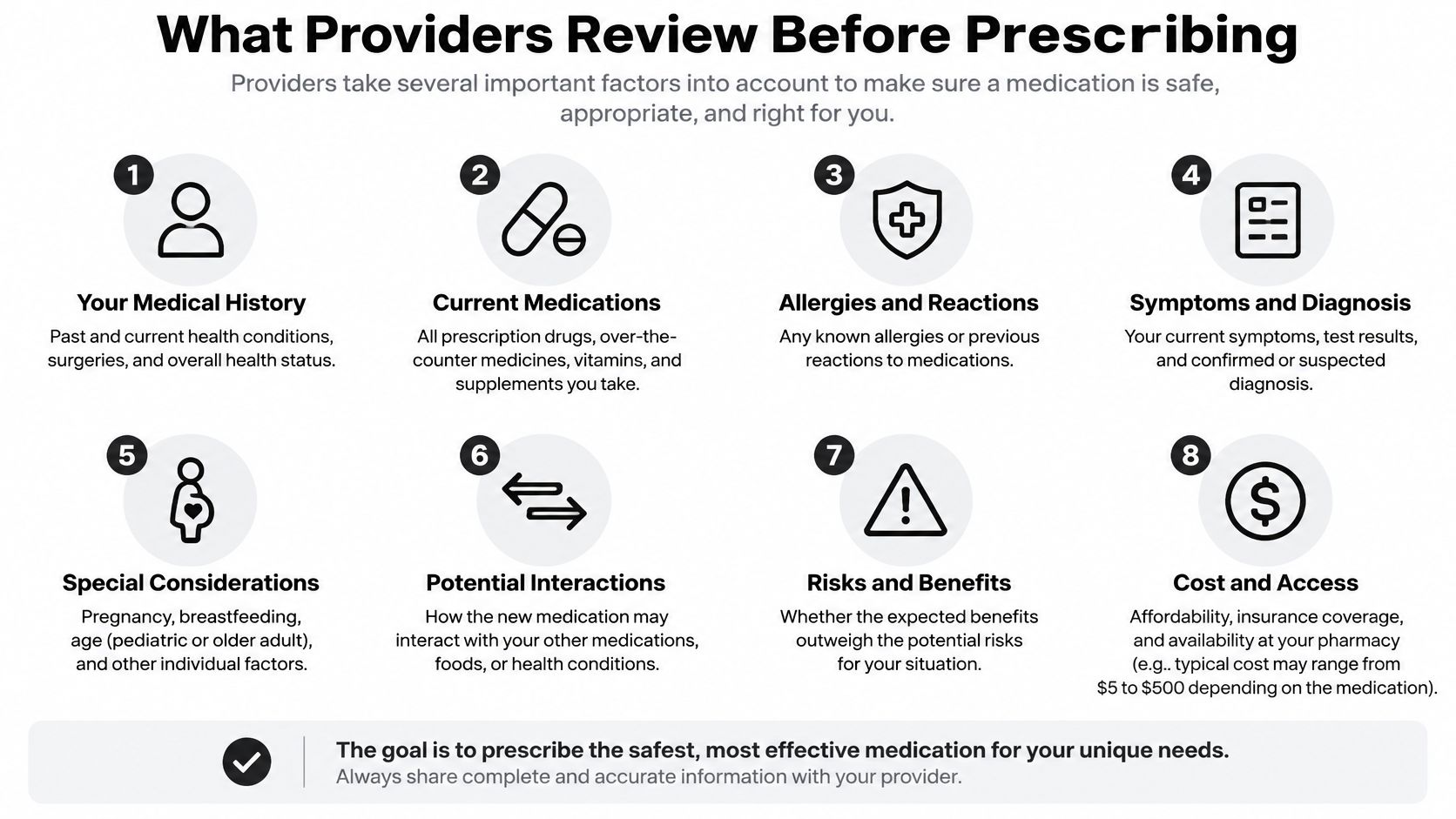
The following visual summarizes the factors that may enter that decision.
Previous use needs a fresh review
Having taken a GLP-1 medication before doesn't establish that your old prescription or dose is appropriate now. Your health, medicines, tolerance, and treatment goals may have changed during the interruption.
Bring a photograph of the previous prescription label if you have it. Distinguish the prescribed dose from the dose you used, and don't restart leftover medication without a prescribing review.
For your appointment: Report what you actually took and when you last took it, not just the highest dose you remember being prescribed.
A careful intake may end with a prescription, a request for records, further assessment, or a different treatment recommendation. Each is a legitimate clinical outcome.
How Coverage and Country Rules Differ
An adult with BMI 31 and hypertension may satisfy a U.S. weight-management label screen yet still need additional referral criteria and specialist access under NICE's semaglutide guidance for England. That guidance recommends semaglutide through a specialist multidisciplinary weight-management service, with a weight-related comorbidity and either BMI of at least 35, or BMI 30.0 to 34.9 when specialist-service referral criteria are also met.
BMI access thresholds by system
| System | BMI screen | Extra gate | Compared with U.S. label |
|---|---|---|---|
| U.S. FDA weight-management labels | 30 or higher, or 27 to 29.9 | One weight-related condition on the lower band | Baseline |
| NICE England semaglutide guidance | 35 or higher, or 30.0 to 34.9 | Specialist service and a comorbidity; referral criteria also apply to the lower band | Stricter |
| STEP 1 trial population | 30 or higher, or 27 or higher with a comorbidity | At least one weight-related comorbidity on the lower band | Aligned with the U.S. label |
| Typical extra payer filter | Plan-specific | Lifestyle attempt, step therapy, or continuation target | Can be stricter than the label |
Separate clinical rules from payment rules
A drug label describes an authorized use. A clinician decides whether prescribing is appropriate for you. An insurer decides whether your contract covers that treatment under its own requirements.
Those decisions aren't substitutes for one another. A coverage denial doesn't necessarily mean you're medically ineligible, and a prescription doesn't establish that an insurer will pay.
Before making financial commitments, obtain the plan's written criteria for the exact medication and indication. Our GLP-1 insurance coverage guide can help you organize questions about prior authorization and coverage requirements.
Ask the plan to clarify:
- Initial approval. What documentation must the prescriber submit?
- Previous treatment. Must you show a lifestyle-treatment attempt or use another medication first?
- Continuation. What evidence of response or follow-up is required?
- Treatment interruptions. Does a coverage gap change the authorization process?
Use the rules for your actual care setting
Country-specific guidance can be narrower than the population studied in a clinical trial. Trial eligibility helps explain the evidence base, but it doesn't establish entitlement to publicly funded treatment.
If you're comparing GLP-1 weight loss options UK, Courier Pharmacy's overview offers additional context for questions about access. Distinguish private prescribing from NHS access, and check the rules that apply where your care is delivered.
Successful treatment can also change your current weight. That makes the original treatment record useful, but continuation coverage still needs to be checked against the plan's policy rather than inferred from a current BMI alone.
Keep separate answers to these questions: Does the label fit? Does the clinician agree? Will this plan pay?
What Happens Below BMI 27
A larger waist or a concerning metabolic history deserves medical attention even when someone falls outside a medication's usual weight-management screen. It doesn't, however, automatically establish eligibility for semaglutide or tirzepatide.
The clinical framework discussion available through PubMed Central describes a European Association for the Study of Obesity proposal to consider treatment at BMI of at least 25 when waist-to-height ratio exceeds 0.5 and medical, functional, or psychological impairment is present, while also noting an evidence gap below BMI 27. A broader assessment proposal isn't the same as an FDA indication.
Health risk and prescribing eligibility aren't identical
Consider adults with different situations. Someone on the obesity pathway may satisfy the BMI screen without an additional diagnosis. Someone on the overweight pathway may not satisfy it if no qualifying condition is documented.
A person below the labeled screen may still have important health concerns, including a high waist measurement or a diagnosed metabolic condition. The appropriate response is to evaluate those concerns directly, not to dismiss them because of BMI or assume that they justify a particular medication.
Not meeting a medication screen doesn't mean you don't need care. It means the next decision requires more than applying the familiar BMI rule.

What a broader assessment can include
A clinician may consider several aspects of your health together:
- Waist measurement. This adds information about body-fat distribution that BMI doesn't provide.
- Documented conditions. Bring established diagnoses and relevant test results rather than relying on a general concern about metabolic risk.
- Functional effects. Explain how your health affects movement, sleep, work, or daily activities.
- Previous treatment. Describe what you've tried, what helped, and what was difficult to sustain.
- Medication-specific suitability. Contraindications and the exact product's labeling still matter.
If off-label prescribing is discussed, it remains an individualized clinician decision. It isn't an automatic exception, an assurance of insurance coverage, or proof that the likely benefits outweigh the risks.
Avoid seeking a higher scale reading to qualify. A useful consultation starts with accurate information and an honest discussion of the health problem you want help addressing.
See If You Meet the Criteria
Gather these items before completing an eligibility assessment:
- Current measurements. Write down your height, weight, and calculated BMI, along with any uncertainty about the measurements.
- Diagnosed weight-related conditions. Include when each condition was recorded, the treating clinician, and any medicine or device used to manage it.
- A complete medication list. Include prescriptions, over-the-counter medicines, supplements, and allergies.
- Previous GLP-1 treatment details. Record the product, prescribed dose, last dose taken, treatment gaps, and side effects.
These details make the medical review more useful than a yes-or-no quiz result. They help a licensed clinician identify the relevant pathway, review safety concerns, and determine whether a weight-management medicine fits your needs.
Know what your assessment can establish
Our licensed clinicians determine eligibility from your health history and provider assessment. A screening result can help start that process, but it doesn't replace the prescribing decision.
You don't need to guess which answer will qualify you. If a diagnosis is uncertain or a previous dose is unclear, say so and bring the records you have.
Keep your medical assessment separate from your coverage inquiry. You'll want a clear clinical recommendation and, if you intend to use insurance, confirmation of the plan's requirements for the proposed treatment.
If your measurements fall outside the usual labeled screen, bring your concerns anyway. Waist measurement, diagnosed conditions, and functional difficulties can still warrant evaluation without any assumption that a GLP-1 prescription will follow.
The most useful next step is an accurate intake, not a promised approval. Prepare your measurements and medication history, identify the health goals that matter to you, and let a licensed clinician decide what treatment is appropriate.
Weight Method connects adults with licensed clinicians who review BMI, medical history, and treatment goals for GLP-1 weight-management care. Visit Weight Method to begin an eligibility assessment, with your current measurements, diagnoses, and medication list ready for review.