You've seen the weekly injection charts, and your next dose is coming up. Maybe you're still hungry, or maybe you're wondering whether the nausea you're feeling means you shouldn't increase. The chart gives you a date, but it doesn't tell you how to interpret what your body is doing.
Why GLP-1 Dosing Is a Question Worth Getting Right
The most useful question about GLP-1 dosage for weight loss isn't how high the dose can go. It's how your clinician decides whether the next dose is appropriate for you.
A starting dose, an escalation dose, and a maintenance dose serve different purposes. Confusing them can create unrealistic expectations, especially when someone compares their early treatment with another person's long-term results.
Understand the decision, not just the chart
Think of your prescription as a treatment plan with checkpoints, rather than instructions to keep increasing regardless of symptoms. Your prescriber needs to consider your response, adverse effects, other medicines, and health history alongside the product's prescribing information.
You can make those conversations more useful by bringing concrete observations:
- Eating and drinking: Explain whether you can comfortably finish meals and maintain hydration.
- Daily functioning: Report symptoms that interfere with work, sleep, or activity.
- Treatment goals: Discuss what you want to improve beyond the number on the scale.
- Practical barriers: Mention affordability, travel, or access problems before they interrupt treatment.
Nutrition support has a separate role from prescribing. For someone who wants help organizing meals and building consistent habits, DietOwl's WhatsApp-based diet coaching for weight loss is a resource to consider alongside medical care, not a replacement for medication monitoring.
Practical rule: Use a dosing chart to understand your prescription, not to change it yourself.
You don't need to become a medication expert. You need enough vocabulary to describe what's happening and enough confidence to ask why your clinician recommends increasing, waiting, or reconsidering the plan.
How GLP-1 Medications Work and Why Dosing Must Be Gradual
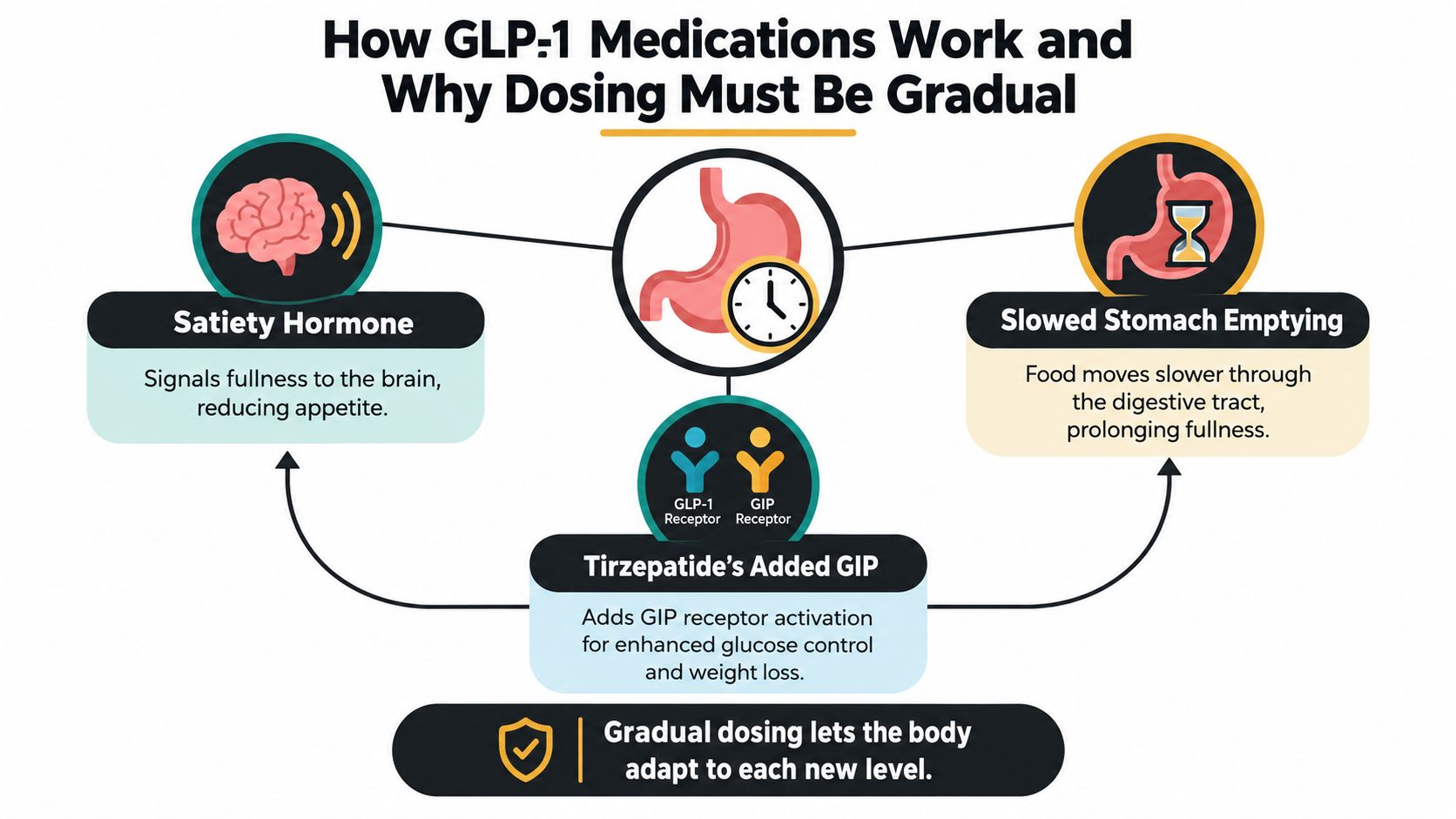
GLP-1 is a hormone involved in signals between the gut and brain. In plain language, GLP-1-based medicines influence appetite and fullness, while also slowing stomach emptying. Tirzepatide adds activity at another receptor, called GIP, rather than acting on GLP-1 receptors alone.
These effects help explain both the intended benefit and the digestive discomfort some people experience. Feeling satisfied sooner can support eating less, but uncomfortable fullness isn't the treatment goal.
Think of dose changes as adjusting a sensitive dial
Turning a sensitive dial all the way up doesn't necessarily produce a better experience. A gradual adjustment gives you and your clinician time to assess what changes at each setting.
That's the logic behind titration, the planned process of introducing medication and increasing the dose gradually. The introductory phase isn't wasted time, and a starter dose shouldn't be judged against the results of sustained maintenance treatment.
- Appetite response: Your clinician wants to understand whether eating feels more manageable, not whether hunger has disappeared completely.
- Digestive response: Nausea, vomiting, diarrhea, or constipation can affect whether an increase is appropriate.
- Overall function: A useful treatment plan needs to fit daily life, including adequate food, fluid intake, and activity.
The important trade-off is between potential additional benefit and tolerability. More medication may increase the treatment effect, but the next step still needs to be appropriate for the person taking it.
For a plain-language explanation of the underlying biology, the guide to how GLP-1 medications work provides additional context. Keep the distinction clear: understanding the mechanism helps you interpret your experience, but it doesn't identify your personal dose.
Semaglutide Dose Escalation for Weight Loss
For injectable Wegovy, the labeled starting dose is deliberately different from the recommended adult maintenance dose. The schedule introduces semaglutide gradually rather than beginning at the amount used for sustained treatment.
The FDA Wegovy prescribing information describes the following weekly subcutaneous dosing sequence, generally advancing after each four-week stage when tolerated:
| Treatment stage | Once-weekly dose | Purpose |
|---|---|---|
| Initial four-week stage | 0.25 mg | Introduce treatment |
| Following four-week stage | 0.5 mg | Continue escalation |
| Following four-week stage | 1 mg | Continue escalation |
| Following four-week stage | 1.7 mg | Assess tolerability before the target dose |
| Maintenance phase | 2.4 mg recommended | Sustain treatment; 1.7 mg may be used when tolerability limits the target |
These are specified steps, not an invitation to create intermediate doses. If an increase isn't going well, the decision is whether to adjust the prescribed plan, not improvise a smaller injection.
What maintenance actually means
Maintenance means the ongoing treatment phase after introductory escalation. It doesn't mean you've finished losing weight, reached a permanent endpoint, or no longer need follow-up.
The lower maintenance option matters because the recommended target isn't appropriate for every adult. A clinician may delay escalation or select an alternative labeled maintenance dose when tolerability prevents reaching the target.
Put the trial result on the right timeline
In STEP 1, adults receiving semaglutide 2.4 mg weekly alongside lifestyle intervention lost an average of 14.9% of baseline body weight after 68 weeks, compared with 2.4% with placebo and lifestyle intervention, according to the FDA's description of the pivotal semaglutide trial.
That finding describes an extended treatment course, not what someone should expect during the introductory stage. It also describes a group average, not a personal target or promise.
A useful appointment question is: “Am I ready for the next prescribed stage, or is there a reason to stay here longer?” That question keeps the focus on the clinical decision rather than on whether you're keeping pace with someone else.
Tirzepatide Dose Escalation for Weight Loss
For Zepbound, the starting dose is an introduction to treatment, not the long-term maintenance destination. That distinction helps prevent an early misunderstanding: a modest initial response doesn't establish that tirzepatide won't work for you.
The FDA Zepbound prescribing information starts treatment at 2.5 mg once weekly for four weeks, followed by 5 mg weekly; subsequent increases are in 2.5-mg increments only after at least four weeks at the current dose, with recommended weight-management maintenance options of 5 mg, 10 mg, or 15 mg weekly.
Read the schedule as a set of decisions
The introductory stage asks whether you can begin treatment comfortably enough to continue. Later stages ask whether additional benefit justifies another increase.
Those questions aren't interchangeable. Feeling little appetite change during introduction calls for a different discussion from experiencing persistent vomiting during escalation.
- When response is useful and tolerability is acceptable: Your clinician can assess whether the current maintenance option meets your needs.
- When response is inadequate: Review the treatment course and overall plan before assuming a higher dose is the answer.
- When adverse effects interfere with daily life: Discuss the symptoms before the next scheduled increase.
What the dose-response evidence shows
In SURMOUNT-1, average weight reduction at 72 weeks was 15.0% with 5 mg, 19.5% with 10 mg, and 20.9% with 15 mg, compared with 3.1% with placebo. Those results support a dose-response relationship at the population level, but they don't establish which dose an individual should take.
A head-to-head trial of maximum-tolerated tirzepatide and semaglutide reported average weight changes of −20.2% and −13.7%, respectively, at 72 weeks. Participants received maximum-tolerated doses within the studied regimens, so the comparison isn't a milligram-for-milligram conversion guide.
A higher-dose group average can inform a prescribing conversation. It can't tell you to increase your own dose.
The practical aim is a maintenance plan that balances benefit with tolerability, not a race to the highest available strength.
Weight Loss Doses Versus Diabetes Doses
A familiar ingredient name doesn't tell you everything about a prescription. You also need the brand, formulation, indication, and product-specific instructions.
Online charts can be confusing. Someone may share a chart for diabetes treatment while you are looking for weight-management guidance, or describe a brand used differently in another country.
Weight Loss Versus Diabetes Dose Ranges
| Medication | Weight-loss brand and range | Diabetes brand and range |
|---|---|---|
| Semaglutide | Wegovy, using the introductory and maintenance schedule described above | Ozempic, using its own diabetes-specific prescribing range rather than the Wegovy chart |
| Tirzepatide | Zepbound, using the introductory and maintenance options described above | Mounjaro, using the locally applicable diabetes prescribing information |
The table deliberately doesn't convert one prescription into another. The weight-management labels and trials discussed earlier support those specific treatment regimens, not unsupervised substitution between brands.
For additional context on treatment goals, see the guide to GLP-1 medications for diabetes. If you have diabetes as well as weight-management goals, make sure the clinician overseeing your prescription knows about all medicines you take.
Questions that prevent chart confusion
- Which product is this chart describing? Match the full brand and formulation to your prescription.
- What condition is being treated? Ask whether the instructions address weight management, diabetes, or another indication.
- Which country's instructions apply? Don't assume an international discussion describes your local label.
- Is this a starting or maintenance dose? Identify the phase before comparing it with your own treatment.
If you're changing products, ask for a written transition plan. Don't use the size of the number on the prescription to estimate equivalent strength.
Reading Your Body During Dose Increases
You're approaching an escalation appointment, but your experience feels mixed. You're less interested in snacking, yet breakfast is uncomfortable and constipation has become distracting.
That combination deserves a conversation, not a simple judgment that the medicine is either working or failing. Benefit and tolerability need separate attention.
Bring a short treatment log
You don't need elaborate tracking software. A phone note can capture observations that are easy to forget during an appointment.
- Nausea and vomiting: Record when symptoms occur and whether they affect eating, sleep, work, or keeping fluids down.
- Bowel habits and hydration: Describe changes, discomfort, and whether drinking has become difficult.
- Appetite and cravings: Note whether meals feel manageable, rather than judging success by the complete absence of hunger.
- Weight trajectory: Bring the overall pattern alongside symptoms and daily functioning, not just the latest reading.
Avoid treating any single observation as a dose instruction. Appetite returning before the next injection, for example, is something to report, not a reason to add medication.
Understand the possible responses
A clinician may recommend more time at the current dose, a slower escalation plan, a supervised reduction, or a different treatment. The choice depends on the product instructions and your circumstances, rather than a universal symptom score.
Before your appointment: Describe what symptoms prevent you from doing. “I can't comfortably drink” is more useful than “the side effects are bad.”
Don't turn a symptom log into a self-dosing system. Its purpose is to help your prescriber see the trade-offs clearly.
If symptoms are persistent or worsening, contact the prescribing team before the next planned increase. If you can't keep fluids down or feel acutely unwell, seek prompt medical assessment rather than waiting for routine follow-up.
Side Effects, Safety, and Contraindications to Know
Nausea, vomiting, diarrhea, and constipation are recognized tolerability issues in the prescribing information discussed above. Abdominal discomfort also deserves attention, especially when it changes your ability to eat, drink, or function.
Don't assume that severe symptoms are an acceptable price for weight loss. Feeling ill isn't evidence that you've reached an effective dose.

Separate screening from symptom management
Your clinician needs your health history before deciding whether treatment is suitable. A contraindication is a reason a medicine shouldn't be used, while a precaution may call for assessment or monitoring rather than automatically ruling treatment out.
Make sure the prescribing team knows about:
- Relevant personal or family history: Include medullary thyroid carcinoma or multiple endocrine neoplasia.
- Pancreatic, gallbladder, or significant digestive problems: Give the diagnosis and describe any current symptoms.
- Pregnancy, pregnancy planning, or breastfeeding: Ask for advice specific to your situation before starting or continuing.
- Other medicines: Include insulin, sulfonylureas, and nonprescription products so the clinician can review the full regimen.
Don't use this checklist to decide eligibility yourself. These situations aren't all interchangeable, and your prescriber should explain which are contraindications and which require individualized assessment.
Know when not to wait
Seek urgent assessment for persistent severe abdominal pain or symptoms of a serious allergic reaction, such as trouble breathing or swelling. Contact your prescriber promptly if you become pregnant or develop ongoing symptoms that compromise hydration.
For help preparing a side-effect discussion, the guide to GLP-1 weight-loss side effects can support your questions. Ask for clear instructions about who to contact, including outside routine office hours.
Maintenance, Missed Doses, and Planning for the Long Term
Reaching maintenance changes the conversation. Instead of asking only whether to increase, you and your clinician need to decide whether the current plan remains effective, tolerable, and practical.
A reasonable discussion is whether an appropriate labeled maintenance dose can sustain benefit without unnecessary adverse effects. That's different from assuming everyone should stay at the highest dose or gradually reduce treatment without monitoring.
Make interruptions part of the plan
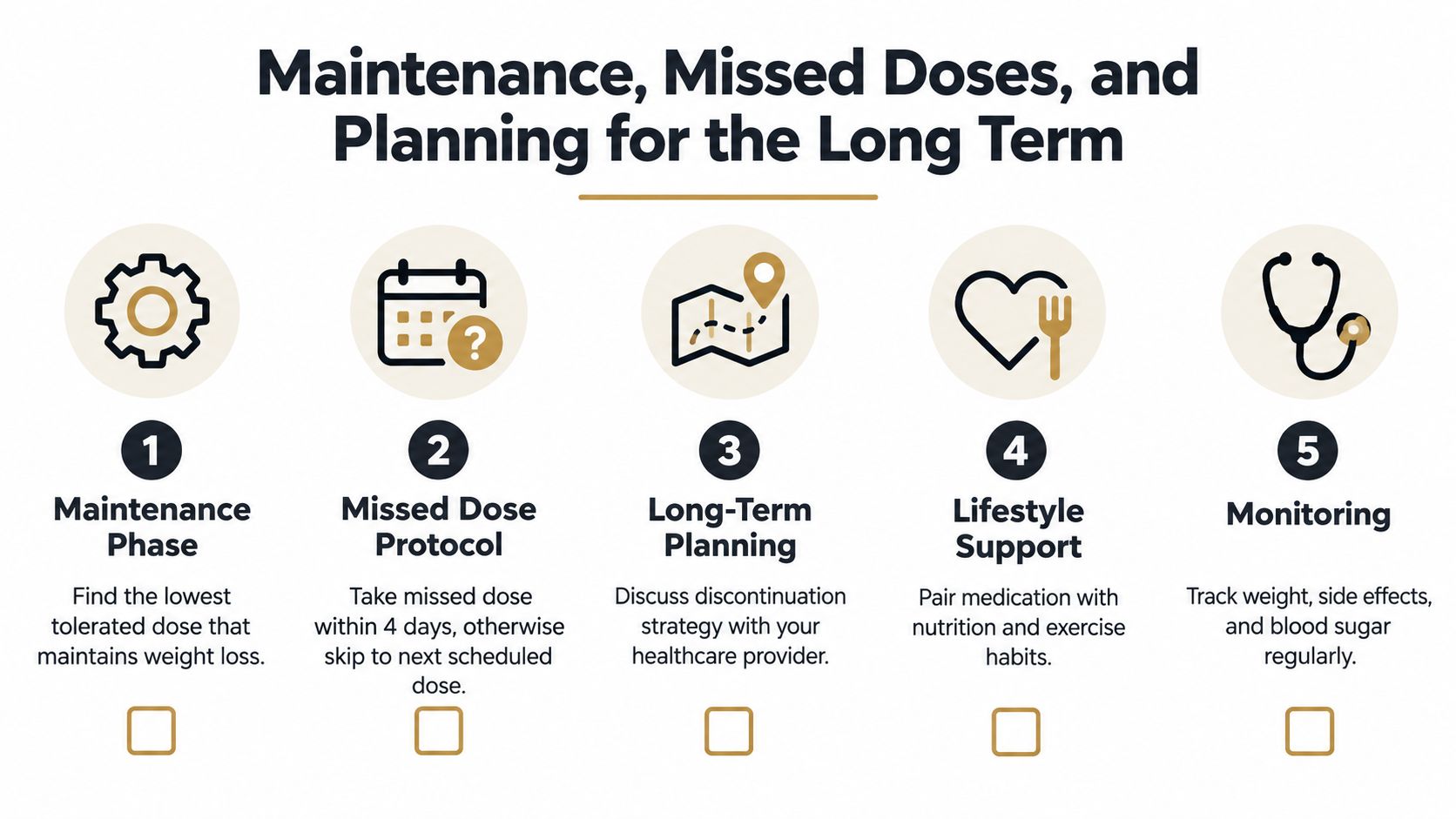
The Zepbound missed-dose instructions allow a missed tirzepatide dose to be taken within 96 hours; beyond that window, the missed dose is skipped and the regular schedule resumed. Don't apply that product-specific instruction automatically to semaglutide.
A prolonged interruption raises a different question from a single missed injection. Ask your prescriber whether restarting requires a revised titration plan rather than immediately returning to the former dose.
The checklist below summarizes planning topics. Its missed-dose reminder applies to tirzepatide, not every weight-loss medication.
Plan for changes before they become urgent
Maintenance follow-up should include more than a prescription renewal. Agree on what changes should trigger a review and how you'll reach the prescribing team.
- Weight or appetite changes: Decide what pattern merits an appointment rather than an automatic dose adjustment.
- Affordability or access problems: Discuss options before supplies run out.
- Surgery, illness, or pregnancy planning: Involve the relevant clinicians so medication decisions fit the broader care plan.
- Stopping treatment: Arrange follow-up, nutrition support, and a response plan if appetite or weight changes become difficult to manage.
Stopping isn't a moral failure, and maintenance isn't a test of willpower. Both are phases of care that deserve a considered plan.
Before your next appointment, write down your current prescription, recent symptoms, treatment goals, and any expected interruption. Ask for a clear answer to the practical question: “What should I do next, and what would make us change that decision?”
Weight Method is one telehealth option offering licensed-provider consultations, progress monitoring, and prescription dose adjustments for GLP-1 weight management. Visit Weight Method to discuss whether supervised treatment fits your needs and how a clinician would guide escalation, maintenance, and interruptions.