Semaglutide isn't risk-free, but for most adults its common side effects are gastrointestinal and dose-related: nausea, vomiting, diarrhea, and constipation each affected at least 5% of treated adults in weight-loss trials. Serious reactions are uncommon, but recognizing their warning signs matters more than being told to expect nausea.
The usual advice to start low and go slow is useful, but incomplete. Risk comes from three places: the medicine's effects, your health history, and how the product is prepared and taken. Persistent fluid loss and an incorrectly measured dose can turn an otherwise manageable treatment into a medical problem.
The Short Answer on Semaglutide Risk
Is semaglutide dangerous? It can cause harm, but that doesn't mean everyone who takes it faces the same risk. A useful safety discussion asks whether the medicine fits your medical history, whether you can use the product correctly, and whether you have timely access to a clinician when symptoms change.
Semaglutide is a GLP-1 receptor agonist, a medicine that acts on signals involved in appetite and blood-sugar regulation. It reduces appetite and slows stomach emptying. It's sold under names including Ozempic, Wegovy, and Rybelsus, although those products aren't interchangeable instructions for treatment.
Think of medication safety like driving a car with airbags and a speed limit. Safety features help, but the driver still needs the right vehicle, clear instructions, and maintenance. With semaglutide, a gradual prescription schedule doesn't replace checking for contraindications or learning how to measure an injection.
Separate the medicine from the treatment process
Before deciding whether treatment feels acceptable, distinguish these questions:
- The medicine: Which effects are expected, and which symptoms suggest a serious reaction?
- The person: Do your conditions, family history, or other medicines change the safety plan?
- The process: Who supplies the medication, how is the dose measured, and who handles problems between appointments?
If you're seeking local care, Georgia Plastic & Reconstructive Surgery provides a resource to find semaglutide options in Marietta. Use that kind of consultation to discuss medical suitability and follow-up, not just weight-loss goals.
Practical rule: A prescription is only part of a safe treatment plan. You should also know what you're taking, how to take it, and whom to contact.
Common digestive symptoms, urgent warning signs, contraindications, and product-specific dosing checks all belong in that conversation. Risk depends on the person, the product, and the monitoring, not on the weight-loss result alone.
Common and Rare Side Effects at a Glance
Semaglutide side effects by frequency, timing, and typical response
The FDA prescribing information for Wegovy lists nausea, vomiting, diarrhea, and constipation among adverse reactions affecting at least 5% of treated adults; nausea caused discontinuation in 1.8% versus 0.2% receiving placebo, vomiting in 1.2% versus 0%, and diarrhea in 0.7% versus 0.1%.
| Effect | How Often (Label or Trial Data) | When It Usually Appears | Typical Response |
|---|---|---|---|
| Nausea | Common in adult weight-loss trials | Often early or during dose increases | Smaller meals; ask about delaying escalation |
| Vomiting | Common in adult weight-loss trials | Often during dose escalation | Small sips of fluid; call if it persists |
| Diarrhea | Common in adult weight-loss trials | Can occur during treatment, including escalation | Replace fluids and electrolytes; report prolonged symptoms |
| Constipation | Common in adult weight-loss trials | Can develop during treatment and continue | Fluids, gradual fiber, activity; discuss ongoing laxative use |
| Low blood sugar with insulin or sulfonylureas | Combination increases risk; no single rate applies to every regimen | While using these medicines together | Check glucose; clinician reviews diabetes medicine doses |
| Acute kidney injury | A serious warning; trial rates discussed below | Often after dehydration from digestive symptoms | Prompt medical evaluation |
| Pancreatitis | A serious warning; a single frequency isn't established here | No reliable symptom-free window | Stop semaglutide and seek emergency care for severe, persistent abdominal pain |
| Gallbladder disease | A recognized warning; no single rate given here | Can occur during treatment | Prompt evaluation for upper abdominal pain, especially with fever |
| Serious allergic reaction | A serious warning; frequency isn't established here | Can occur during treatment | Emergency care for face or throat swelling or breathing difficulty |
What common actually tells you
The common category describes how often people reported a symptom, not how severe it was. Someone who felt briefly queasy and someone who struggled to eat may both have been counted as having nausea.
Discontinuation measures something different: how often a symptom led someone to stop treatment. It doesn't count every uncomfortable day, and it isn't a direct measure of emergency visits or hospitalization.
The digestive effects occurred especially during dose escalation. That makes the timing useful when you speak with your prescriber, but it doesn't make every symptom after an increase harmless.
Mild discomfort still needs boundaries
For mild nausea, try smaller meals, eat slowly, and stop when you feel comfortably full. Avoid forcing a large meal because it's your usual portion.
For constipation, add fiber gradually rather than suddenly. Ask for advice before treating persistent constipation with daily laxatives, particularly if you also have abdominal pain or vomiting.
A common symptom deserves a different response when it stops you from drinking, becomes severe, or keeps getting worse.
Don't use a low average risk to talk yourself out of reporting a concerning symptom. Your ability to drink, urinate, eat, and function matters more than whether a reaction is usually described as common or rare.
Serious Reactions and When to Seek Urgent Care
The overlooked kidney danger often begins in the stomach. Persistent vomiting or diarrhea can leave you unable to replace the fluid you're losing, reducing the blood flow your kidneys need to work properly.
The FDA labeling describing acute kidney injury reports postmarketing cases requiring hemodialysis, usually following dehydration from gastrointestinal symptoms, including in people without known kidney disease; in the cited weight-loss trials, acute kidney injury occurred at 0.4 versus 0.2 cases per 100 patient-years with Wegovy and placebo, respectively.
That distinction matters: kidney injury can follow fluid loss rather than direct kidney toxicity. It also explains why ongoing vomiting shouldn't be dismissed as something you have to tolerate.
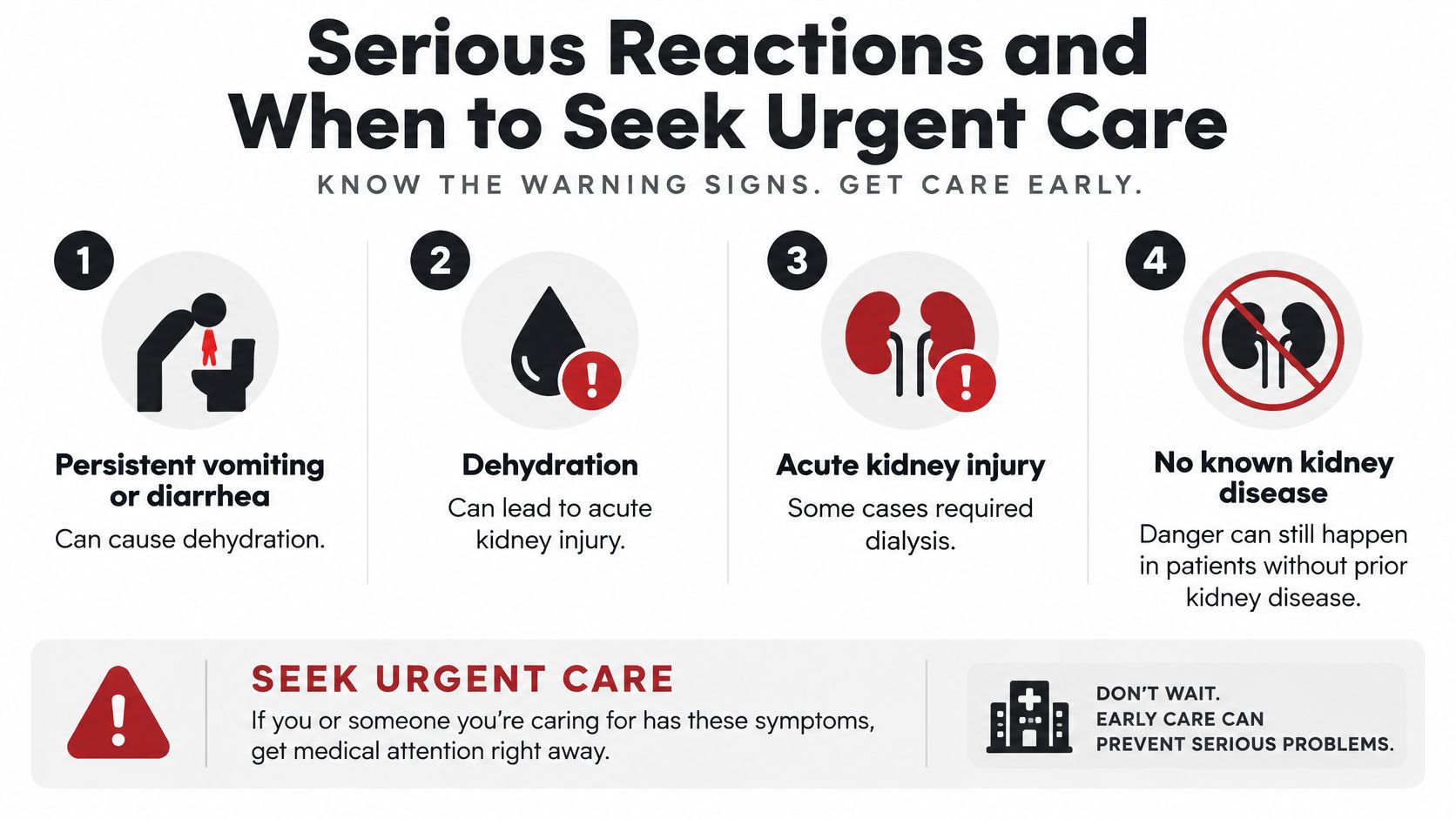
Contact a clinician within the day
- Persistent vomiting or diarrhea: Contact your prescriber when symptoms continue or interfere with drinking.
- Inability to keep fluids down: Seek prompt advice rather than repeatedly trying home remedies.
- Markedly reduced urination: Report a clear drop from your normal pattern.
- Dizziness on standing: Tell the clinician, especially when it occurs alongside poor intake or fluid loss.
These aren't instructions to wait until the end of the day. If symptoms are worsening, you feel seriously unwell, or you can't obtain prompt advice, seek urgent in-person care.
Seek emergency care now
- Confusion, collapse, or fainting: These can signal a serious problem, including severe dehydration.
- Severe, persistent abdominal pain: Pain extending toward the back can indicate pancreatitis. Don't take another dose while awaiting assessment.
- Upper abdominal pain with fever or yellowing skin: This needs urgent evaluation for possible gallbladder or related disease.
- Hives with facial, lip, or throat swelling: Treat this as a possible serious allergic reaction.
- Trouble breathing: Call emergency services rather than waiting for a portal response.
A new neck lump, swelling, persistent hoarseness, or difficulty swallowing also needs prompt medical review. Breathing difficulty is an emergency regardless of its suspected cause.
Make remote care workable before symptoms start
Telehealth can support monitoring, but a message inbox isn't an emergency service. Save the clinic's daytime number, after-hours instructions, and the location of an accessible urgent-care service before treatment begins.
If you're vomiting, don't assume drinking a large amount at once will solve the problem. Try small, frequent sips while arranging advice, and follow any existing fluid restrictions. People with kidney disease or other conditions affecting fluid balance need an individualized plan, not a universal daily water target.
Who Faces Higher Risk and Contraindications
A contraindication means the medicine shouldn't be used in that situation. A higher-risk circumstance means the clinician must decide whether treatment is appropriate and what safeguards it requires. Those categories aren't interchangeable.
The thyroid warning needs particularly careful wording. The FDA semaglutide labeling describes thyroid C-cell tumors in animal studies but states that whether semaglutide causes these tumors in humans is unknown; Ozempic, Rybelsus, and Wegovy are contraindicated with a personal or family history of medullary thyroid carcinoma or Multiple Endocrine Neoplasia syndrome type 2.
The animal finding isn't proof that semaglutide causes thyroid cancer in people. It nevertheless supports a prescribing restriction that you and your clinician should take seriously.

Contraindications and higher-risk situations for semaglutide
| Situation | Concern | Action Before Starting |
|---|---|---|
| Personal or family history of medullary thyroid carcinoma | Contraindicated for Ozempic, Rybelsus, and Wegovy | Don't start; disclose family history |
| Multiple Endocrine Neoplasia syndrome type 2 | Contraindicated | Don't start |
| Known serious allergy to semaglutide | Potential serious hypersensitivity | Don't start; have the allergy reviewed |
| Kidney disease | Dehydration can threaten kidney function | Agree on a fluid plan and kidney-function review |
| Older adults | Fluid loss may be harder to tolerate | Review hydration, other medicines, and monitoring |
| Taking diuretics | These medicines can add to fluid loss | Ask whether an illness-day medication plan is needed |
| History of gallbladder disease or pancreatitis | Relevant to serious treatment warnings | Discuss the history before prescribing |
| Pregnancy or planned pregnancy | Weight-loss treatment isn't appropriate during pregnancy | Discuss alternatives and stopping before planned conception |
Bring details, not just diagnosis names
A family history of thyroid cancer needs clarification. Medullary thyroid carcinoma is a specific diagnosis, not a synonym for every thyroid condition or every thyroid cancer. If you don't know the type a relative had, tell your clinician that rather than guessing.
A history of pancreatitis or gallbladder disease also deserves more than a checkbox. Bring information about what happened, whether you required hospital care, and any treatment you received.
For help organizing that discussion, review this guide to semaglutide contraindications. It can help you prepare questions, but it can't replace a review of your own records.
Don't stop a diuretic or another prescribed medicine yourself. Ask your clinician to document what you should do if you become ill, and explicitly mention family history even if the appointment form doesn't ask.
What Clinical Trials Show and How to Read Them
A safety percentage means little without knowing who was studied, what they received, and what happened in the comparison group. Placebo-controlled trials help clinicians distinguish treatment-associated effects from symptoms that also occur without the active medicine.
However, a side effect doesn't have to occur more often than placebo in a particular trial to be possible or clinically important. Small studies, uncommon events, and differences between participants can make comparisons uncertain.
Read the outcome before reacting to the number
The digestive-symptom figures describe different outcomes. Reporting nausea isn't the same as stopping because of nausea, and stopping treatment isn't the same as requiring hospitalization.
Ask what a safety claim counted:
- A reported symptom: Someone experienced an event during treatment.
- Discontinuation: Someone stopped because of that event.
- A serious outcome: The event met a specified seriousness definition.
- A postmarketing report: Someone submitted a suspected problem after the product entered use.
Those categories shouldn't be combined into a single impression of danger. A headline about reported adverse events may sound like a count of confirmed injuries caused by the medicine, even when that isn't what the reporting system establishes.
Understand time-based rates
Patient-years combine participants' time under observation. A rate expressed per patient-years isn't the percentage of people who experienced a problem.
The kidney-injury comparison also illustrates why uncommon events require restraint. When event counts are small, a modest change in the count can noticeably change the comparison. The result deserves attention without being treated as a precise forecast for you.
Ask whether a number describes symptoms, treatment discontinuation, or serious harm before using it to make a decision.
Trials also have limits. Their eligibility rules, follow-up duration, and monitoring may not match your circumstances, particularly if you have complex medical conditions.
Longer-term questions need evidence collected over longer periods, not confident extrapolation from shorter follow-up. A guide to long-term GLP-1 safety can help you frame that conversation with your prescriber.
When someone makes a strong safety claim, ask what was compared, over what period, and how many people were affected. If those answers aren't available, the claim shouldn't carry the same weight as a clearly described clinical result.
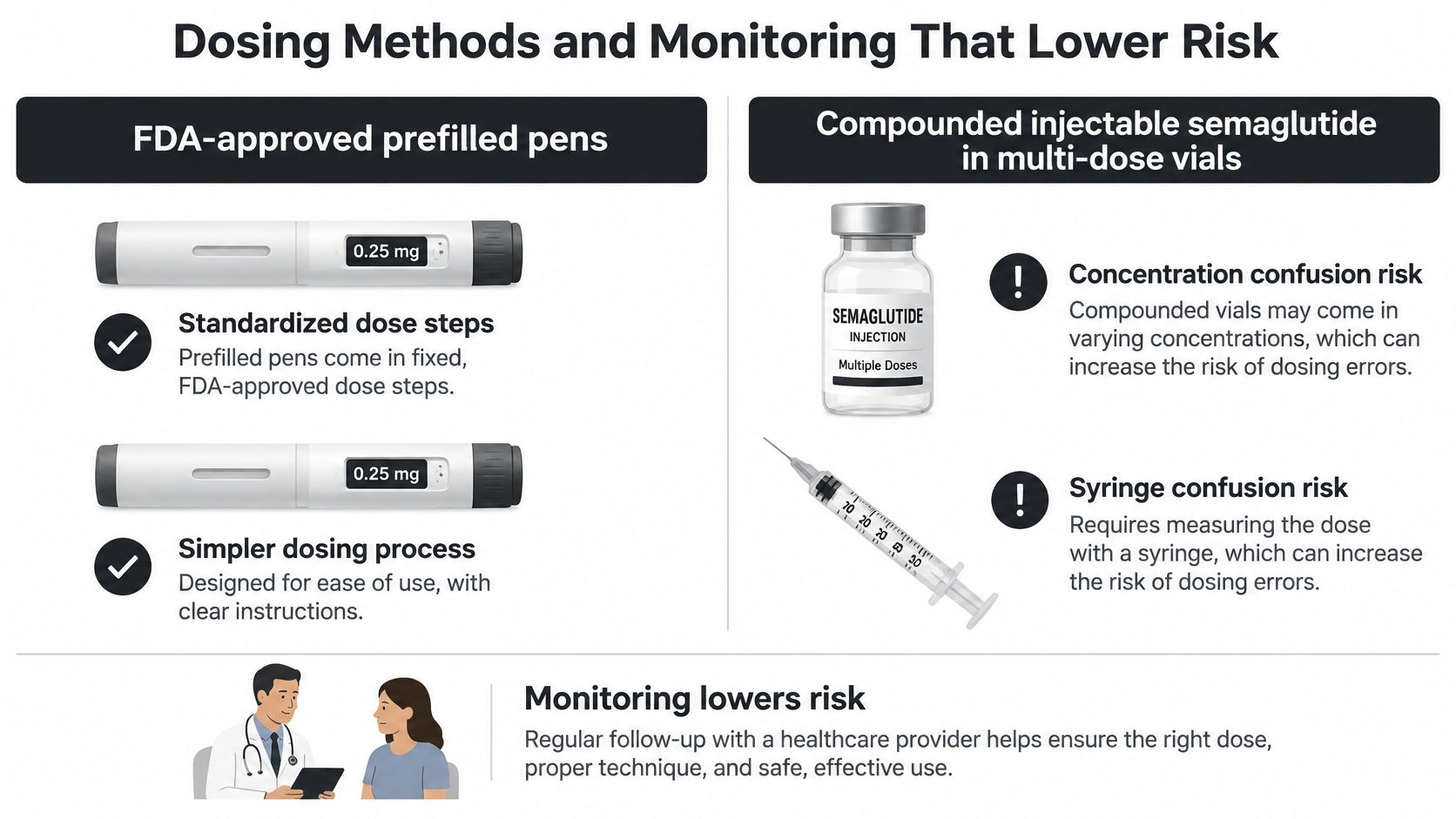
Dosing Methods and Monitoring That Lower Risk
Dosing setups compared by main risk and safety check
| Product or Setup | Main Dosing Risk | Safety Check |
|---|---|---|
| FDA-approved prefilled pen, such as Wegovy or Ozempic | Misreading the prescribed dose or escalation schedule | Confirm the specific device, dose, and schedule through demonstration |
| Compounded injectable semaglutide in a multi-dose vial | Confusing concentration, volume, and syringe markings | Obtain written concentration and injection instructions using the actual syringe |
| Compounded product from an unfamiliar source | Unclear labeling or an unverifiable supply chain | Verify pharmacy licensing and product details before use |
The product matters because a milligram dose isn't the same thing as a syringe marking. Prefilled pens reduce the need to calculate injection volume, while multi-dose vials require the patient to draw up the correct amount from a particular concentration.
The FDA alert on compounded semaglutide dosing errors describes patients administering five to 20 times the intended dose, with some requiring hospitalization for problems including severe vomiting, dehydration, fainting, pancreatitis, and gallstones. The same FDA resource records 605 adverse-event reports associated with compounded semaglutide as of July 31, 2025, but these reports aren't an incidence rate.
Reporting systems don't establish how many people used the products and may contain incomplete or duplicate information. They do, however, identify a practical hazard that deserves a specific prevention plan.
Make the instructions usable at home
-
Identify the product. Confirm whether you're receiving an FDA-approved pen or a compounded preparation. Don't assume a familiar medicine name establishes what's inside the package.
-
Get the measurement in writing. For a vial, the instructions should specify the prescribed dose in milligrams, the concentration, the volume to inject, and the corresponding markings on your supplied syringe. Never reuse another person's conversion.
-
Demonstrate the injection. With teach-back, you show the pharmacist or clinician exactly how you'll prepare and administer it. If the concentration or syringe changes, repeat that demonstration.
-
Write down your fluid-loss plan. Include what to drink, any fluid restrictions, and whom to contact if drinking becomes difficult.
-
Clarify laboratory monitoring. Ask whether you need baseline or repeat kidney-function tests and what symptoms should trigger earlier testing. Vital iQ Health's guide to understanding abnormal blood panel results can help you prepare questions, but your clinician must interpret results in context.
-
Follow the prescribed escalation schedule. Don't increase early because appetite returns or weight loss slows. Use a semaglutide titration schedule guide to understand the process, then follow your own written prescription.
Keep a symptom log that supports decisions
Record the product, dose, injection date, digestive symptoms, ability to drink, and any noticeable change in urination. Include glucose readings if your diabetes care plan calls for them.
If you think you've injected too much, contact your clinician or poison control immediately rather than waiting to see how you feel. Keep the vial or pen, packaging, and syringe available so they can identify the likely amount.
Questions to Ask Your Provider Before Starting
A useful consultation ends with instructions you can explain back in your own words. You shouldn't have to reconstruct the dose from a marketing page or decide alone whether a symptom is urgent.
When you compare medical weight loss clinics, ProMD Health Bel Air's overview can help you organize questions about supervision and follow-up. Alongside cost and convenience, assess how clearly each clinic explains its product, monitoring, and access to clinical advice.
Bring this checklist to the appointment
-
Do any of my conditions or family history match a contraindication?
Ask specifically about medullary thyroid carcinoma and inherited endocrine conditions. If a relative's diagnosis is unclear, ask what information the clinician needs before prescribing. -
Is this an FDA-approved product or a compounded preparation?
Get the product name and dispensing pharmacy. For a compounded product, ask who licenses the pharmacy and how you can verify its details. -
What is my starting dose, and when should it increase?
Request written instructions and demonstrate the injection using the device or syringe you'll receive. Ask what happens if symptoms make the next increase unsuitable. -
Which current medicines need review?
Bring prescription drugs, over-the-counter products, and supplements. Insulin and sulfonylureas deserve particular attention because combining them with semaglutide can increase low-blood-sugar risk; diuretics also belong in the review. -
What is my written plan for vomiting or diarrhea?
Ask how to replace fluids within your medical restrictions and what to do about an upcoming dose. The answer should fit your health conditions. -
When will kidney function be checked?
Clarify whether testing is needed before treatment, during escalation, or after concerning symptoms. Ask who reviews results and contacts you. -
Who answers after hours, and which symptoms mean emergency care?
Save the contact route in your phone. Confirm that you understand when not to wait for a reply.
Clear answers are part of informed consent
A clinician may need to check records or consult your pharmacist before answering. That's different from leaving you with vague directions or an unexplained dose.
Pause if the product, measurement, or follow-up plan remains unclear. Bring this checklist to your consultation, write down each answer, and confirm every item before your first dose.
Weight Method offers medically supervised telehealth weight-loss care with licensed-provider consultations, ongoing messaging, and monitored dose adjustments. Visit Weight Method to discuss whether GLP-1 treatment fits your medical history and what a personalized dosing and safety-monitoring plan would involve.