In 2025, 43% of surveyed U.S. adults reported going to bed earlier as a measure to improve their sleep routine, according to U.S. News & World Report's survey of 2,000 consumers. Going to bed earlier can help, but it doesn't tell you whether you fell asleep faster, stayed asleep, or woke restored. For adults on medical weight loss treatment, that distinction matters because meal timing, medication side effects, and breathing during sleep can pull in different directions. Sleep quality improvement starts when you treat sleep as a measured outcome, not a vague goal.
Baseline Sleep Numbers to Record First
Start with numbers, not advice. Keep a sleep diary for one to two weeks and write down bedtime, lights out time, estimated minutes to fall asleep, awakenings, final wake time, naps, and total sleep. Do it each morning while the night is fresh, using estimates rather than clock watching at 2 a.m.
The U.S. Centers for Disease Control and Prevention reported in CDC data for 2024 that 30.5% of adults slept fewer than 7 hours on average during a 24 hour period, while only 54.8% said they woke feeling well rested most days or every day. That gap is the lesson. Someone can log seven hours and still wake unrefreshed, so hours alone don't describe quality.
Five Values to Calculate
Average each value across the baseline period so one bad night, a late flight, or a Sunday lie in doesn't set the picture. If you want a structured way to score the pattern before you change anything, the Gates Home Furnishings sleep assessment guide can help you organize what you're noticing alongside your diary.
| Metric | How to measure | Reference point |
|---|---|---|
| Total sleep time | Average of diary entries across 1 to 2 weeks | 7 or more hours for most adults |
| Sleep onset latency | Minutes from lights out to sleep | Brief and consistent, trending down from your baseline |
| Wake after sleep onset | Total minutes awake during the night | Brief awakenings only, trending down from your baseline |
| Sleep efficiency | Total sleep time divided by time in bed, times 100 | At least 85% |
| Feeling rested | Days per week you wake feeling rested | Most days |
Work the efficiency math once so it stops feeling abstract. Say you're in bed for 8 hours, or 480 minutes, but sleep 6 hours, or 360 minutes. That's 360 divided by 480, times 100, which equals 75% sleep efficiency. You're not short on opportunity, you're spending two hours awake in bed.
Circle the one metric furthest from its reference point. That metric, not a generic tip list, decides your first change.
A long onset latency points toward your evening routine and what happens when you can't sleep. Low efficiency points toward too much time in bed for the sleep you're getting. Low total sleep with good efficiency points toward a schedule problem, because you're sleeping solidly but not long enough.
Medical Red Flags and When to Get Professional Care
It's common to assume poor sleep always means insomnia. That assumption can delay care, because loud snoring, breathing pauses, restless legs, depression, and medication effects aren't fixed by a better bedtime routine. Behavioral steps are useful, but they shouldn't become a reason to wait months while another condition goes unchecked.
Sleep apnea deserves special attention if you have overweight or obesity. The airway narrows or closes during sleep, oxygen dips, and your brain briefly wakes you to breathe, sometimes without you remembering it. You can spend eight hours in bed and still wake with a headache, dry mouth, and heavy daytime sleepiness. If that pattern sounds familiar, read about weight loss treatment in the context of sleep apnea and bring specific questions to a clinician rather than trying to self diagnose.
Warning Signs That Change the Plan
| Warning sign | Why it matters | Next step |
|---|---|---|
| Loud or persistent snoring | Can indicate sleep disordered breathing such as sleep apnea | Ask a clinician about a sleep evaluation |
| Witnessed breathing pauses | Points to a possible apnea that behavioral changes will not fix | Book a clinical evaluation soon |
| Urge to move legs at night | A separate disorder, not ordinary insomnia | Clinician review |
| Persistent low mood or hopelessness | Depression commonly disrupts sleep | Talk with a clinician promptly |
| Sleep trouble after a new medication | Medication effects can change sleep | Contact the prescriber before changing any dose |
| No improvement after 4 to 6 weeks | Suggests the cause needs assessment | Return to a clinician with your diary |
A partner's report counts as data here. If someone has watched you stop breathing, gasp, or choke in your sleep, write down when it happens and how often they notice it. If a clinician recommends testing, learning how to prepare for a sleep study beforehand can make the night less unfamiliar and help you give the clinic a cleaner picture of your usual routine.
Don't adjust a prescription because you suspect it's disturbing sleep. Note the timing instead, such as nausea after a dose increase, reflux on certain evenings, or new vivid dreams, and show that pattern to the prescriber. Timing often gives a clinician more to work with than a general statement that sleep got worse.
Two situations need immediate help, not a self help plan. If you're drowsy while driving, pull over somewhere safe and don't push through. If you have thoughts of harming yourself, contact emergency help or a crisis line right away.
Daily Routine Steps That Set the Foundation
Regularity comes before supplements, apps, or a new pillow. Your body clock learns from repeated timing, especially wake time, light, meals, and activity. The steps below work in order, and each one has a common slip that undermines it.
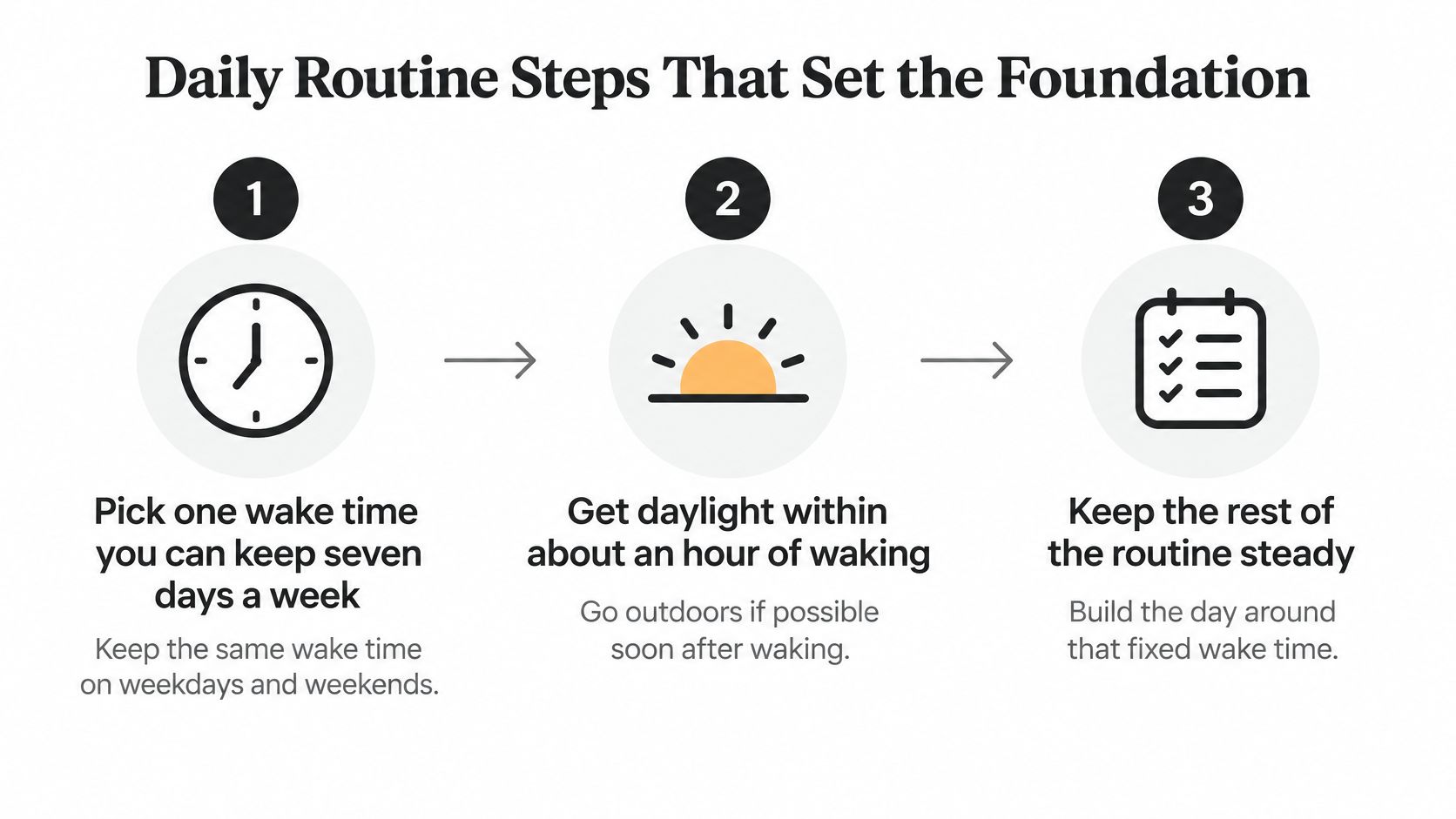
- Pick one wake time you can keep seven days a week. Choose something realistic for weekends, not just workdays. Sleeping in on Saturday feels like recovery, but it shifts your clock and makes Sunday night onset harder.
- Get daylight within about an hour of waking. Go outdoors if you can, even briefly with coffee or a walk to the mailbox. Morning light anchors the body clock so sleepiness arrives at a more predictable time that night.
- Move during the day. Regular activity builds sleep pressure and helps separate day from night. If vigorous late workouts leave you wired, move those sessions earlier and keep evenings gentler.
- Set cutoffs for caffeine and alcohol. Stop caffeine in early afternoon, and stop alcohol several hours before bed. Alcohol can make you drowsy at first, then fragment the second half of the night.
- Skip naps, or keep them short and early. A long late nap spends the sleep pressure you need at night. If you must nap, keep it before mid afternoon and set an alarm.
- Make the bedroom cool, dark, and quiet. Dim lights in the last hour, charge your phone outside arm's reach if scrolling keeps you up, and use the bed mainly for sleep. Small comfort changes count here, and practical ideas to improve your bedtime routine can help you make the wind down repeatable instead of improvised.
- Check sleep efficiency once a week. Compare it with your baseline rather than reacting to a single night. Weekly checks show whether the routine is consolidating sleep or just changing bedtime.
This foundation matters because clinical guidance summarized by the National Library of Medicine identifies CBT-I as first line treatment for chronic insomnia, while sleep hygiene works best as a supporting component rather than a standalone intervention. In other words, a dark room helps, but it doesn't replace fixing timing and time in bed.
What Two Weeks Should Show
After two consistent weeks, look for a steadier time of falling asleep, fewer unplanned naps, and diary entries that vary less from night to night. You may not sleep longer yet, and that's fine. Cleaner data and a stable wake time make the next adjustments possible, including for people who are also thinking about losing weight without a heavy exercise focus and need daytime activity that fits their current capacity.
CBT-I Techniques You Can Run at Home
Sleep restriction causes the most confusion, so start there. It doesn't mean forcing yourself to sleep less forever. It means trimming time in bed so it matches the sleep you're getting, then expanding it gradually only when sleep becomes more solid.
Say your diary shows 6 hours of sleep inside 8.5 hours in bed. Going to bed earlier usually adds more awake time, more frustration, and a weaker link between bed and sleep. A restriction approach keeps your fixed wake time, sets a later bedtime based on your actual sleep, and widens the window in small steps as efficiency rises. That's counterintuitive, which is why diary data has to drive it.
Cognitive behavioral therapy for insomnia, or CBT-I, is typically delivered over 4 to 8 sessions and produces approximately a 50% average reduction in insomnia symptoms, with treatment effects maintained for as long as 24 months in follow up studies, according to an evidence review published in PMC. The same review summarizes a meta analysis in the American Academy of Sleep Medicine evidence review that found remission rates 33% higher than control conditions, with a 95% confidence interval of 28% to 39%.
Core Techniques Side by Side
| Technique | Core rule | Common failure |
|---|---|---|
| Stimulus control | Leave bed when unable to sleep; return only when sleepy | Staying in bed awake and watching the clock |
| Sleep restriction | Limit time in bed to match current sleep, then expand gradually | Forcing an early bedtime without diary data |
| Cognitive restructuring | Replace beliefs such as needing exactly 8 hours with realistic expectations | Treating one bad night as a catastrophe |
| Relaxation training | Brief breathing or muscle relaxation before bed | Using it as a substitute for fixing the schedule |
Stimulus control rebuilds the bed as a cue for sleep. Go to bed when you're sleepy, not just tired from the day. If you're awake and alert in bed, get up, go somewhere dim, do something quiet, and return when sleepiness builds again.
People often break this rule by staying in bed to rest, checking the time, or scrolling until they drift off. That teaches your brain that bed is a place for worrying and waiting. Getting up feels worse for ten minutes and better across two weeks.
Cognitive restructuring targets the thoughts that spike arousal at night. A belief like "If I don't get exactly eight hours, tomorrow is ruined" turns one short night into pressure to perform sleep. Replace it with something accurate and calmer, such as "I've functioned after short nights before, and one night doesn't set the trend." Write the replacement down during the day, because 3 a.m. isn't when you'll invent it.
Relaxation training is the supporting piece. Slow breathing, progressive muscle release, or a brief body scan can lower physical tension before bed. It works best when your schedule and time in bed are already addressed, not as a way to force sleep inside a broken routine.
Expect a rough first phase with sleep restriction. Early daytime sleepiness, irritability, fatigue, and reduced concentration are common, and they generally improve by treatment completion.
Don't run restriction aggressively if you have warning signs, severe daytime sleepiness, or a job where drowsiness creates danger. Get clinical guidance first. Also keep the hygiene caveat in view, because the AASM conditionally recommends against sleep hygiene as a single component intervention. Use comfortable surroundings and caffeine limits as support, not as the whole treatment.
How Weight, Diet and Exercise Shape Your Sleep
Meal timing is often the first lever for adults on medical weight loss treatment. A large meal close to bed keeps digestion active while you're lying flat, which can worsen reflux and trigger awakenings. If medication slows digestion or causes nausea, that effect can feel stronger, so finishing your last substantial meal two to three hours before bed is a practical place to start.

Portion and composition come next. Large, high fat, or spicy evening meals are common reflux triggers, and heavy alcohol use fragments sleep later in the night. A steadier pattern is protein and fiber earlier in the day, a moderate evening meal, and a small snack only if genuine hunger would otherwise keep you awake.
A Typical Pattern to Test
Say someone notices reflux and broken sleep during early dose increases. They move dinner earlier, reduce the evening portion, raise the head of the bed slightly, and log awakenings each morning. Within two weeks the diary shows fewer wake ups on early dinner nights, which gives them and their prescriber a clear pattern to discuss. The medication dose isn't changed on guesswork, and the sleep change is visible in the numbers.
Exercise supports sleep through a different route. Regular moderate activity, such as brisk walking, cycling, or resistance training, helps most adults sleep more soundly and feel more alert during the day. Timing is individual, so if late vigorous sessions leave you alert for hours, shift them earlier and compare onset latency across the week. Activity also connects with broader metabolic health, which is why readers often pair sleep work with learning how to improve metabolic rate through daily movement and muscle preserving habits.
Weight change can ease some airway related sleep problems over time, but don't assume snoring will resolve on its own. Keep logging snoring reports, witnessed pauses, morning headaches, and awakenings as your weight changes. Improving numbers are encouraging, while persistent pauses still need evaluation.
Try adjustments in this order:
- First, move the last substantial meal earlier if reflux, nausea, or fullness shows up at night.
- Next, shrink and simplify the evening meal on nights when symptoms are worst, and compare awakenings.
- Then, move vigorous exercise earlier only if your diary shows delayed sleep onset after late sessions.
Tracking Progress Without Guesswork
A diary is the default tool because it captures what behavioral treatment changes. It shows bedtime, time to fall asleep, awakenings, wake time, naps, and how rested you feel. Wearables and questionnaires can add context, but they don't replace those entries.
| Method | What it measures | Main limit |
|---|---|---|
| Paper or app sleep diary | Bedtime, lights off, awakenings, wake time and naps | Accuracy depends on daily entries |
| Wearable tracker | Estimated sleep duration and stages | Estimates; can mislabel quiet wake time as sleep |
| Insomnia Severity Index | Self rated severity score over recent weeks | Snapshot only; no nightly detail |
| Clinician review | Symptoms, medication effects and response to treatment | Periodic, so bring your own diary |
A wearable can be useful for spotting schedule drift, such as bedtimes creeping later across a workweek. Don't treat its sleep stage percentages as a diagnosis. If you lie still while awake and worried, a device may score that time as light sleep, which can hide the exact problem stimulus control is meant to fix.
The Insomnia Severity Index gives you a severity score across recent weeks rather than night by night detail. In a 2024 sleep app trial published by JMIR Formative Research, among 101 participants, the intervention group's Insomnia Severity Index score improved by a mean of 2.5 points over time, compared with 1.6 points in the control group. Read that as evidence that change can be measured, not as a promised result for any one person.
A Simple Tracking Rhythm
- Nightly: Complete the diary each morning in under two minutes.
- Weekly: Calculate average total sleep time and sleep efficiency.
- Monthly: Repeat the Insomnia Severity Index and note how often you woke feeling rested.
Judge the plan by the trend across weeks. One excellent night after exhaustion doesn't prove the routine works, and one poor night during travel doesn't prove it failed. You're looking for efficiency rising, onset becoming more predictable, and rested mornings becoming more frequent.
Confirm the Right Next Step Before You Act
Use your baseline to choose, not your mood after a single bad night. These four decision rules connect your efficiency, warning signs, and treatment context into one next step.
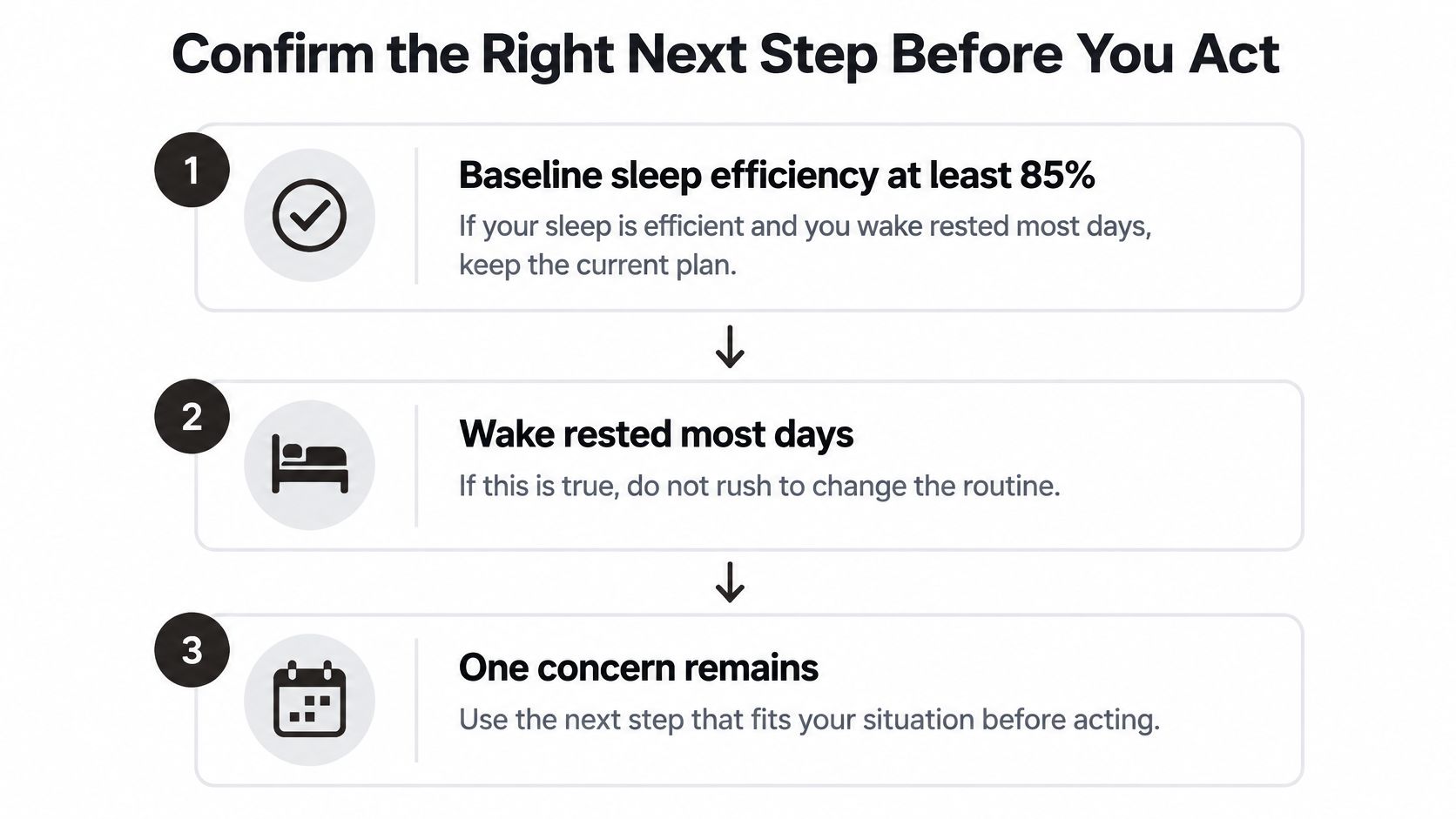
Decision 1, keep and monitor. If your sleep efficiency is at least 85%, you wake rested most days, and no warning signs appear, keep the routine and recheck monthly. Don't add new rules to a system that's already working.
Decision 2, start structured CBT-I. If efficiency stays below reference after four to six weeks of a consistent routine, begin structured CBT-I with a clinician or a structured program. Bring your diary, because your baseline total sleep time is the starting data for adjusting time in bed.
Decision 3, get evaluated first. If any warning sign appears, such as witnessed breathing pauses, an urge to move your legs at night, persistent low mood, or sleep trouble that began after a new medication, book a clinical evaluation before changing anything else. Behavioral steps can sit alongside care, but they shouldn't delay diagnosis.
Decision 4, review sleep and dose together. If you're on GLP-1 treatment for weight loss, bring your diary to your prescriber so dose changes and sleep changes are reviewed together, and never adjust a dose alone. With Weight Method, patients can expect gradual dose escalation over 8 to 16 weeks and regular provider check ins, which gives you scheduled points to raise nausea, reflux, meal timing, and sleep data in the same conversation.
Compare Against Your Own Baseline
Starting BMI, adherence to the prescribed schedule, diet, physical activity, and individual metabolism all influence response. Results may vary depending on individual adherence, provider guidance, and lifestyle changes, so no single timeline is promised. Your weekly averages are a fairer comparison than another person's progress story.
Finish with three concrete actions:
- Fill in the baseline for the next seven mornings, even if the estimates feel rough.
- Choose one routine change for this week, matched to the metric furthest from its reference point.
- Set the next review date now, and decide in advance which number will tell you whether to continue, start CBT-I, or seek evaluation.
If broken sleep is making weight loss harder to sustain, Weight Method offers medically supervised GLP-1 care by telehealth, with a licensed provider who builds your plan, reviews your response at regular check ins, and adjusts dosing gradually over time. Bring your sleep diary to that conversation so meal timing, side effects, snoring, and rested mornings are reviewed alongside your weight trend. Visit Weight Method to take the brief assessment and see whether treatment fits your health profile.