A large telehealth obesity-clinic analysis reported 19.4% average weight reduction at twelve months, according to FDA prescribing information summarizing the cohort. Fewer than one in six of those who started, though, still had a recorded weight at that point.
That attrition reframes the question. An average describes only the patients still being measured, and since the FDA resolved the semaglutide shortage in February 2025, the sharper tests sit elsewhere: whether a program keeps patients on treatment safely, how fast it responds when side effects or supply problems surface, and whether the dispensed medication traces to an approved product rather than a compounded fallback.
Program design determines whether remote care delivers. Dosing decisions, pharmacy sourcing, and scheduled follow-up carry more weight than the channel a visit happens through.
What Telehealth Weight Loss Means
Telehealth weight loss describes a delivery channel, a way of getting clinical assessment, prescribing where appropriate, and follow-up into a patient's home rather than a single diet, drug, or standardized program. The care itself can involve medication, behavioral support, or both. A 2021 review of telemedicine obesity interventions found that remote programs can produce meaningful weight reduction, but outcomes varied widely depending on how each program was built and how consistently patients stayed engaged.
That design-dependence is what separates this category from adjacent products. A wellness app offering general tracking or coaching without prescribing is not the same service. Neither is a med-spa whose model may not include longitudinal medical management. Legitimate remote care involves a licensed clinician reviewing a patient's health information and making individualized decisions, then remaining reachable as treatment progresses.
An online seller shipping medication after a perfunctory questionnaire does not meet that standard.
The sharper question is whether a clinician takes ownership of the same decisions that would matter in a physical clinic. Is the medication appropriate for this patient's history? How is response assessed between visits? What happens when side effects appear, a dose needs adjusting, or supply is interrupted? Since the February 2025 resolution of the semaglutide shortage, the provenance question sits inside that assessment too, because the difference between an approved product and a compounded fallback is now a marker of program quality rather than a necessity.
Five decisions shape the experience
Keep these questions in view when comparing programs:
- Medication pathway: Is treatment built around medication, behavioral support, or a combination, and has a clinician assessed fit against your health history?
- Provider access: Who evaluates you, and how do you reach them after the initial appointment?
- Pharmacy source: Is the product FDA-approved or compounded, and can the service explain where it comes from?
- Cost structure: Are consultation, program, and medication costs clearly separated?
- Safety process: Does a provider review symptoms and authorize dose changes, or do refills run automatically?
For broader context on nonprescription products, compare weight options while keeping clear that supplements and lifestyle products are not equivalent to clinician-managed prescription care. The useful comparison is whether the care pathway gives a patient access to a qualified clinician, dependable follow-up, and a medication source the program can account for.
How GLP-1 Medications Changed Remote Obesity Care
Telehealth existed as a way to deliver obesity care before semaglutide became a major weight-management treatment. But the FDA's June 2021 approval of Wegovy for eligible adults helped alter what remote programs could offer: a clinician could assess a patient virtually, prescribe an evidence-based medication when appropriate, and arrange ongoing monitoring without requiring every interaction to take place in person. (FDA approval announcement and STEP 1 results)
In the 68-week STEP 1 trial, participants receiving semaglutide lost an average of 14.9% of their initial body weight, compared with 2.4% among participants receiving placebo. At least 5% of baseline weight was lost by 83.5% of semaglutide-treated participants, versus 31.1% of those receiving placebo. Those are trial results, not a promise of what any individual will lose through a telehealth service.
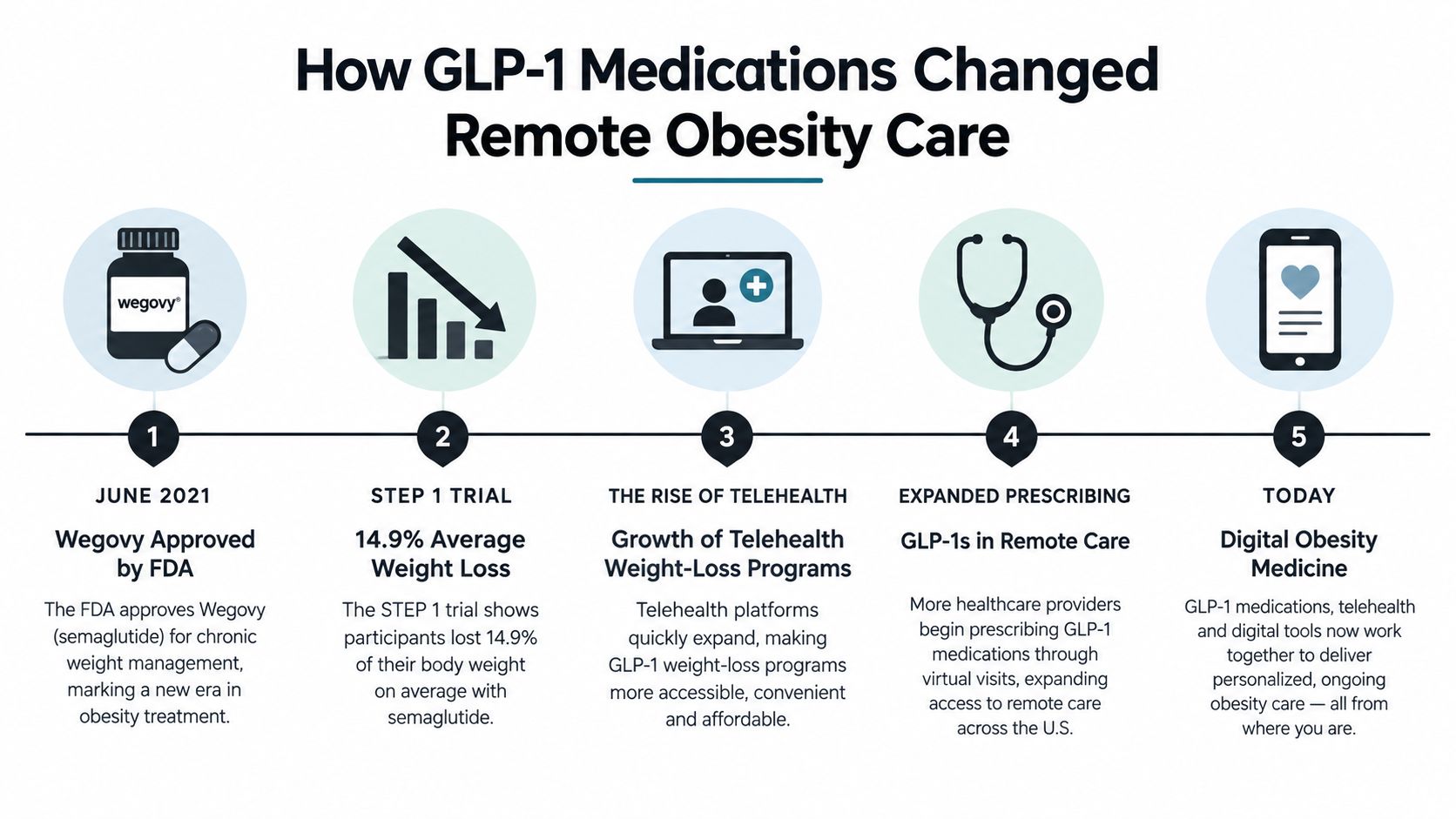
The distinction is important: the medication produces the pharmacological effect; telehealth supplies the care infrastructure. That infrastructure can include screening for eligibility, explaining risks and alternatives, monitoring symptoms during dose escalation, supporting adherence, and coordinating refills. A platform that processes a questionnaire and sends medication skips much of the work that makes prescribing safe.
How to read a marketing claim: Ask whether the result comes from a controlled medication trial or from patients using a particular telehealth service. Those settings answer different questions.
Trial outcomes help establish what a medication did in a defined study. They don't tell a patient exactly how they'll respond, whether they'll tolerate treatment, or whether their program will provide enough support to stay on it. For practical food-planning ideas that may complement a clinician's treatment plan, see Gym Snack GLP-1 satiety tips. Nutrition advice can support care, but it doesn't replace individualized medical guidance.
Inside a Typical Telehealth Weight-Loss Program
A credible program should feel like clinical care conducted remotely, not like an automated subscription box. The online interface may make enrollment easier, but the provider still needs to assess the patient, decide whether treatment is appropriate, and remain involved as care continues.
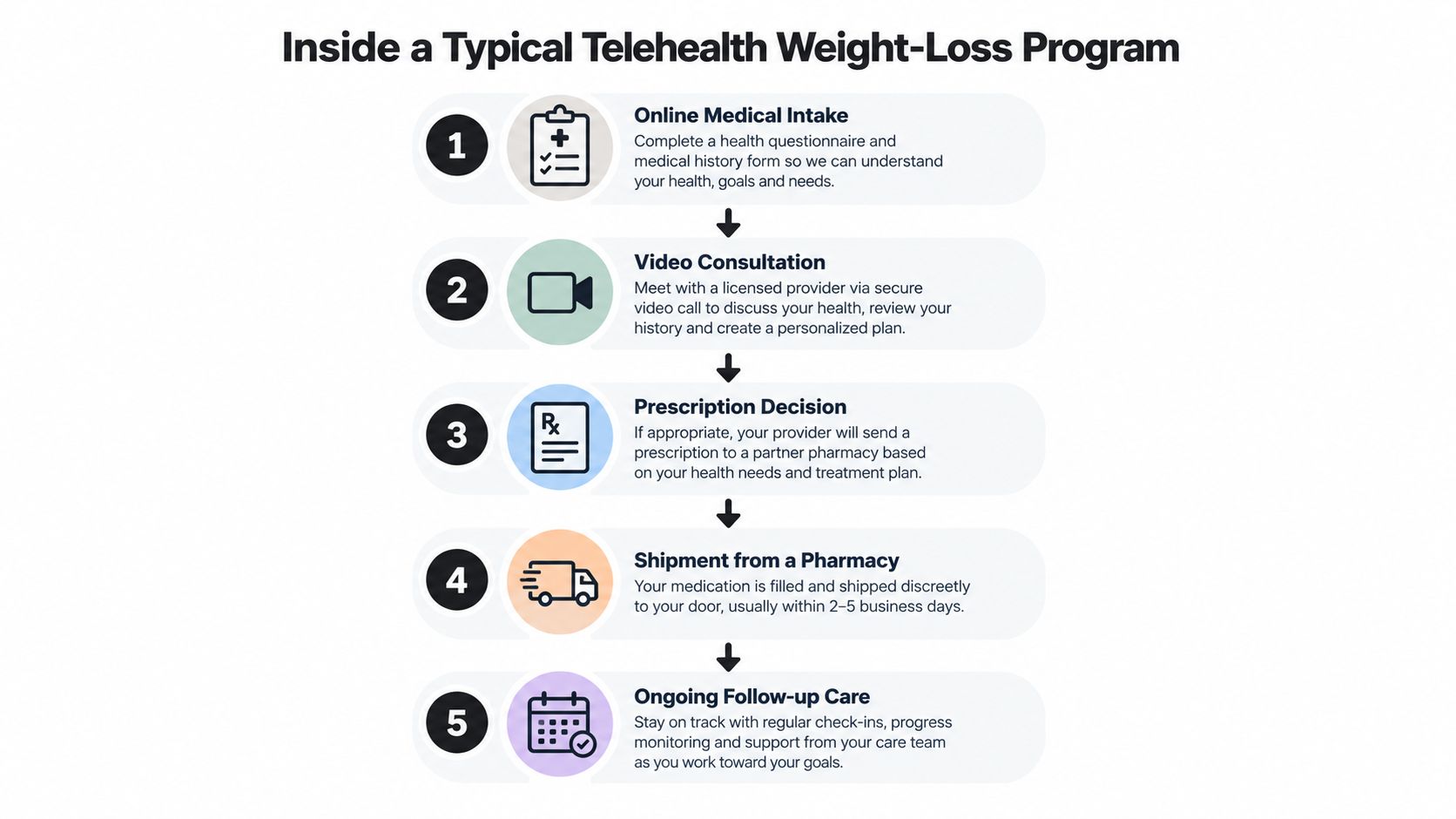
From intake to a prescribing decision
First comes the medical intake. A patient supplies health history and information about current medications and relevant health concerns. A clinician should review that information rather than treating completion of the form as automatic approval.
Next, the patient meets with a licensed provider for a virtual assessment. The provider determines whether a prescription is appropriate and discusses the treatment plan. A real-world example of this general flow is Weight Method's brief online quiz, video visit with a licensed provider, and ongoing monitoring. These steps describe a service's process, not a guarantee that any particular medication will be prescribed.
If the provider prescribes medication, the pharmacy fulfills it. Patients should know whether the product is FDA-approved or compounded, which pharmacy dispenses it, and whom to contact about questions or delays. Home delivery can remove a trip to the pharmacy, but it doesn't remove the need to verify the product and coordinate care.
Dose changes need a clinician's oversight
For Wegovy, the FDA prescribing information starts at 0.25 mg once weekly and increases at four-week intervals through 0.5 mg, 1.0 mg, 1.7 mg, and 2.4 mg. This gradual schedule allows tolerability to be assessed before moving to a higher dose. (FDA Wegovy prescribing information)
A clinician should review symptoms and treatment progress before approving each increase. If a patient is struggling with side effects, the provider should be able to pause or adjust the plan rather than advancing automatically because a new billing period has begun.
Follow-up may happen through video visits, secure messaging, or symptom check-ins. The key is not whether every contact is a video appointment. It's whether the patient can get timely clinical review when a concern arises, and whether dose decisions remain in the clinician's hands.
What the Clinical Evidence Actually Shows
Telehealth weight-loss evidence arrives in layers, and each layer answers a different question. Remote lifestyle studies ask whether care delivered by video or messaging can change weight-related behavior. Drug trials ask what a specific molecule does under controlled conditions. Real-world clinic analyses ask what happened to patients who enrolled, paid, and stayed.
A 2021 review of telemedicine interventions for obesity found statistically significant weight reductions in 60% of included studies, and every reviewed study reported improvement in diet and physical activity, as noted in the section on what telehealth weight loss means. That pattern supports remote delivery as a workable channel. It says nothing about whether any single program produces a predictable result.
Evidence layers behind telehealth weight-loss claims
| Evidence layer | Setting | Reported average result | Key caveat |
|---|---|---|---|
| Telemedicine lifestyle interventions | Review of obesity-care studies | 60% of included studies found statistically significant weight reduction | Programs and outcomes varied widely |
| Wegovy trial evidence | Controlled STEP 1 trial | 14.9% average initial body-weight loss with semaglutide, compared with 2.4% with placebo | A trial average is not a guaranteed individual outcome |
| Telehealth clinic analysis | Retrospective real-world cohort | 8.9% at three months, 14.1% at six months, 17.7% at nine months (twelve-month figure and attrition counts: see introduction) | Results describe patients still measured at each interval |
The trajectory matters more than the endpoint. Loss of 8.9% at three months and 14.1% at six months shows the cohort was still improving well after initiation, which argues for follow-up intensity rather than a single weigh-in headline. At the same time, the twelve-month average describes only the smaller group still being measured then, not everyone who started. Patients who stopped treatment, lost access, or skipped weigh-ins drop out of the observed pool, so completer averages can flatter the program. The FDA prescribing information summarizes this cohort analysis and its measurement limits.
Read the persistence signal alongside the provenance question. The FDA resolved the semaglutide shortage in February 2025, which ended the circumstances under which compounded versions were broadly permitted. A real-world cohort built during the shortage period may include products and sourcing arrangements that no longer apply, so historical averages deserve scrutiny on that basis as well.
A provider dashboard worth trusting would report outcomes for the full enrolled group and for follow-up completers separately, track treatment continuation and dose achieved, and name whether dispensed products were FDA-approved or compounded. Those three disclosures, persistence, contact cadence, and product origin, separate an honest evidence claim from a favorable one.
Real Risks Beyond the Headline Weight Loss
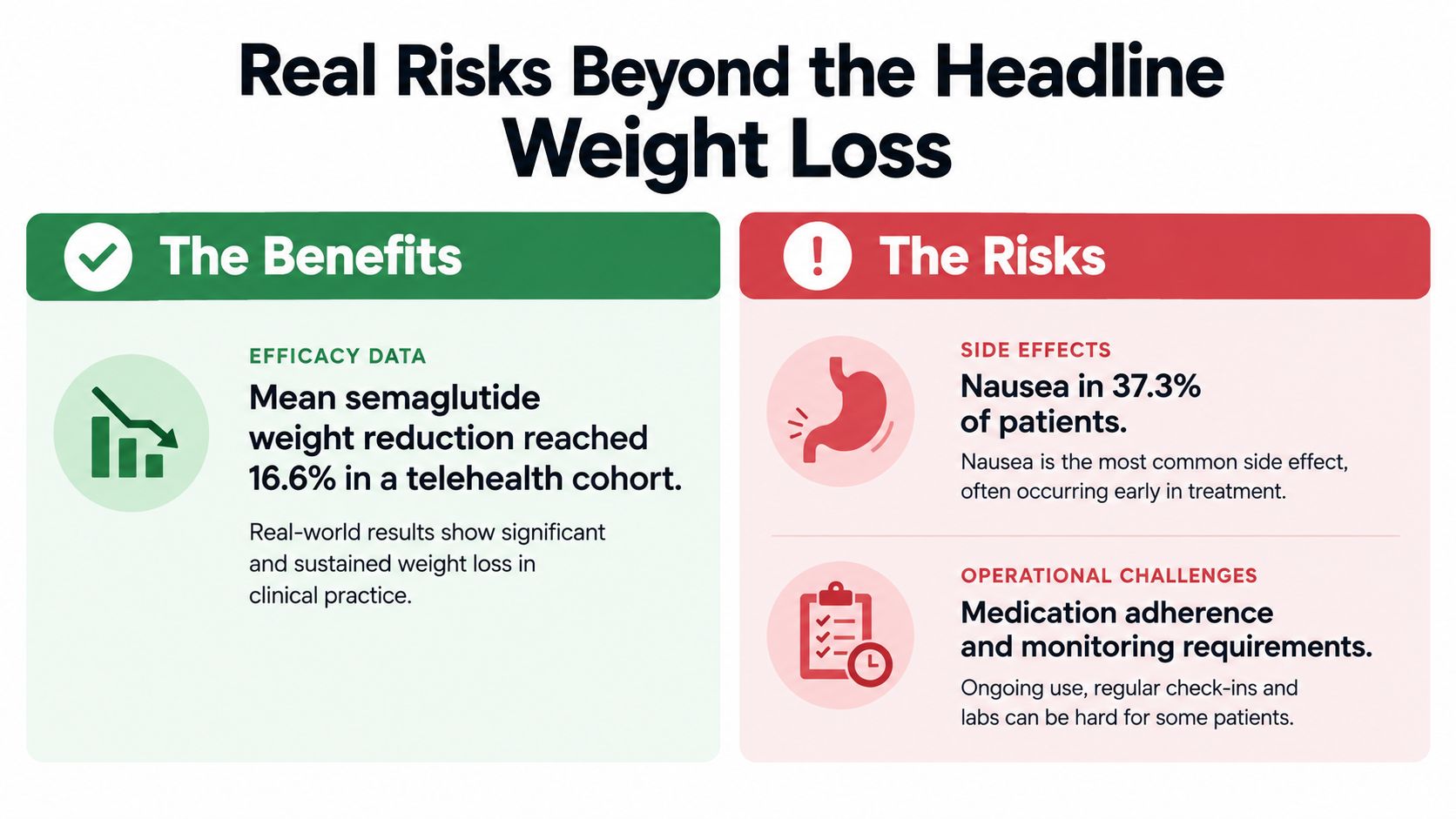
A patient who loses 15% of body weight but spends three weeks vomiting through dose escalations has not had a good outcome. Tolerability during titration, clinical support between appointments, and a working channel for reporting symptoms all determine whether a headline figure describes a treatment the person could stay on.
In a large telehealth cohort, mean semaglutide-associated weight reduction reached 16.6%. The same cohort reported nausea or vomiting in 37.3% of patients and constipation in 15.6%, while observing no new safety signals. (Telehealth cohort and primary-care survey) Roughly two in five patients dealt with gastrointestinal symptoms alongside that loss, which is the part of the result a marketing page rarely quotes.
The same NEBGH report records a gap in clinician confidence: in a 2025 primary-care survey, 18% of respondents were comfortable with patients using third-party telehealth providers for weight-loss GLP-1 prescriptions, while 67% believed such prescribing could put patient health at risk. Survey responses register opinion, not proof that remote prescribing is unsafe. They do show where skepticism concentrates: follow-up quality and pharmacy sourcing.
What responsive monitoring looks like
A patient should be able to report symptoms and receive a clinical response rather than a customer-service reply. Persistent or severe symptoms, trouble keeping fluids down, signs of dehydration, or concerning abdominal pain warrant prompt contact with a clinician; urgent or severe symptoms may require in-person or emergency evaluation. Ask for the escalation pathway in writing before the first prescription ships.
Practical rule: A dose increase is a clinical decision. If a program advances the dose automatically without checking tolerability, ask how a clinician reviews symptoms and how you can pause escalation.
Follow-up quality is also tested when a patient misses doses or a medication becomes unavailable. Before starting, ask whom to contact, how quickly a clinician reviews clinical concerns, and how the program manages a safe restart after an interruption. For a closer look at symptoms and their management, see this guide to GLP-1 weight-loss side effects.
FDA-Approved Versus Compounded GLP-1 Medications
The product's source matters as much as the clinician's prescription. In February 2025, the FDA determined that the U.S. semaglutide injection shortage was resolved and clarified tighter limits on compounded versions. The agency also states that compounded drugs aren't FDA-approved and aren't reviewed by the FDA for safety, effectiveness, or quality before marketing. (FDA clarification on compounded GLP-1 drugs after shortage resolution)
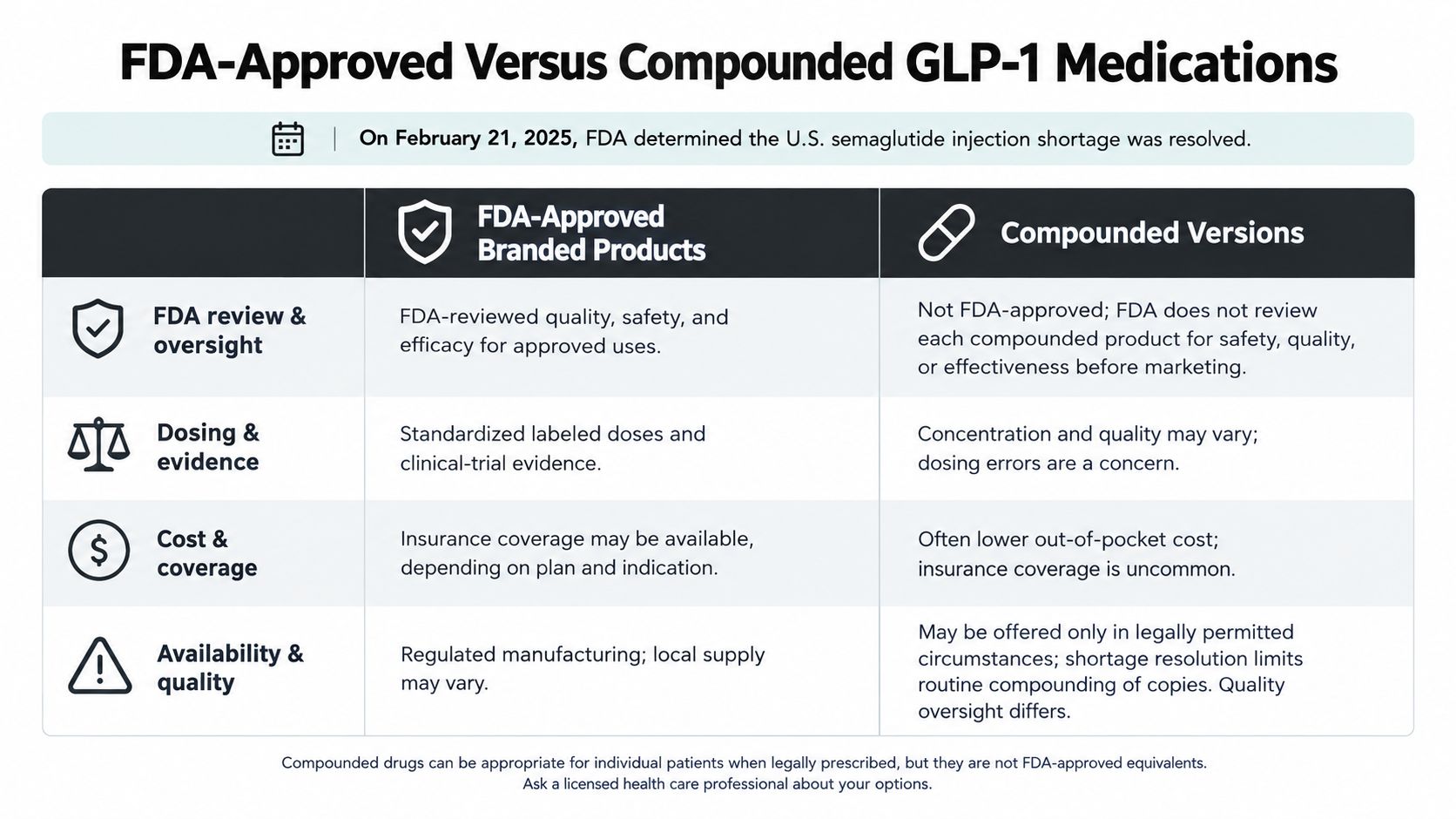
Compounding pharmacies prepare medications for specific patient needs, but a compounded product isn't the same as an FDA-approved branded medicine. During a shortage, compounded versions became an alternative for some patients. After the shortage determination, patients and clinicians have a stronger reason to check whether a dispensed product is approved or compounded instead of assuming that every semaglutide or tirzepatide prescription comes from the same regulated product pathway.
Verify the product before using it
Ask the pharmacy and clinician direct questions:
- What product is this? Confirm whether it's an FDA-approved medication or a compounded preparation.
- Who dispenses it? Get the pharmacy's name and verify its status with the relevant state pharmacy regulator.
- What's on the label? Check the active ingredient and prescribed dose on the vial or pen, and ask the dispensing pharmacist to explain any uncertainty.
- What if supply changes? Ask the clinician how a pharmacy switch, missed doses, or a treatment interruption will be managed.
Don't independently restart at a higher dose or make a dose transition based on advice from an unverified seller. The prescriber should review the treatment history and direct the next step. Convenience only counts as good access when the patient and clinician can identify the product, confirm its source, and respond safely if supply changes. For more detail, see this comparison of compounded and brand-name GLP-1 medications.
How to Choose a Reputable Telehealth Provider
A provider's signup flow can look polished while leaving important clinical questions unanswered. Evaluate the care behind the interface: who makes decisions, how treatment is monitored, where medication comes from, and what you'll pay.
Questions to ask before enrolling
- Who evaluates me? Confirm that a licensed clinician reviews your medical information and that you can identify who is responsible for your care.
- How does the appointment work? Ask whether a video consultation is part of the assessment and what happens if the clinician needs more information before deciding about medication.
- How are dose changes approved? Look for scheduled symptom reviews and a process for holding or adjusting treatment if tolerability is poor.
- Where does medication come from? Request the dispensing pharmacy's name and ask whether the product is FDA-approved or compounded.
- What does the fee cover? Find out whether program charges, consultations, and medication are billed separately, and whether the service accepts FSA or HSA payments.
- Who responds between visits? Ask how to report side effects, how clinicians handle urgent concerns, and what to do if a prescription can't be filled.
Price transparency matters because a quoted membership fee may not include the medication. Weight Method lists pricing starting at $149 per month, an introductory $99 first-month promotion, FSA/HSA eligibility, and a first-month money-back guarantee. These are service-specific terms, so confirm current pricing and exactly what's included before enrolling. (Weight Method online-prescription guide)
Red flags include no meaningful clinical assessment, unclear pharmacy sourcing, no instructions for side effects, and no contingency plan for a missed dose or interrupted supply. Also ask how you can obtain your treatment records if you change providers. Clear answers let another clinician make safer decisions if care transitions.
Making the Right Choice for Your Situation
The safest choice isn't necessarily the program with the most convenient signup or the boldest weight-loss claim. It's the one that joins a real clinical assessment to verified medication sourcing and follow-up that still works when treatment becomes difficult.
Start by asking whether a licensed provider will review your health history and make an individualized decision. Then establish exactly what medication you may receive and how the pharmacy source will be confirmed. If the service can't explain the difference between an FDA-approved product and a compounded version, that's a meaningful gap in the care process.
Next, test the follow-up plan. Ask how clinicians review nausea, vomiting, constipation, or other concerns; who authorizes dose changes; and what happens if you miss doses or can't get a refill. A portal with messaging isn't enough by itself. Patients need a clear route to a clinical decision when symptoms or supply disrupt the plan.
Finally, read the pricing and guarantee terms in plain language. Confirm which services and medications are included, what may cost extra, and how to reach the provider or pharmacy. Those details affect whether you can sustain care, not just whether you can begin it.
For a busy adult considering evidence-based GLP-1 therapy, the central test is straightforward: choose a program that treats dose escalation as a clinical safety process, not a billing cycle. Safe persistence, responsive follow-up, and verified product provenance matter more than a headline average.
Weight Method offers online intake, video consultations with licensed providers, and ongoing support for adults considering GLP-1 treatment, with medication prescribed only when clinically appropriate. Review the care process, pharmacy details, and current pricing, then visit Weight Method to decide whether its approach fits your needs.