You're comparing online weight-loss programs late at night, trying to work out whether a short questionnaire can really replace a clinic visit. One provider promises medication delivered to your door. Another mentions semaglutide or tirzepatide but says little about follow-up. The important question isn't only whether you can receive an injection. It's whether a qualified clinical team will help you start, adjust, and continue treatment safely.
Telehealth for weight loss injections should function as a complete care pathway. The prescription is one part of that pathway. Screening, clinician evaluation, pharmacy standards, injection education, side-effect support, dose reviews, and a plan for long-term treatment matter just as much.
What Telehealth for Weight Loss Injections Really Means
Consider a patient named Maya. She completes an online form because she wants help with weight management, lists her medications, and explains that previous attempts haven't lasted. A responsible service doesn't treat that form as a checkout page. A licensed prescriber reviews the information, meets with her through a clinical visit, discusses risks and alternatives, and decides whether a GLP-1 medication is appropriate.
That distinction separates telehealth care from a prescription transaction. A full program usually combines a health questionnaire, a live or otherwise clinically meaningful evaluation, an electronic prescription when appropriate, pharmacy fulfillment, injection instructions, and scheduled follow-ups. The provider should remain responsible for the treatment plan rather than handing off a vial and leaving the patient to interpret symptoms alone.
The medication might be semaglutide or tirzepatide, depending on the patient's health history, treatment goals, eligibility, and the prescriber's judgment. These medicines affect appetite, digestion, and blood-sugar regulation, so the starting dose and later increases need to reflect how the individual responds.
The practical test: If a service can explain how it prescribes medication but can't explain who reviews side effects, how dose changes are approved, and when follow-ups occur, you're looking at a product transaction rather than a complete care model.
A thin service may ask for payment before a meaningful evaluation, offer little information about the prescriber, or provide no clear way to report nausea, vomiting, dehydration, or other concerns. A stronger service creates a record of the assessment, gives written instructions, and makes a human care team reachable after delivery.
The first appointment should feel like a medical encounter. You should have time to discuss your history, ask what the medication can and can't do, and understand what happens if treatment isn't tolerated.
How the Remote Process Works From Quiz to Delivery
The remote process is easier to follow when you know what each stage is designed to accomplish. A good workflow collects enough information for a clinician to make a reasoned decision, then keeps that decision connected to follow-up care.
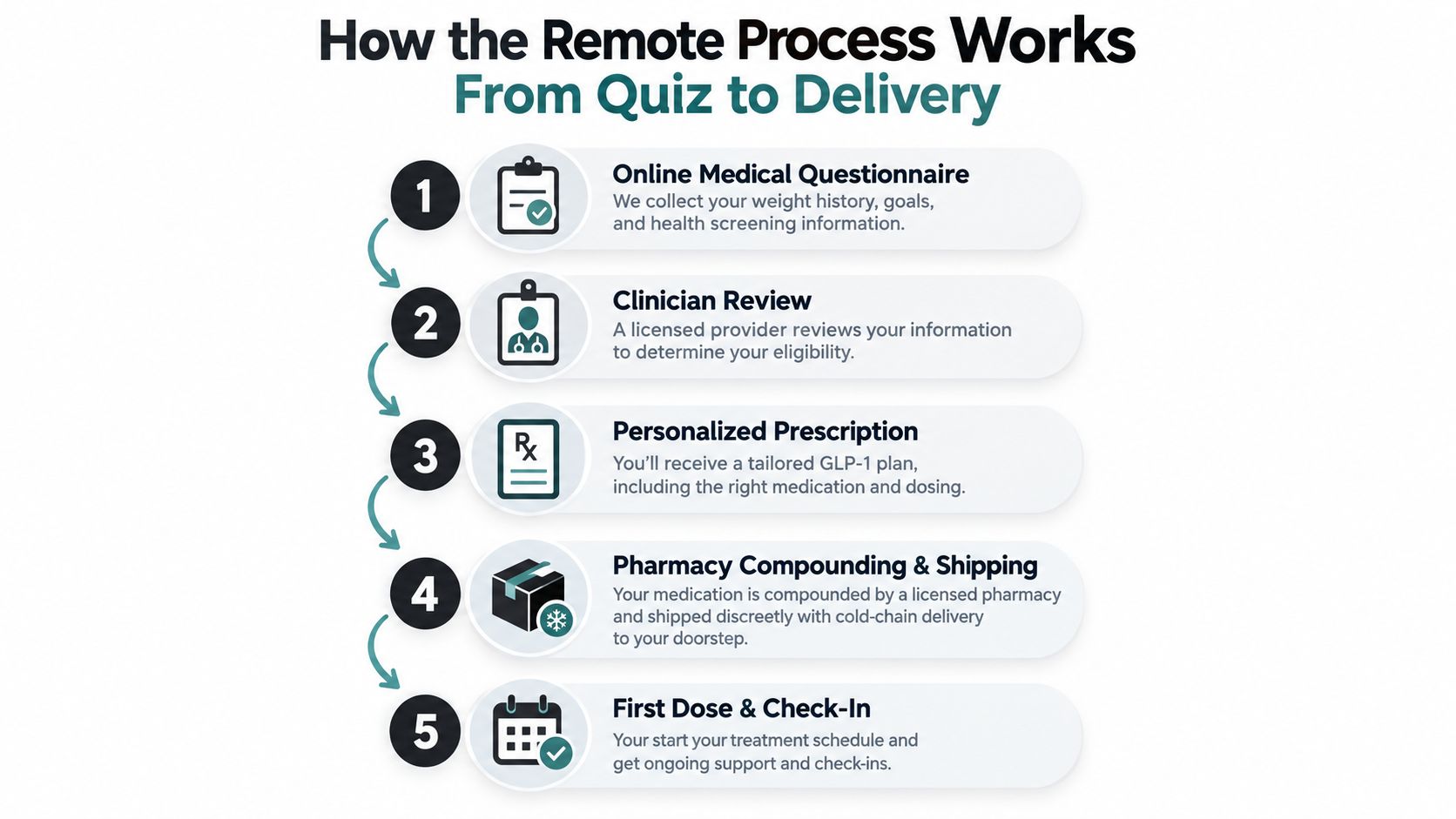
Start with the medical questionnaire
The intake form commonly asks about your weight history, previous approaches, health conditions, allergies, current medicines, and treatment goals. Conditions such as type 2 diabetes, hypertension, sleep apnea, or a history of gastrointestinal problems can change the safety discussion. Include supplements and medicines prescribed by other clinicians, because interactions and overlapping effects may matter.
Some forms also ask about eating patterns, pregnancy plans, mental health, and prior reactions to medications. Answering accurately is more useful than trying to qualify. A clinician can only assess information that you provide.
Complete the clinician evaluation
The prescriber reviews your intake and discusses whether treatment fits your situation. During a video visit, expect questions about your weight trend, medical history, eating behavior, medications, and what you hope to change. The provider may also ask for recent measurements, blood-pressure readings, or laboratory results.
Some services use asynchronous review, while others require a live video consultation. You can learn more about what a semaglutide-focused online pathway may involve through this guide to semaglutide injection treatment online. Whatever format a service uses, it should identify the clinician making the decision and document the plan.
Move from approval to fulfillment
If treatment is appropriate, the prescriber sends a patient-specific prescription to a pharmacy. That might be a manufacturer pharmacy or a state-licensed compounding pharmacy, depending on the medication and the program. Ask which pharmacy will fill the order, whether the product is FDA-approved or compounded, and how the pharmacy handles storage and shipping.
Injectable medicines may require temperature-controlled delivery. The package should include clear labeling, storage instructions, dosing directions, and a way to contact the care team if the shipment arrives warm, damaged, or incomplete.
Learn before you inject
Before the first dose, you should understand the device or syringe, injection site, schedule, storage requirements, and missed-dose instructions. A short coaching appointment can prevent common mistakes, such as using the wrong amount or repeating a dose too soon.
The first delivery should therefore begin a care relationship, not end one. You should know when the next check-in occurs and where to report symptoms.
Who Qualifies and When Telehealth Is Not the Right Fit
Eligibility is clinical, not a marketing label. Standard adult criteria generally consider a BMI of 30 or higher, or a BMI of 27 or higher with a weight-related condition, such as prediabetes, hypertension, sleep apnea, or polycystic ovary syndrome. A prescriber still needs to assess the full picture, because BMI alone doesn't describe every health risk or treatment need.
The intake should establish recent weight changes, current medicines, pregnancy plans, prior treatment experiences, and relevant diagnoses. Recent laboratory results or physical measurements can help, but the exact requirements vary by provider and by the patient's history. If the service never asks about these areas, its screening process may be too shallow.
Certain situations call for a more cautious setting. Active pancreatitis, a personal or family history of medullary thyroid carcinoma or multiple endocrine neoplasia type 2, severe gastrointestinal disease, uncontrolled psychiatric illness, disordered eating patterns, pregnancy, and breastfeeding should prompt a careful clinician review and may make routine telehealth prescribing inappropriate.
These aren't arbitrary barriers. They're safety guardrails. A person with complex symptoms may need a physical examination, same-day testing, specialist coordination, or urgent treatment that a virtual weight-management service can't provide.
A practical comparison
| Qualifies for Telehealth GLP-1 Therapy | Better Suited for In-Person Care |
|---|---|
| Meets commonly used adult eligibility criteria after clinician review | Has symptoms requiring urgent examination or testing |
| Can provide an accurate medication and health history | Has active pancreatitis or severe gastrointestinal symptoms |
| Has a stable enough situation for remote monitoring | Has a relevant thyroid-cancer history that needs specialist assessment |
| Can access follow-ups and communicate side effects | Is pregnant, breastfeeding, or planning pregnancy without a clear medical plan |
| Understands injection instructions and escalation precautions | Has uncontrolled psychiatric illness or active disordered eating concerns |
Eligibility doesn't guarantee that a prescription is appropriate. It means a qualified clinician has enough information to make an individualized decision.
Telehealth Compared to In-Person Weight Loss Clinics
Telehealth and in-person care solve different problems. Remote treatment removes travel, waiting rooms, and many scheduling obstacles. An office clinic can perform hands-on examinations, collect labs locally, and coordinate more complex care in the same setting.
Neither format is automatically safer for every patient. A motivated adult with a stable medical history may value home delivery and secure messaging. Someone with several diagnoses, changing symptoms, or uncertain medication history may benefit from an in-person assessment before starting.
| Factor | Telehealth | In-Person Clinic |
|---|---|---|
| Access | Often offers flexible scheduling and care from home | Requires travel and appointment availability |
| Evaluation | Relies on history, video assessment, home measurements, and available records | Can add physical examination and on-site testing |
| Follow-up | Secure messaging and virtual visits can make routine contact convenient | Face-to-face visits allow direct observation |
| Support | May include clinicians, nurses, coaches, or dietitians remotely | Can provide local multidisciplinary coordination |
| Privacy | Lets patients discuss sensitive topics from a familiar setting | Offers a controlled clinical environment |
| Complex cases | May require coordination with a primary-care clinician or specialist | Better positioned for examination and same-day escalation |
A blended model often makes sense. Your primary-care clinician can manage blood pressure, diabetes, laboratory work, or other diagnoses while a telehealth prescriber handles medication titration. Both teams should know what the other is prescribing and monitoring.
Cost also requires careful comparison. A remote program may separate the clinical fee, medication price, and shipping. An office clinic may bundle some services while billing others through insurance. Ask for the complete expected cost and the follow-up schedule before choosing based on convenience alone.
The right question isn't “Which format is better?” It's “Which format gives this patient enough evaluation and support for the risks involved?”
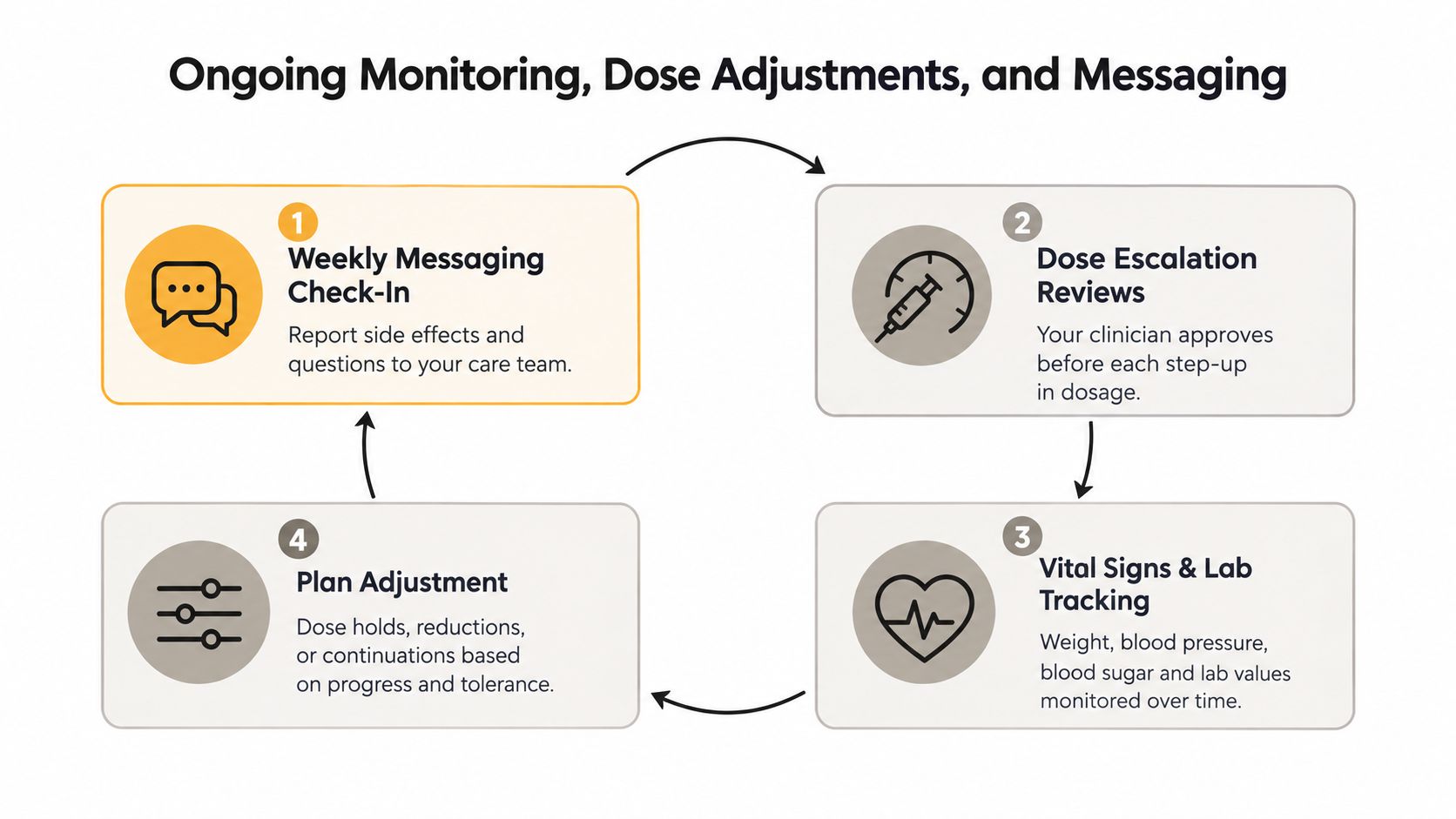
Ongoing Monitoring, Dose Adjustments, and Messaging
The shipment arriving at your door marks the beginning of active treatment. During dose escalation, a responsible program checks how you're responding before approving the next increase. The clinician may review weight trend, appetite, hydration, bowel symptoms, nausea, vomiting, blood pressure, blood sugar, and relevant laboratory values.
Dose changes shouldn't happen automatically because a calendar reminder says it's time. A patient who is tolerating a dose well may continue, while someone with persistent gastrointestinal symptoms may need a pause, a slower increase, or a reduction. Semaglutide and tirzepatide also follow different prescribing schedules, so the program should give you a written plan rather than asking you to infer the next dose from the label.
What contact should look like
Expect a defined channel for questions between visits. It might be secure messaging, a nurse line, or a scheduled check-in with a coach or clinician. Ask who reads the message, when you should expect a response, and what happens outside office hours.
A remotely delivered GLP-1 program described a structured model using monthly pharmacist-reviewed digital surveys, Bluetooth-connected weight tracking, and an escalation pathway in which health coaches responded to adverse-event reports within 24 hours and pharmacists within 4 business hours. Those response windows are specific to that program, but they illustrate the level of operational clarity patients should look for in any service. Read more about documentation for virtual consultations if you want to understand how a well-documented remote encounter supports continuity.
Contact the care team promptly about persistent vomiting, inability to keep fluids down, severe or worsening abdominal pain, fainting, signs of an allergic reaction, or a concerning change in blood sugar. Seek urgent care when symptoms are severe or rapidly worsening.
The care team has different roles
A prescriber makes the medical decision and approves dose changes. A pharmacist may review medication safety and adverse events. A nurse or coach may help with injection technique, symptom tracking, and practical routines. A dietitian can help protect adequate nutrition and support meals that remain manageable as appetite changes.
Use this titration schedule guide to understand why dose escalation should be individualized rather than treated as an automatic race to a higher dose. A good program connects each increase to your symptoms, progress, and clinical record.
Privacy, Data Security, and Pharmacy Standards
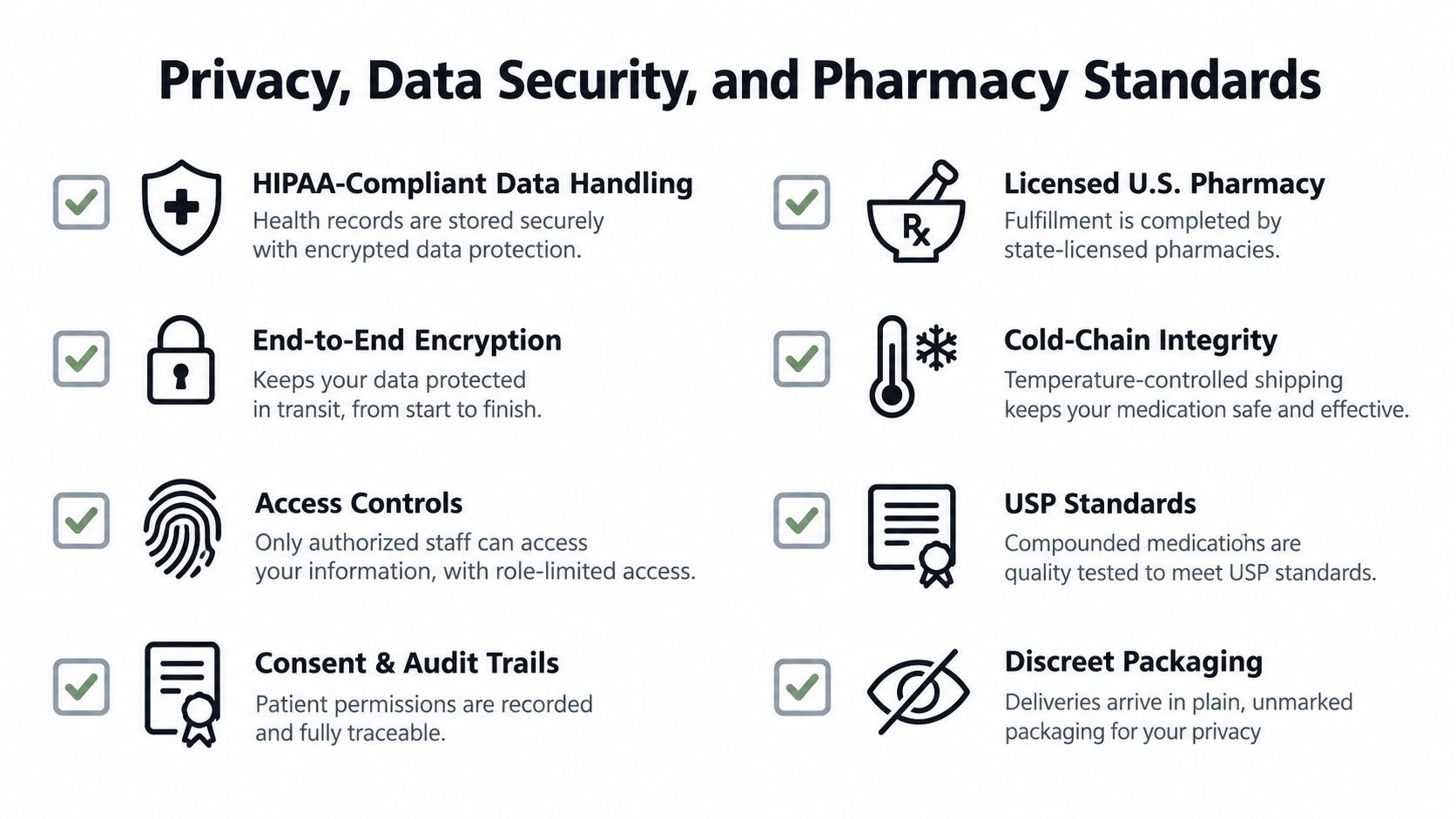
You'll share sensitive information with a telehealth provider, including diagnoses, medications, weight history, and possibly mental-health or eating-behavior details. Before submitting an intake form, read the privacy notice and consent documents. A legitimate service should explain how it stores health information, which vendors can access it, and whether it shares data for advertising or other purposes.
Look for secure video, encrypted messaging, role-based staff access, and clear procedures for correcting or requesting records. HIPAA compliance is important, but the provider should also explain its practical safeguards in plain language. Don't assume that a polished website tells you anything about the security of the underlying systems.
Ask pharmacy questions before paying
A program should identify the dispensing pharmacy and explain whether the medication is FDA-approved or compounded. Compounded products require particular scrutiny. Ask about the source of the active ingredient, pharmacy licensure, testing, labeling, storage, and what to do if the shipment arrives outside the stated temperature range.
Be cautious if a service won't name its pharmacy partner, uses unclear terms for semaglutide or tirzepatide, offers no lot or expiration information, or ships medication without verifying the patient's identity and prescription. “Discreet” packaging can protect privacy, but it shouldn't replace transparent pharmacy information.
The FDA-approved status of a medication and the licensing status of a pharmacy are separate questions. A provider should explain both clearly instead of using a general safety phrase that leaves you guessing.
For a closer look at platform safeguards, review this guide to a HIPAA-compliant telehealth platform. Use the same questions with any service you're considering.
How to Choose a Reputable Telehealth Provider
Treat provider selection like a clinical screening task, not an impulse purchase. Before entering payment details, verify who will evaluate you, where that clinician is licensed, which pharmacy will fill the prescription, and how the program handles complications.
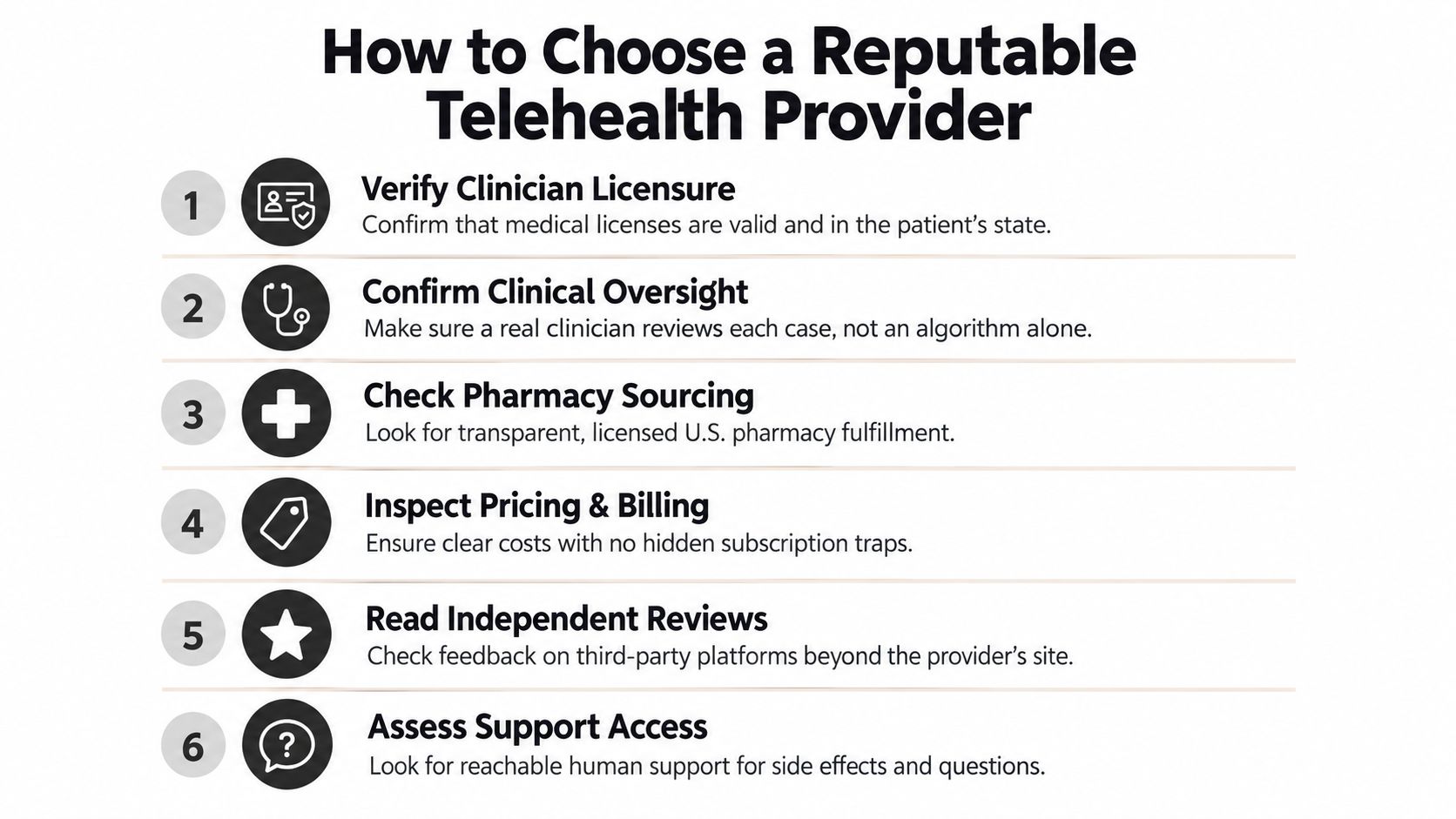
Use this checklist:
- Verify clinician licensure. Confirm the prescriber's license through the relevant state medical or nursing board, and check that the clinician can prescribe where you live.
- Confirm a real evaluation. Ask whether your case receives a live video consultation or another meaningful clinician review. A form processed by an algorithm alone isn't enough for a complex medication decision.
- Check pharmacy sourcing. Look for a named, state-licensed U.S. pharmacy and clear information about whether the medication is FDA-approved or compounded.
- Inspect the full bill. Separate the clinical fee, medication cost, shipping, membership, refill rules, and cancellation terms. A low introductory price can be misleading if later charges aren't explained.
- Read beyond the provider's website. Independent reviews can reveal recurring problems with shipping, communication, refills, or billing. Treat individual testimonials as personal experiences, not proof of clinical suitability.
- Assess support access. Before treatment begins, ask where to report side effects, who responds, how quickly the team replies, and whether automatic refills can be stopped.
Warning signs include pressure to buy immediately, no written follow-up plan, no adverse-event contact route, automatic enrollment that's difficult to cancel, and upsells that distract from the medical evaluation. Ask how dose changes are decided before you sign up. The answer should involve a clinician, not an automatic schedule or a customer-service script.
A program such as Weight Method describes a workflow that includes an online intake, a licensed-provider consultation, prescription fulfillment, messaging, progress tracking, and dose adjustments. Compare those stated features with the actual consent forms, pharmacy information, pricing terms, and support process before making a decision.
Putting It All Into a Clear Picture of Your Care Journey
Think of telehealth treatment as a loop with visible checkpoints:
- Eligibility screening produces a documented medical history and risk review.
- A clinical visit produces an assessment and an individualized treatment decision.
- Pharmacy fulfillment produces a labeled prescription with storage and dosing instructions.
- Injection education produces confidence about the device, schedule, and missed-dose plan.
- Monitoring and titration produce follow-up notes, symptom reviews, and approved dose changes.
- Maintenance or discontinuation planning produces a path for what happens when goals, tolerance, coverage, or treatment needs change.
The medication shouldn't be the only tangible result. You should also receive a written plan, a side-effect protocol, a way to contact the care team, and instructions about measurements or laboratory work. If the only thing you can track is a package, the service hasn't given you enough visibility into your care.
Telehealth's value comes from making the full loop easier to follow. It can reduce logistical friction while preserving clinician oversight, provided the program supplies that oversight. Match the format to your health situation, and judge the service by its care workflow rather than its fastest delivery promise.
Weight Method offers online intake, video consultations with licensed providers, home delivery of prescribed GLP-1 medication, ongoing messaging, progress tracking, and dose adjustments. Visit Weight Method to review how its telehealth workflow could fit your weight-management needs.