73% of adults receiving Wegovy reported a gastrointestinal reaction, compared with 47% receiving placebo, in the adult weight-management trials reviewed in the FDA prescribing information. That doesn't mean people generally became seriously ill. It means digestive symptoms are common enough that a plan for handling them should come before the first injection.
When you're looking up weight loss injections side effects, two questions matter: Can I tolerate this treatment, and does this symptom need medical attention? Those aren't the same question. Mild queasiness may call for a slower dose increase, while severe abdominal pain needs assessment rather than another dietary adjustment.
Side Effect Rates From the Weight-Loss Trials
Start with the split between the two drugs, because a single "GLP-1 side effect rate" hides more than it shows. Semaglutide figures below come from the Wegovy adult weight-management trials identified above. Tirzepatide figures come from the FDA Zepbound prescribing information.
Semaglutide 2.4 mg versus placebo in the Wegovy trials
| Symptom | Semaglutide 2.4 mg | Placebo |
|---|---|---|
| Nausea | 44% | 16% |
| Diarrhea | 30% | 16% |
| Vomiting | 25% | 6% |
| Any gastrointestinal reaction | 73% | 47% |
Tirzepatide 15 mg versus placebo in the Zepbound trials
| Symptom | Tirzepatide 15 mg | Placebo |
|---|---|---|
| Nausea | 28% | 8% |
| Diarrhea | 23% | 8% |
| Vomiting | 13% | 2% |
These are separate trials, not a head-to-head comparison. Each medication has its own placebo group, participant population, and treatment protocol. You cannot conclude from these tables alone that one drug will be easier on your stomach.
The percentages describe participants who reported a symptom at some point during the trials. They do not mean someone felt nauseated after every injection or spent that proportion of treatment time vomiting. A person could report more than one symptom, so adding the rows would count some participants repeatedly.
Read the table as two signals. How common nausea, diarrhea, and vomiting are affects adherence: it shapes whether treatment feels manageable enough to continue. The severe end is a safety-screening question: it determines when a symptom needs assessment. The Wegovy trial summary separates overall digestive complaints from severe reactions, which were much less frequent, and shows that only a subset of people with symptoms stopped treatment because of them. Having a side effect, having a severe side effect, and stopping medication are different outcomes.
Tirzepatide's digestive effects also change across maintenance doses, but not every symptom rises in a perfectly straight line. Vomiting and diarrhea generally become more frequent at higher doses, while the reported nausea pattern is less consistent. Your response to a lower dose therefore helps guide treatment, but it does not predict every later symptom.
Other listed tirzepatide reactions include:
- Digestive complaints: Constipation, abdominal pain, indigestion, and reflux.
- General or local symptoms: Fatigue and injection-site reactions.
- Other reactions: Hair loss and hypersensitivity reactions, which require different responses depending on their severity.
Use the numbers without dismissing symptoms
A trial percentage is a population average, not a personal forecast. Someone with mild nausea who can drink and eat has a different problem from someone repeatedly vomiting and becoming dizzy.
A general guide to understanding potential peptide side effects covers other peptide products and does not replace the prescribing information for semaglutide or tirzepatide. The product labeling and your clinician's directions should take priority over broad lists.
Practical rule: A symptom can be common and still need treatment. Persistent vomiting or diarrhea is a reason to contact your clinician before the next injection, not proof that you should push through.
Why the Stomach Slows Down on These Drugs
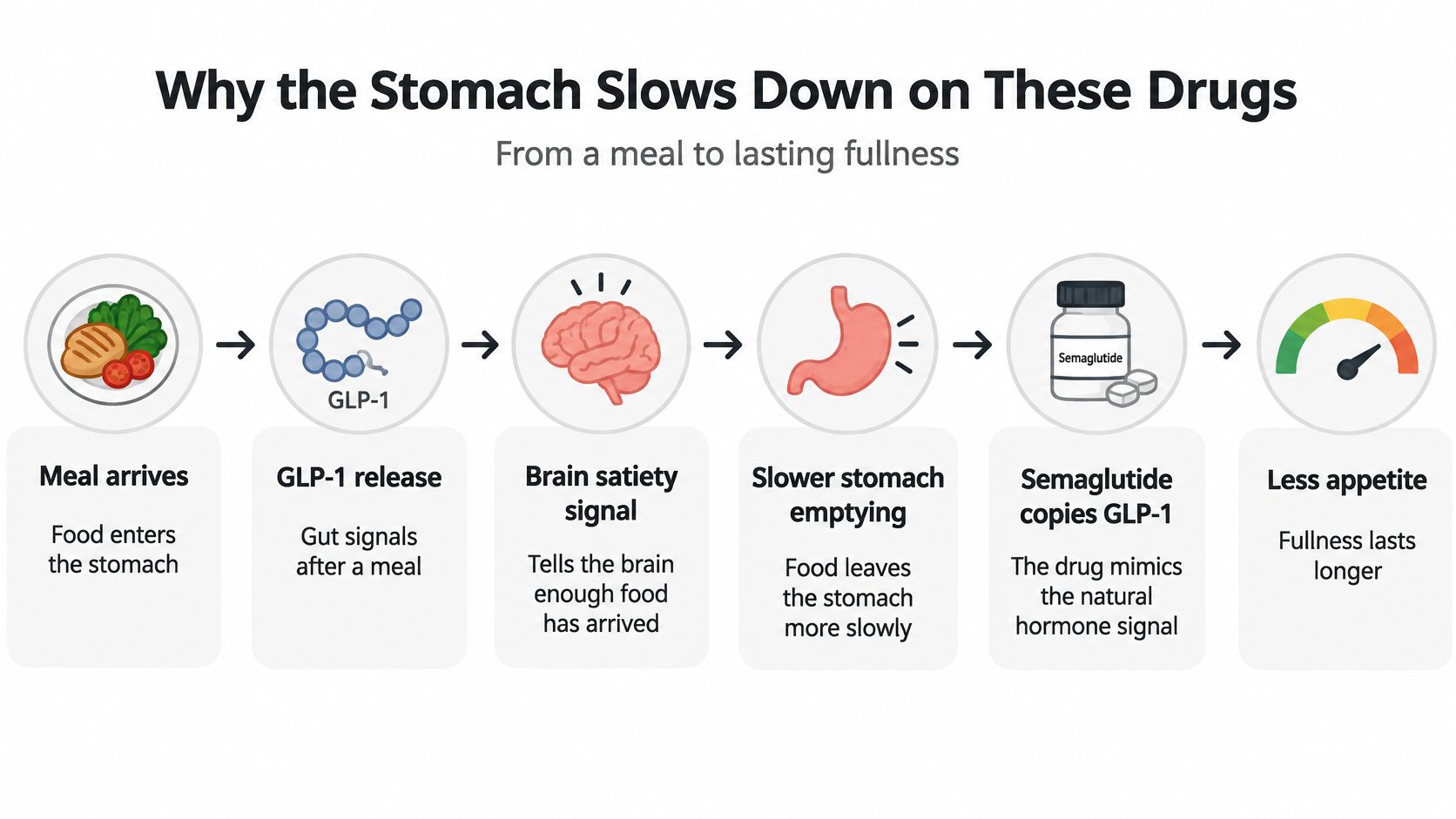
Say you start treatment and eat your usual dinner. Halfway through, you feel unexpectedly full. Finishing the plate may leave you uncomfortable even though that portion never bothered you before.
After a meal, your gut releases GLP-1, a hormone involved in appetite signaling and stomach emptying. Semaglutide activates the GLP-1 receptor. Tirzepatide acts on both GLP-1 and GIP receptors, another part of the body's metabolic signaling system.
Longer-lasting fullness can become discomfort
Think of stomach emptying as traffic moving through a lane that has partly narrowed. Food still moves forward, but a familiar meal may remain in the stomach longer, and fullness can arrive earlier.
That helps explain early fullness, nausea, and some reflux. However, not every digestive symptom comes directly from food sitting in the stomach. Changes in gastrointestinal signaling, food intake, and bowel function also contribute, so diarrhea and constipation shouldn't be explained as identical consequences of delayed emptying.
In the pivotal semaglutide obesity trial published in the New England Journal of Medicine, gastrointestinal disorders occurred in 74.2% of semaglutide-treated participants versus 47.9% receiving placebo, and most were mild to moderate and transient. This single-trial result and the pooled labeling figures describe different evidence sets, so their slightly different percentages aren't contradictory.
Timing helps explain the pattern
Digestive symptoms often appear after treatment starts or a dose increases. That makes the timing useful information for your prescriber. Feeling well on a stable dose and then developing nausea after an increase suggests a different decision from developing new, severe symptoms without any dose change.
Keep a brief record of:
- Injection timing: When you took the medication and whether the dose changed.
- Symptom pattern: Whether discomfort follows meals, persists between meals, or interrupts sleep.
- Functional impact: Whether you can drink, eat, work, and carry out normal activities.
The goal isn't to diagnose yourself from a diary. It's to give the clinician enough detail to distinguish an adjustment problem from something that requires investigation.
Slower emptying also isn't automatically gastroparesis, a condition involving impaired stomach emptying. Persistent symptoms need assessment rather than a label based on an online description, especially if you already had digestive difficulties before treatment.
Gallbladder and Pancreas Warning Signs
In pooled tirzepatide weight-loss trials, gallstones occurred in 1.1% of treated patients versus 1.0% receiving placebo, while gallbladder inflammation occurred in 0.7% versus 0.2%, according to the FDA tirzepatide prescribing information. These events are uncommon, but their symptoms deserve a different response from ordinary queasiness.
Gallstones and gallbladder inflammation aren't interchangeable. Stones may be present without inflammation, while an inflamed gallbladder can cause persistent pain and systemic symptoms such as fever. Substantial or rapid weight loss can increase gallstone risk, but gallbladder disease can occur without a dramatic change on the scale.
Symptoms that should not wait for the next dose
| What you notice | Possible meaning | What to do |
|---|---|---|
| Persistent right-upper abdominal pain, fever, jaundice, or pain after meals | Gallbladder disease | Get prompt clinical assessment |
| Severe abdominal pain radiating to the back with nausea or vomiting | Possible pancreatitis | Stop the drug and seek urgent care; don't restart semaglutide if pancreatitis is confirmed |
| Repeated vomiting or diarrhea, dizziness, or very little urine | Dehydration and possible kidney injury | Seek same-day clinician contact and fluid assessment; use urgent care if severe |
| Severe bloating with inability to pass stool or gas | Possible obstruction | Get urgent evaluation |
| Face or throat swelling, spreading rash, or trouble breathing | Possible hypersensitivity | Get emergency care |
Describe the pain, not just the nausea
Location and persistence matter. Pain under the right ribs, particularly with fever or yellowing of the skin or eyes, warrants prompt assessment. Severe pain that extends through to the back, especially with vomiting, may indicate pancreatitis.
These patterns overlap with other illnesses. You don't need to identify the organ involved before seeking help, and a clinician may need an examination, blood tests, or imaging to establish the cause. Don't increase your dose while unexplained abdominal pain remains unresolved.
Both medications' prescribing instructions call for stopping treatment when pancreatitis is suspected. Confirmed pancreatitis also changes future treatment decisions, including the instruction not to restart semaglutide.
Ordinary symptoms can have serious consequences
Repeated fluid loss can turn a digestive side effect into a hydration and kidney problem. Likewise, severe distension with inability to pass stool or gas isn't a situation to manage by repeatedly adding fiber or taking the next injection.
Safety boundary: Trouble breathing, throat swelling, severe persistent abdominal pain, or signs of serious dehydration need real-time medical care. Don't wait for a routine telehealth reply.
A familiar side-effect label shouldn't override a changing clinical picture. Whether you can keep fluids down, where the pain is, and whether you have fever, jaundice, or worsening distension matter more than the fact that nausea appears on the medication leaflet.
How to Manage Nausea During Dose Increases
Managing nausea isn't just about comfort. It helps protect nutrition, hydration, and your ability to continue an otherwise appropriate treatment. A meta-analysis of 23 semaglutide studies involving 57,911 participants identified gastrointestinal events, particularly nausea and vomiting, as the predominant adverse effects.
A routine to review with your prescriber
-
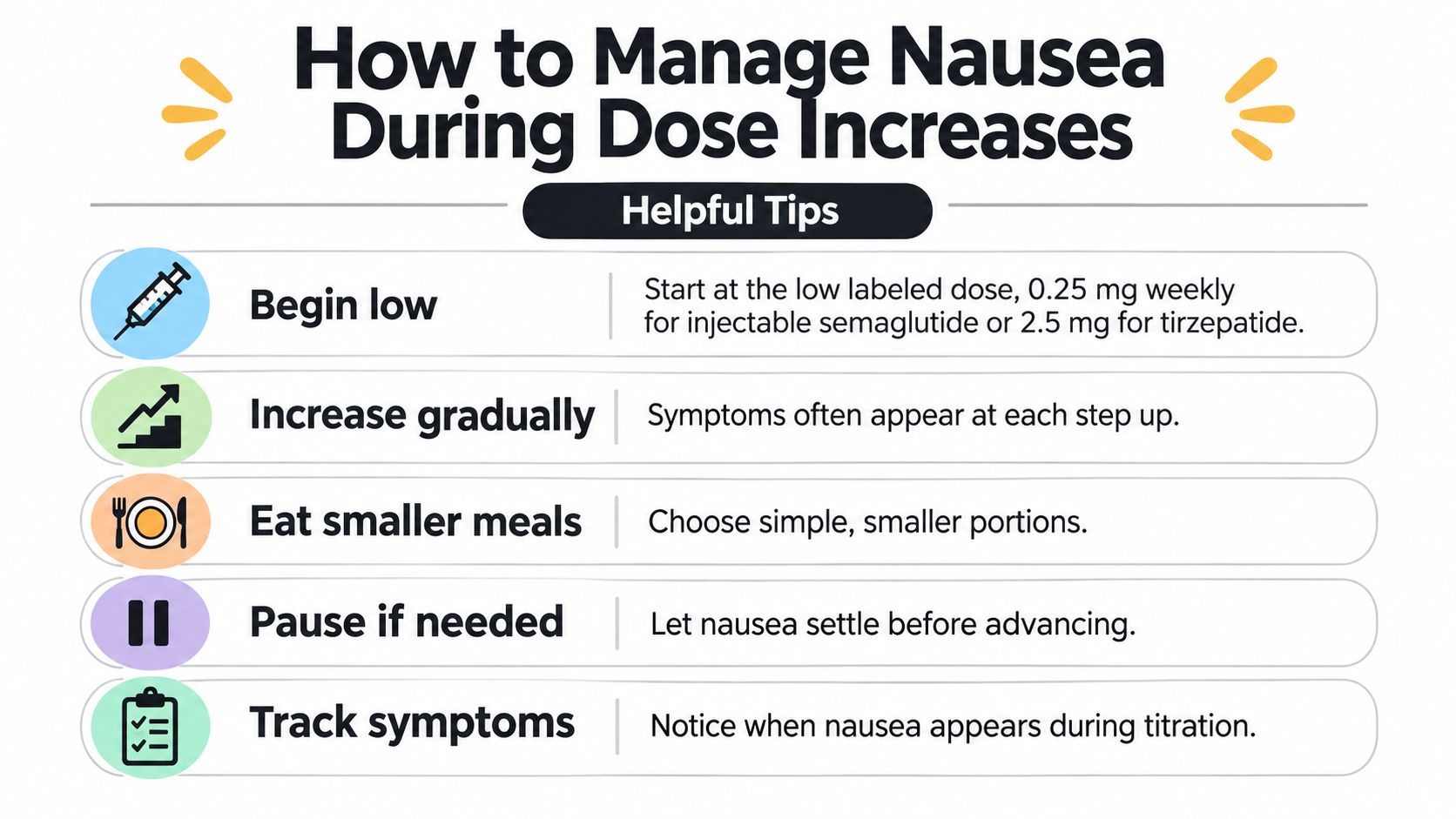
Begin with the prescribed starter dose. Don't copy a friend's dose or restart at an old maintenance dose after a treatment gap without instructions. Injectable and oral semaglutide schedules aren't interchangeable, and neither is a tirzepatide schedule.
-
Make meals smaller and lower in fat. Try a modest portion of toast, rice, soup, or another food you tolerate, then stop when fullness arrives. Eating slowly gives you time to notice that signal before you become uncomfortable.
-
Drink steadily instead of catching up later. Take small, frequent sips if larger drinks worsen nausea. If diarrhea or vomiting begins, discuss fluid replacement with your clinician, especially if you have kidney disease or a prescribed fluid restriction.
-
Report symptoms before an increase. Tell the prescriber whether you've vomited, missed meals, struggled with fluids, or been unable to function normally. A short symptom record is more useful than just saying the dose feels strong.
-
Adjust the schedule with clinical guidance. The prescriber may delay escalation, maintain an appropriate lower dose, or reconsider treatment. Don't improvise partial pen doses, change vial volumes, or compensate later with an extra injection.
Treat tolerability as part of dosing
A scheduled increase isn't an obligation to advance despite ongoing symptoms. Our titration schedule guide explains the role of monitored escalation; our providers also manage high-dose oral semaglutide escalation to minimize side effects while working toward the appropriate dose.
We track weight change over consistent dosing, with periodic check-ins to review tolerance and adjust the plan. That prevents a short-term scale result from becoming the only measure of whether treatment is going well.
For mild symptoms, Yuve's suggestions to calm a queasy stomach offer additional food-and-drink ideas. They aren't a substitute for assessing persistent vomiting, and you should clear new supplements or nausea medicines with your clinician.
Increase only when the current dose is tolerable enough to support normal hydration and adequate nutrition. Seek care sooner if fluids won't stay down.
Staying On Treatment Versus Stopping Early
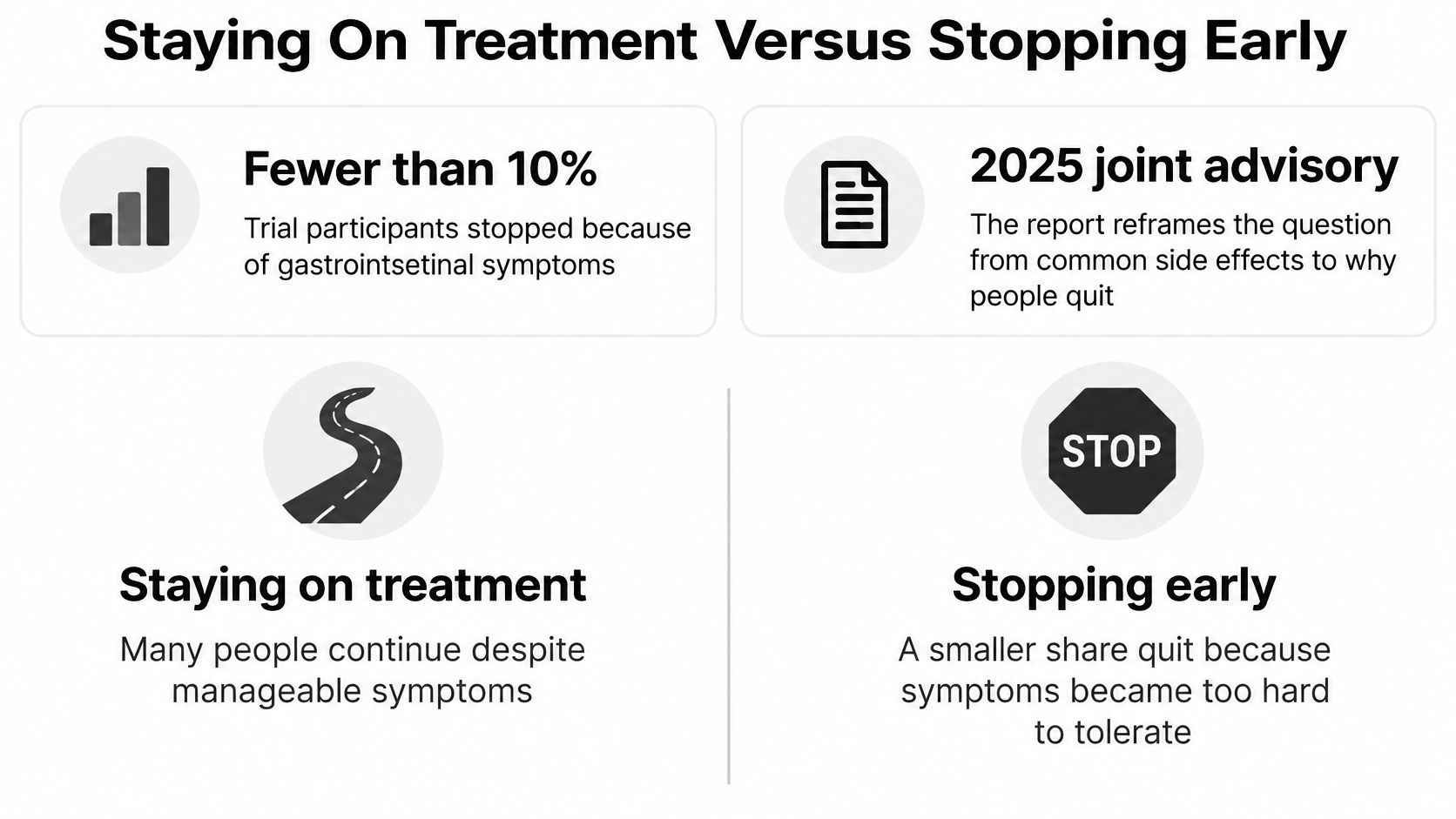
In a real-world GLP-1 discontinuation cohort of 125,474 adults, 53.6% stopped within one year and 72.2% within two years (cohort study). Those figures count every reason a person stops: cost, access, another illness, or a decision that the side effects are not worth it. They are not a gastrointestinal dropout rate. Trial summaries often report digestive-related stopping separately, and the distinction matters. A person who stops after one severe vomiting episode and a person who stops because insurance changes both appear in the all-cause number, but only one is a tolerability problem.
There are more options than enduring or quitting
A dose increase works like a dimmer, not a light switch: the goal is the highest dose a person can tolerate with normal hydration and adequate food intake, not the fastest possible escalation. The safer choice depends on why someone wants to stop. Intolerable symptoms, a possible contraindication, and a practical barrier each call for a different response.
Pace is the first issue. If the current dose is tolerable but the next step is not, more time at the lower dose may be safer than abandoning treatment. Intake is the second. Persistent nausea that leads to skipped meals, low fluids, or poor daily function needs clinical assessment, not encouragement to push through. Fit is the third. If intolerance continues despite adjustments, discussing another medication or delivery route is a clinical decision, and switching does not guarantee fewer symptoms.
In that cohort, moderate or severe gastrointestinal events were associated with a higher chance of stopping. That makes early reporting useful: a clinician can adjust only what they know about. For help coordinating other ongoing conditions, patients can explore personalised chronic care plans through a separate nursing service, while medication decisions stay with the prescribing clinician.
Stopping deserves a plan too
Weight regain is expected after discontinuing any semaglutide formulation, including oral Wegovy. An exit plan should address more than the final injection. It may include how weight and relevant health measures will be monitored, what nutrition and activity support will continue, and whether another treatment is appropriate. It should not become pressure to continue a medication that is causing harm.
A brief adjustment symptom and an adherence-threatening side effect differ in duration, severity, and impact on daily life. A symptom that is severe, escalating, or paired with dehydration belongs in the safety conversation, not the willpower conversation. If you repeatedly dread dosing, skip food to avoid nausea, or miss injections, tell your clinician directly.
Extra Risk From Compounded Injection Errors
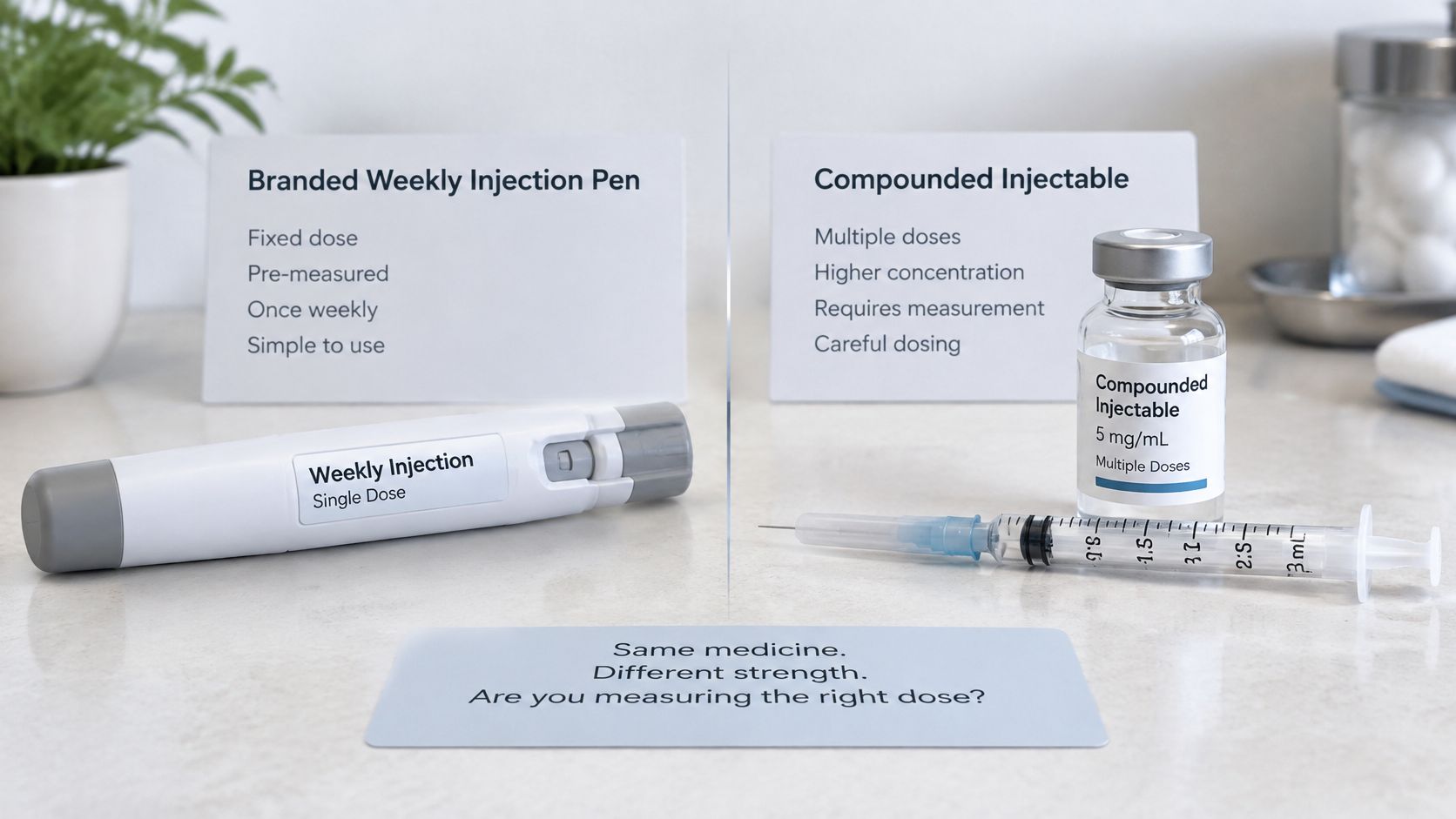
A dosing error can produce symptoms that look exactly like a drug side effect. That overlap matters because the response differs. A drug effect usually calls for a dose review. A preparation or measurement error calls for stopping and checking the product, the concentration, and the syringe before the next dose.
A branded injection pen and a compounded multi-dose vial ask different things of the person using them. A pen may deliver a preset dose. A vial asks you to match the prescribed amount to the product's concentration and to the correct syringe marking. Branded products also come in different presentations, so never assume all devices work alike.
The FDA's safety notice on unapproved GLP-1 drugs records 605 adverse-event reports for compounded semaglutide and 545 for compounded tirzepatide through July 31, 2025.
Compounded GLP-1 adverse-event reports
| Product | Reports |
|---|---|
| Compounded semaglutide | 605 |
| Compounded tirzepatide | 545 |
Severe GI reactions in controlled tirzepatide trials were much less common than mild ones. The report counts above do not measure severity, and they do not prove that a compounded product caused every event. They do point to a practical problem: dosing mistakes can produce substantial symptoms, sometimes requiring hospitalization.
Reports aren't incidence rates
Adverse-event reports don't tell us how many people used a product, prove that the product caused every event, or allow a direct safety comparison with trial percentages. They do identify a practical concern: dosing mistakes can produce substantial symptoms, sometimes requiring hospitalization.
Milligrams, milliliters, and syringe units aren't interchangeable. Milligrams describe the drug amount. Milliliters describe liquid volume. Syringe markings measure a volume according to that syringe's scale. Concentration links them. When concentration changes, the same volume can contain a different drug amount.
Verify before drawing up a dose
Ask the dispensing pharmacy to confirm four things together: the prescribed milligrams, the vial concentration, the matching volume, and the exact syringe marking. Use the specified syringe. Recheck the instructions whenever the product or concentration changes. If the label, the syringe, and the prescription do not line up, pause and get clarification before injecting.
If you've already made an error, our guide to drawing the wrong amount from a GLP-1 vial explains the information to gather for clinical review. Don't try to correct an uncertain injection with another injection.
Compounded medications aren't FDA-approved Wegovy or Zepbound products. Their risks involve product quality and preparation as well as concentration, administration technique, and escalation speed.
Contraindications and Drug Interactions to Check First
A safety screen should happen before treatment begins, not only after symptoms develop. Bring your medication list, supplements, relevant diagnoses, and family history to the prescribing visit.
Conditions that change eligibility
- Medullary thyroid carcinoma or MEN2: A personal or family history of medullary thyroid carcinoma, or multiple endocrine neoplasia type 2, is a contraindication to semaglutide and tirzepatide. Both carry a boxed warning concerning thyroid C-cell tumors.
- Previous serious allergic reaction: Report the exact medication and reaction. A serious reaction to the proposed drug or its ingredients rules out routine re-exposure.
- Severe gastroparesis: Semaglutide isn't recommended because further slowing of stomach emptying may worsen significant digestive dysfunction.
- Pregnancy or pregnancy plans: Weight-loss treatment should stop when pregnancy is recognized. Discuss discontinuation before trying to conceive rather than waiting for a positive test.
- Previous pancreatitis or gallbladder disease: These histories require individualized review. They aren't automatically the same as an absolute contraindication.
Medicines that need a coordinated plan
Insulin and sulfonylureas deserve particular attention because combining glucose-lowering effects can cause hypoglycemia. The prescriber may need to adjust those medicines and explain how you'll recognize and manage low blood sugar.
Delayed stomach emptying can affect oral medication absorption. Tirzepatide also requires specific contraceptive counseling during initiation and escalation, so tell the clinician if you use an oral contraceptive.
Our GLP-1 drug interactions guide can help you prepare a complete review, but don't stop or adjust another prescription yourself. Include medicines taken only occasionally, not just daily prescriptions.
Kidney disease also changes the response to fluid loss. If you have kidney problems, ask for an individualized hydration and sick-day plan before treatment starts.
Get a Dose Plan Before Side Effects Decide
Don't choose a maintenance dose from an online success story. A useful plan matches the medication and delivery route to your medical history, then specifies how the clinician will respond if tolerance deteriorates.
The written plan should make these points clear:
- Your prescribed dose: The medication name, milligram amount, and device or vial instructions.
- Your escalation decision: Who reviews symptoms and authorizes a change.
- Your contact pathway: How to reach clinical support and when to use in-person care instead.
Weight Method connects patients with licensed healthcare providers for evaluation, prescription, and delivery of semaglutide and tirzepatide. We provide ongoing clinical support to help patients work through plateaus and sustain progress, while our providers review tolerance and adjust treatment when appropriate.
Weight loss isn't guaranteed. Diet, physical activity, and individual biology influence results, and a trial average isn't a personal promise. A workable dose plan must support health and daily functioning, not just appetite suppression.
Before starting, make sure you know how follow-up will happen. Routine messaging can help with nonurgent questions, but emergency symptoms require immediate assessment rather than waiting for a scheduled check-in.
Visit Weight Method to complete a medical intake and discuss clinician-supervised GLP-1 treatment with ongoing support. Confirm your exact prescribed dose, how increases will be reviewed, and whom to contact about side effects before you begin.