You're standing at the bathroom sink with a new pen in one hand and the leaflet in the other. The dose is due today, you've watched a video twice, and you still aren't sure if the needle goes straight in, how long to hold it, or whether this week's strength matches your prescription. That pause is normal, and it's useful. Learning how to inject GLP-1 safely isn't about being brave with a needle. It's about matching the product, milligrams and device to your prescription before every injection, then following the same calm routine each week. If any check doesn't match, you stop and call your pharmacy or prescriber.
Where to Inject and How Often for Each Medicine
FDA-labeled GLP-1 injections go under the skin, not into a vein or muscle, once a week into the abdomen, thigh or upper arm. The Wegovy prescribing information directs patients to inject semaglutide into the abdomen, thigh, or upper arm, at any time of day, with or without meals, once weekly on the same day each week. The medicine sits in fatty tissue beneath the skin and is absorbed gradually, which is why depth matters more than force.
Say you choose Tuesday morning and your abdomen for week one. Next Tuesday you stay with the same day but move a few inches away, or switch to a thigh. That simple rotation protects the skin and helps absorption stay consistent. A practical guide to planning your injection site rotation can help you map spots so you don't reuse the same point by habit.
| Medicine | Injection frequency | Approved sites | Meal timing |
|---|---|---|---|
| Semaglutide (Wegovy) | Once weekly, same day each week | Abdomen, thigh or upper arm | Any time, with or without meals |
| Tirzepatide (Zepbound, Mounjaro) | Once weekly, same day each week | Abdomen, thigh or upper arm | With or without food |
| Compounded products | Once weekly, per prescription | Per prescriber instructions | Confirm with the pharmacy |
Picking a site you can repeat safely
Choose a fixed day you'll remember, then rotate within the approved areas. Skip skin that's bruised, red, scarred or hard, because damaged tissue can change how the medicine is absorbed and makes the injection hurt more. You can change your day or site only as your product instructions or clinician allow, not because a different schedule feels more convenient that week.
Before your first dose: Write the product name, injection day and planned site in a dosing log. You'll check that line every week.
People who want in-person context for supervised care sometimes look into medical weight management in Bradenton as an example of a structured program. Wherever you're treated, your own prescriber's instructions for your exact pen come first.
Dose Steps and Missed Doses to Track
Dose increases aren't a sign that a lower dose failed. They're built into the treatment so your body adjusts gradually. The FDA Wegovy labeling starts semaglutide at 0.25 mg once weekly for 4 weeks, then 0.5 mg during weeks 5 to 8, 1 mg during weeks 9 to 12, 1.7 mg during weeks 13 to 16, and 2.4 mg once weekly from week 17 onward as the usual adult maintenance dose. That maintenance dose is 9.6 times the starting dose, which explains why jumping ahead isn't a shortcut.
| Medicine | Dose | Timing | Limit or note |
|---|---|---|---|
| Semaglutide (Wegovy) | 0.25 mg | Weeks 1-4 | Starting dose only |
| Semaglutide (Wegovy) | 0.5 mg | Weeks 5-8 | Step up only as prescribed |
| Semaglutide (Wegovy) | 1 mg | Weeks 9-12 | Step up only as prescribed |
| Semaglutide (Wegovy) | 1.7 mg | Weeks 13-16 | Step up only as prescribed |
| Semaglutide (Wegovy) | 2.4 mg | From week 17 | Usual adult maintenance dose |
| Tirzepatide (Zepbound, Mounjaro) | 2.5 mg | Weeks 1-4 | Starting dose only |
| Tirzepatide (Zepbound, Mounjaro) | 5 mg | After at least 4 weeks at 2.5 mg | Labeled maintenance option |
| Tirzepatide (Zepbound, Mounjaro) | 10 mg or 15 mg | Increases in 2.5 mg steps, each after at least 4 weeks | 15 mg is the maximum |
For tirzepatide, the FDA tirzepatide labeling sets a starting dose of 2.5 mg once weekly for four weeks, followed by 5 mg once weekly, with increases in 2.5 mg increments only after at least four weeks on the current dose and labeled maintenance options of 5, 10, or 15 mg weekly. Your clinician can delay a step when a dose isn't tolerated. Staying longer at a dose on medical advice isn't falling behind.
The three timing errors to avoid
- Escalating early: You feel fine in week two, so you move up. Tolerance at a low dose doesn't predict tolerance at a higher one, and early increases raise the chance of stomach symptoms.
- Confusing starting and maintenance doses: A starting dose is meant to introduce the medicine, not deliver the full effect. Don't judge treatment by week one.
- Taking two doses too close together: A late dose and a duplicated dose aren't the same problem. A late dose may still be handled under the timing rule in your leaflet, while a possible double dose needs prompt advice.
Don't double up or make up a dose on your own, and don't alter the timetable without prescriber instructions. Follow the missed-dose rule in your Instructions for Use or call your prescriber if you're unsure where you fall. If you want background on the systems clinics use, reading about how medication adherence tracking works shows why a simple written record helps. Keep it basic. Write this week's dose beside your injection day, every week, before you inject.
Verify the Dose Before You Draw
The needle can be a source of worry. For anyone drawing medicine from a vial, the bigger risk is the measurement. Prefilled pens deliver a set dose, but a vial asks you to convert milligrams into a volume on a syringe, and that conversion changes with concentration.
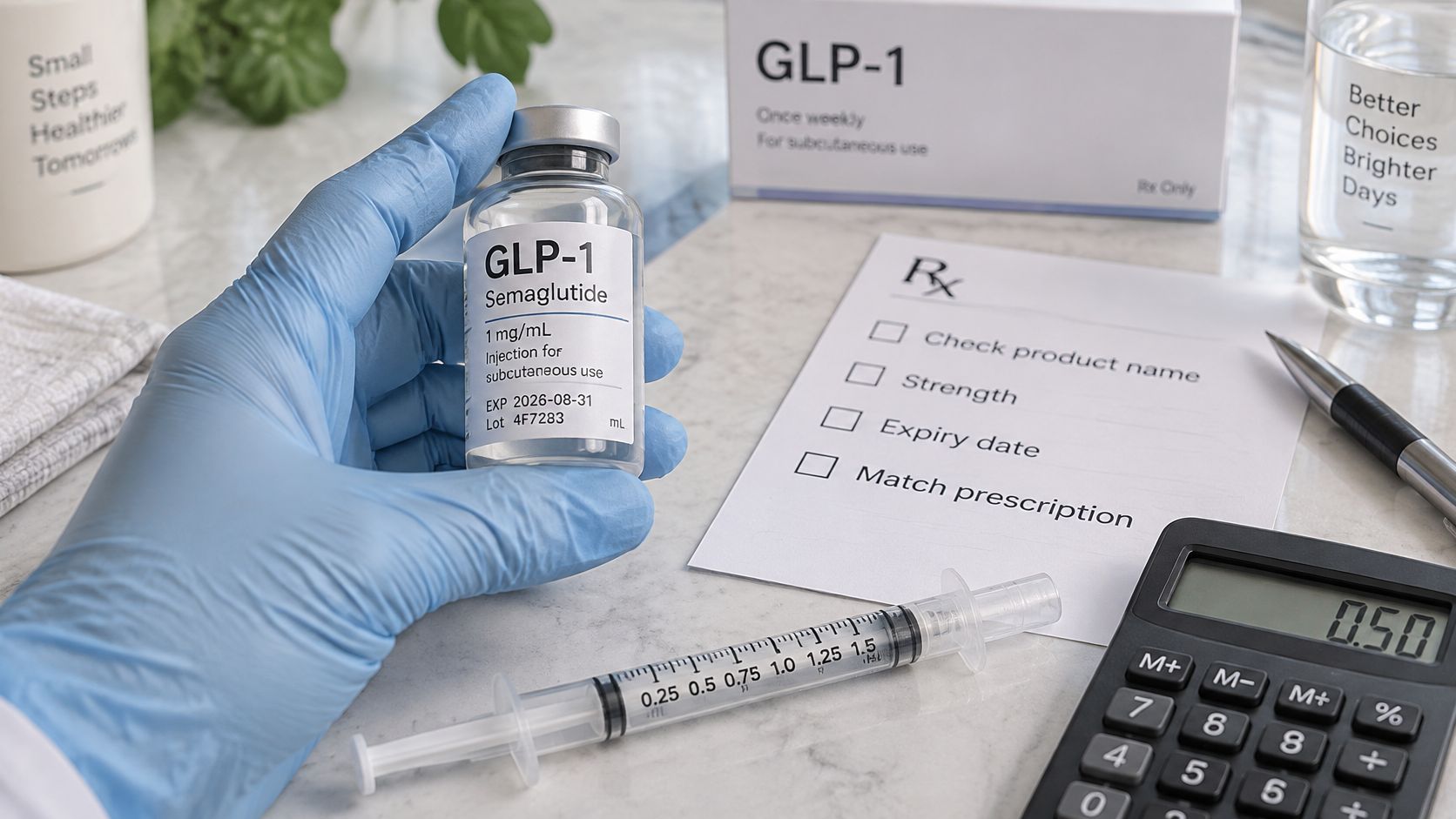
The FDA alert on dosing errors with compounded semaglutide describes patients administering five to 20 times the intended semaglutide dose after misunderstanding syringe markings, milligrams, milliliters, or "units", and some reports involved hospitalization. Many affected patients lacked experience withdrawing medication from a vial, and providers also made conversion errors. That isn't a reason to panic. It's a reason to verify out loud, every time.
| Device | What you verify | Common error |
|---|---|---|
| Manufacturer prefilled pen | Product name, strength and dose shown on the device and leaflet | Assuming a pen works the same as another GLP-1 pen |
| Multidose vial with syringe | Concentration on the label and the syringe marking | Reading units or milliliters as milligrams |
| Compounded medication | Concentration and instructions on the pharmacy label | Copying a dose from a video or another patient's plan |
The same volume in a syringe can mean different doses in different products, because concentrations differ. A units number that was correct for another person, or in an online video, may be wrong for your vial. There's no universal chart you can safely borrow.
Your stop and verify routine
- Confirm the label: Read the medicine name and concentration on your vial or pen, not from memory.
- Translate with help: Have your clinician or pharmacist convert your prescribed milligram dose into the volume for your specific product.
- Check the syringe: Confirm you have the correct syringe size and that its markings match the instructions you were given.
- Ignore copied numbers: Never use a units amount you saw online or heard from another patient.
- Stop on any mismatch: If the label, marking or calculation doesn't line up, don't inject. Call the pharmacy first.
If you can't explain, in one sentence, how your milligram dose becomes the mark on your syringe, you aren't ready to draw yet. Call and ask.
After a suspected overdose, contact your provider right away or call Poison Control at 1-800-222-1222 in the US. Note the product, concentration, amount drawn and time, because those details help the clinician advise you quickly.
How to Inject Your Pen Step by Step
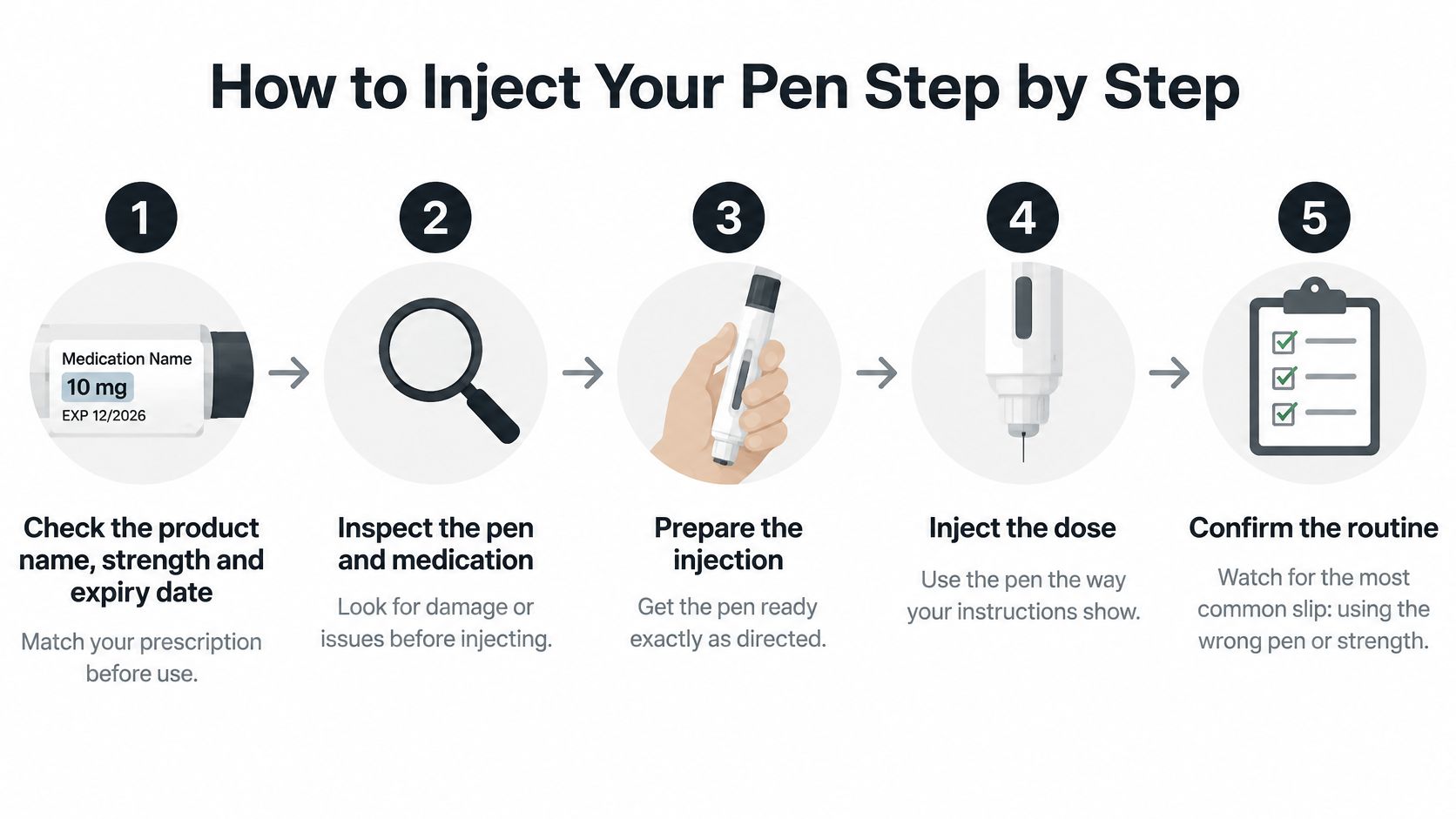
Devices differ, so your leaflet controls the details for your pen. The routine below follows the order most Instructions for Use share, with the reason for each step and the slip that causes trouble. Read your device steps once fully before you start, not while the needle is uncapped.
Prepare before the needle is exposed
- Check the pen against your prescription. Read the product name, strength and expiry date on the device itself. A mismatch means you stop and call the pharmacy, because injecting the wrong strength is a dosing error even if your technique is perfect.
- Wash your hands and set out supplies. You'll need an alcohol swab, a new needle if your device uses one, and a sharps container within reach. Setting up first means you aren't walking around holding an exposed needle. If you're unsure what your device should have, our overview of choosing the right GLP-1 needle size explains how pen needles differ.
- Let the pen reach room temperature as directed. Follow the time in your Instructions for Use. Don't warm it with hot water, a heating pad or a microwave, since heat can damage the medicine.
- Choose and clean the site. Pick the next spot in your rotation, clean it with alcohol and let it dry fully. Injecting through wet alcohol stings, and wiping it dry with tissue undoes the cleaning, so just wait a few seconds.
Deliver the full dose
- Attach the needle and prepare the pen. Attach a new needle if your device requires one, remove the caps in the order shown, and run any safety test or priming step the leaflet specifies. Skipping the test is a common slip, and it can leave you unsure whether the pen is working.
- Confirm the dose, insert, press and hold. Set or confirm the dose display so it matches this week's prescribed milligrams. Insert the needle straight in at the angle your leaflet shows, press the button fully, and hold it in place for the number of seconds your device specifies. Pulling out early is the most common reason part of a dose ends up on the skin instead of under it.
- Withdraw and dispose immediately. Pull the needle straight out, cover it as directed, and place the used needle or pen in the sharps container. Don't recap with two hands, reuse a needle, or share a pen with anyone, even with a new needle.
- Log it while it's fresh. Write the date, site and dose in your log. That one line settles next week's rotation and any later question about whether a dose was missed or repeated.
Dose-match check: Product, strength, milligrams, day. Say all four out loud before step 6. If one doesn't match your prescription, the injection waits.
What normal looks like afterward
A brief sting during the injection, a small bruise, or mild redness at the site is common and usually settles on its own. You might see a tiny drop of blood, which you can press gently with clean gauze. Don't rub the site hard, since that can irritate the tissue.
Call your provider if redness spreads, swelling grows, the area feels hot or painful hours later, or you notice drainage. Those signs point to something other than a routine reaction, and they deserve a same-day conversation rather than watchful waiting.
Storage, Disposal and Troubleshooting
Storage protects the medicine before technique ever matters. Keep unused pens in the refrigerator as your Instructions for Use specify, away from the freezer compartment and direct heat, and protect them from light in their original carton. A pen that's been frozen shouldn't be used, so don't store pens against the back wall where temperatures dip lowest.
Mark, store and dispose with intention
A pen in use may be kept at room temperature for the period your leaflet allows. Write the date you first used it on the carton, because memory is unreliable by week three. If you're unsure how dates apply, our guide to reading medication expiration dates explains the difference between an expiry date and an in-use period.
Place used needles and pens directly into a sharps container, never loose in household trash. Keep the container upright, out of reach of children, and follow your local rules for disposing of it when full. Don't overfill it past the marked line.
When the device does not behave
- No click or plunger movement: Don't repeat the dose right away. Check the dose display and the troubleshooting steps in your leaflet, then call the pharmacy if it's still unclear.
- Medicine leaks after injection: A small drop can happen, but if a visible amount leaked, note the date and call the pharmacy to ask whether anything needs to change. Don't inject extra to compensate.
- Bent needle or stuck pen: Stop and don't force it. Forcing a stuck device can deliver an unpredictable amount. Contact the pharmacy for a replacement.
- Interrupted injection: If you pulled out early or the dose seems incomplete, don't inject again on your own. Call your provider for timing guidance, since a second attempt can become a double dose.
Each problem has the same safe answer. Pause, record what happened, and ask before you inject again.
Side Effects and When to Call Your Provider
The common effects are mainly nausea, diarrhea and vomiting, and they're most likely around dose increases. That's the practical reason the schedule is gradual. The FDA statement on unapproved GLP-1 drugs used for weight loss reports adverse events when patients received doses beyond labeled schedules, including doses taken more often or increased too quickly. A technically perfect injection can still be unsafe if the timing or amount is wrong.
Call your prescriber the same day for
- Persistent vomiting: You can't keep fluids down or it keeps recurring.
- Signs of dehydration: Dizziness, very little urine, or unusual weakness.
- Spreading injection-site redness: Redness that expands, drains, or feels increasingly painful.
Seek emergency care for
- Severe abdominal pain: Intense pain that doesn't ease.
- Fainting or confusion: You feel you may pass out or can't think clearly.
- Suspected allergic reaction: Face or throat swelling, or trouble breathing.
If symptoms follow an unplanned increase or a dose you think may have been doubled, check your log against your schedule and tell your provider exactly what you took and when. Don't add another injection to fix how you feel. For compounded products, concentrations can differ from pen products, so compare symptoms and amounts against your pharmacy label, not generic pen advice. Keeping these lists on your phone means you aren't searching for guidance while you feel unwell.
Confirm Your First Injection Before You Start
Before your first injection, make sure you can match the medicine in your hand to the instructions from your prescriber. Write down the product and strength on the pen or pharmacy label, your prescribed dose and injection day, and what to do if you miss a dose. Keep your prescriber's and pharmacy's contact details handy.
At your appointment, ask your clinician to demonstrate the injection if you need help. Then repeat the plan in your own words: product, dose, day, and next step after a missed dose. This quick check can catch a mix-up before you inject.
If any instruction is unclear, pause and contact your prescriber or pharmacy before starting. If you already have a prescription, follow its instructions.
Weight Method connects patients with licensed clinicians who assess medical history and determine eligibility for GLP-1 treatment. Take the 2-minute quiz to see if you qualify, then bring your checklist to your consultation.