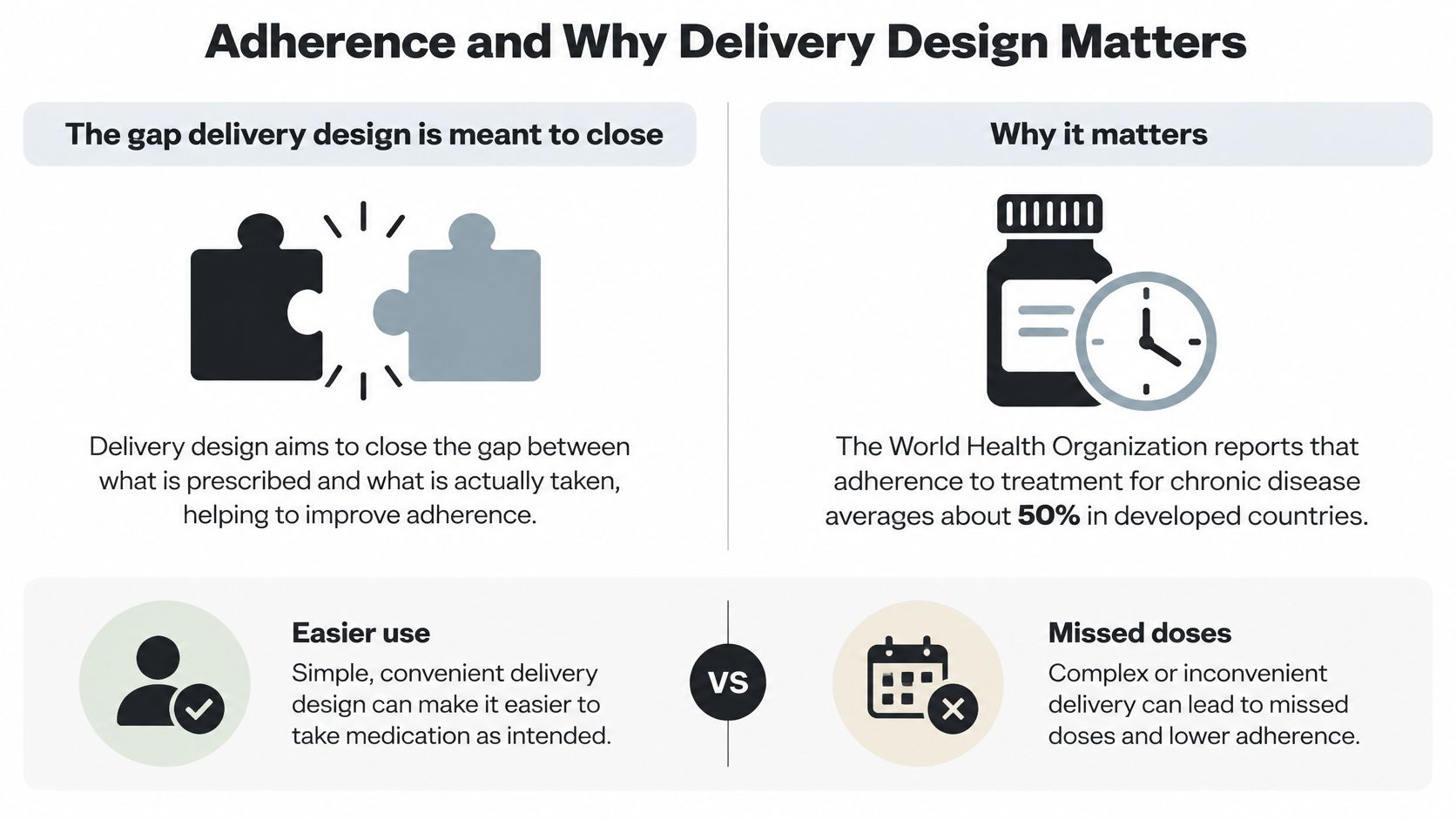
Adherence among people with chronic diseases averages only 50% in developed countries, according to the World Health Organization. That reframes the question of which medication delivery system is best: a treatment has to fit the person's life, not just deliver the right molecule.
A tablet, inhaler, injection pen, pump, or patch can make treatment easier, but each introduces different responsibilities. For medication delivered to your home, those responsibilities also include verifying what was dispensed, who prepared it, and whether it arrived in usable condition.
Medication Delivery System Types Side by Side
A medication delivery system is the formulation, device, and dosing method that determines how a drug enters the body, how quickly it becomes available, and how often you administer it.
Start with the dosing frequency column below. It tells you when you'll need to act, although a continuous-delivery device still requires attention between doses. These are broad patterns, not instructions for an individual prescription.
Medication delivery system types by dosing, advantage and limit
| Delivery type | Typical dosing frequency | Main advantage | Main limitation |
|---|---|---|---|
| Oral tablet or capsule | At prescribed daily dosing times | Simple, non-invasive, often inexpensive | Food and gut conditions can affect absorption |
| Sustained-release oral tablet | At the product's extended dosing interval | Releases medicine gradually | Crushing or chewing can disrupt release |
| Metered-dose inhaler | Scheduled maintenance doses or prescribed rescue use | Delivers a measured puff toward the lungs | Poor technique reduces the dose reaching the lungs |
| Injectable pen or auto-injector | At the prescribed daily or weekly interval | Supports self-administration without drawing medicine from a vial | Requires injection training; not every pen has a preset dose |
| Insulin or infusion pump | Continuous delivery, with programmed additional doses when prescribed | Allows delivery to be programmed around treatment needs | Device interruptions and infusion-site problems need prompt attention |
| Transdermal patch | At the product-specific replacement interval | Delivers medicine through the skin without an injection | Can irritate skin and only suits suitable drugs |
Conventional tablets often involve less equipment and lower costs than device-based treatment, but the cheapest format isn't automatically the cheapest prescription. Coverage, formulation, and the medication itself affect what you pay. Pumps and pens offer different kinds of control, with added training and supplies.
Separate the device from the fulfillment route
Retail pickup, mail-order dispensing, and telehealth delivery sit on top of these options. Receiving something by mail doesn't tell you whether it's a tablet, branded pen, or compounded medication in a vial.
For a closer look at route-specific decisions, our oral versus injectable semaglutide guide addresses that comparison. Start by identifying a routine you can maintain, then check whether the medicine and device are clinically appropriate.
How Delivery Systems Control Drug Release
Think of a bathtub with water flowing in and draining out. An immediate-release medicine resembles a faster-running tap: drug becomes available relatively quickly, then the body clears it. A sustained-release formulation resembles a slower tap, designed to spread delivery across a longer interval.
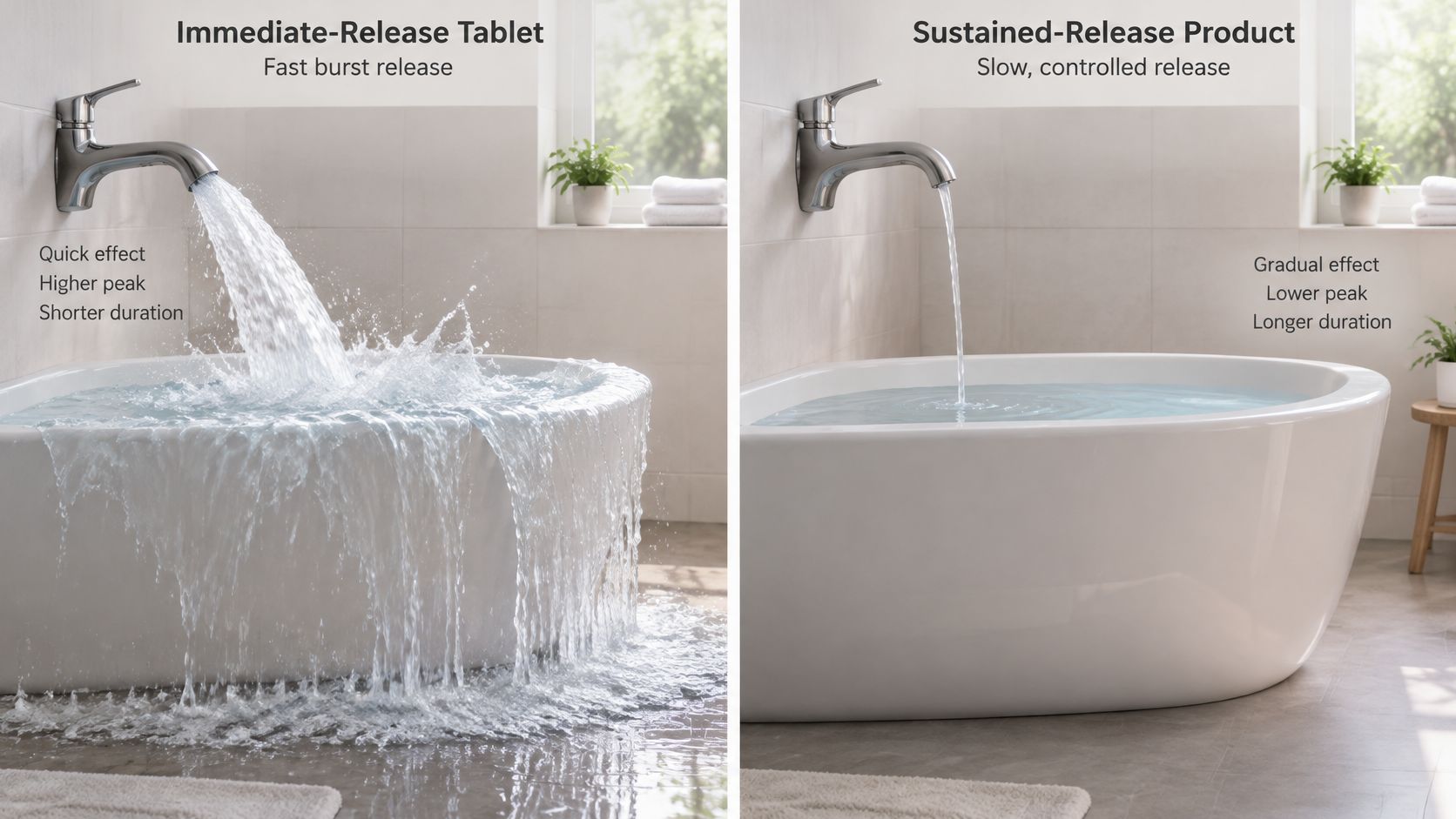
The analogy isn't exact. An immediate-release tablet doesn't necessarily produce an unsafe peak, and extended release doesn't guarantee a perfectly flat drug level. Clinicians consider the peak, the higher concentration after a dose, and the trough, the lower concentration before another dose, alongside the medicine's therapeutic range.
Different mechanisms, different patterns
Coatings and matrices can control how an oral formulation releases its contents. An inhaler meters medicine with each actuation, while a pump delivers according to programmed settings. A patch controls delivery across the skin rather than through the digestive tract.
The historical milestones illustrate that distinction: a review of drug-delivery development describes 12-hour Spansule sustained release in 1952 and the 1979 FDA approval of Transderm Scop, a scopolamine patch providing motion-sickness prevention for up to 72 hours.
Handling rule: Don't crush, chew, split, open, or cut a modified-release product unless a pharmacist confirms that the specific formulation permits it.
That qualification matters because modified-release products aren't interchangeable in how they're handled. Some capsules have approved opening instructions, while other products must remain intact.
A slower release pattern may reduce dosing decisions and concentration swings, but release speed is only part of the picture. How quickly the body absorbs and eliminates the drug also determines how long its effects last.
Adherence and Why Delivery Design Matters
Adherence means following the agreed treatment regimen, not just having medication at home. The WHO's chronic-disease findings highlight a practical gap: prescribing an effective drug doesn't ensure that a patient can consistently use it.
A less frequent schedule can help someone who repeatedly misses lunchtime tablets. It won't necessarily help someone who forgets which day an injection is due, cannot tolerate the medication, or struggles to operate its device.
Judge the task, not the technology
- Tablets and capsules: Easy to carry, but food instructions and repeated dosing can complicate a working day.
- Extended-release medicines: Fewer administration times may help, provided the patient can swallow and handle the formulation correctly.
- Inhalers: Portable and targeted, but the patient needs a technique demonstration and a chance to demonstrate it back.
- Pens and auto-injectors: Convenient for some people; needle anxiety, vision, and hand strength still matter.
- Pumps: Reduce some manual dosing tasks but add alarms, supply changes, and infusion-site checks.
- Patches: Avoid swallowing and injection, but adhesion, skin tolerance, and remembering removal remain important.
A useful medication record includes the dose taken, symptoms afterward, and the reason for a missed administration. For caregivers, Guiding Growth's resource on documenting medication routines before pediatric appointments provides a focused way to prepare that conversation.
A missed dose is information about the treatment routine, not a reason to blame the patient.
Ask what made the task difficult. A reminder may solve forgetfulness, but it won't solve nausea, an unaffordable refill, or an unreadable device display. The most sustainable system is the one the patient can keep using after the novelty wears off, with appropriate education and monitoring.
Weekly GLP-1 Pens and Dose Escalation
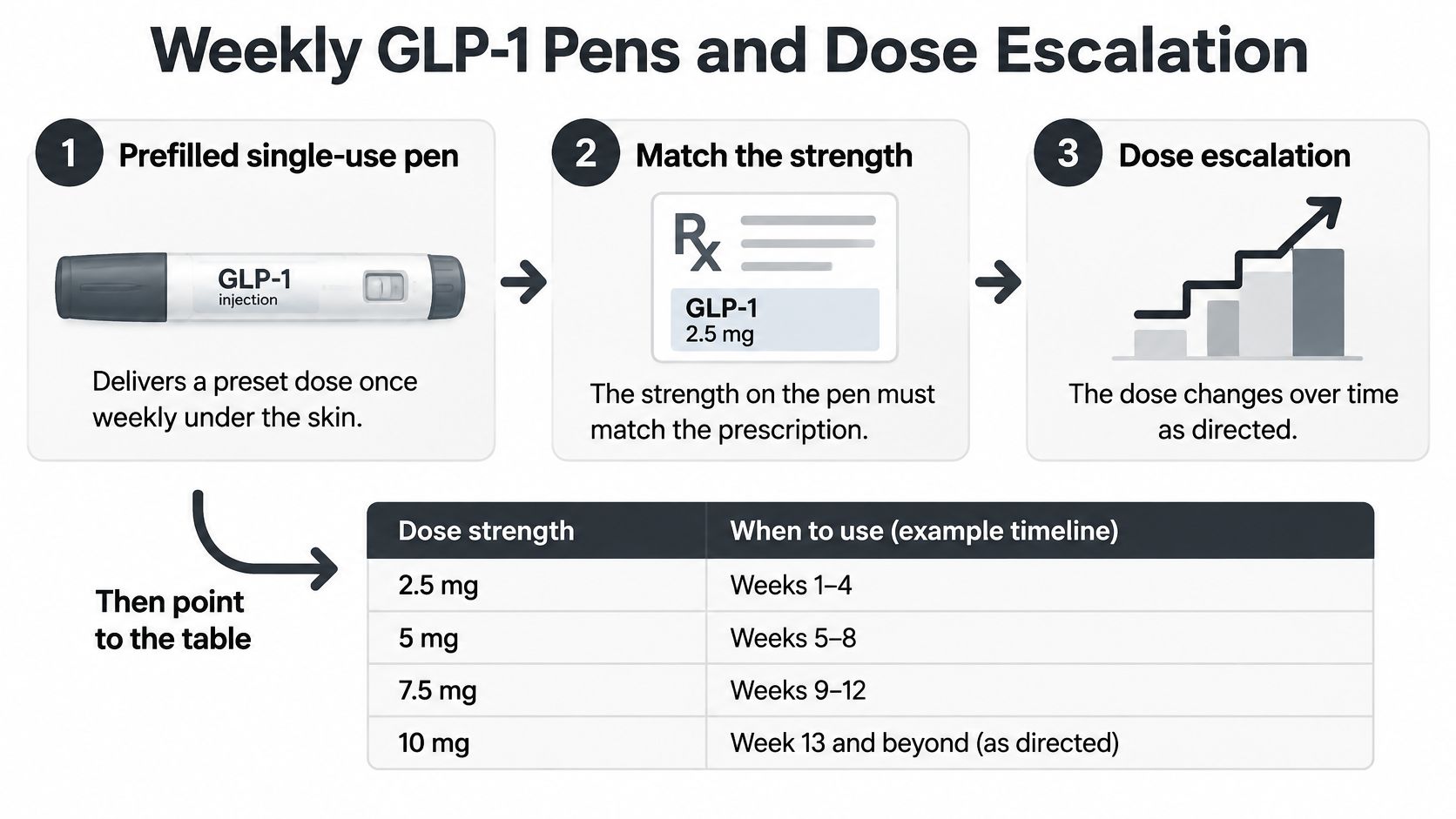
Some branded weekly GLP-1-related treatments are supplied as prefilled, single-use pens with preset doses. Don't assume every semaglutide or tirzepatide product uses that format: presentations differ, and a compounded vial isn't a branded pen.
For a preset pen, the strength on the device must match the prescription. It isn't a syringe from which you should estimate a smaller dose.
Starting doses are an introduction, not a race
The schedules below summarize the initiation and escalation instructions in the respective FDA prescribing documents. They aren't complete prescribing instructions or schedules for compounded products.
Weekly GLP-1 pen titration schedules
| Medication | Starting dose | Escalation |
|---|---|---|
| Semaglutide (Wegovy) | 0.25 mg once weekly, according to the FDA semaglutide prescribing information | Increase at four-week intervals; consider delaying escalation for four additional weeks if the dose isn't tolerated |
| Tirzepatide (Zepbound) | 2.5 mg once weekly for four weeks, according to the FDA tirzepatide prescribing information | Increase in 2.5 mg increments after at least four weeks at the current dose, as prescribed |
The provider selects the maintenance dose rather than automatically advancing every patient to the highest strength. Tirzepatide's initiation dose isn't a maintenance dose.
Gradual escalation gives the gastrointestinal system time to adapt and helps manage nausea, vomiting, and diarrhea. Finishing the current supply doesn't, by itself, establish that you're ready for a stronger prescription.
Make each escalation a clinical checkpoint
Before using the next strength, review how you've tolerated treatment and whether you've missed doses. Report persistent vomiting, inability to keep fluids down, or signs of dehydration promptly rather than waiting for a routine refill. Severe or persistent abdominal pain also needs medical assessment.
Rotate injection locations within the approved areas of the abdomen, thigh, or upper arm, using the product's administration instructions. Don't repeatedly inject into the same spot, and have a pharmacist or clinician explain any device step you can't confidently demonstrate.
Our GLP-1 dosing guide offers additional context for provider-managed treatment. At Weight Method, your provider selects treatment and dosing based on your preferences, medical history, and lifestyle; care includes ongoing monitoring and care-team messaging. If oral results are insufficient, your provider can discuss whether an injectable option is appropriate.
How Mail-Order and Telehealth Medication Reaches Your Door
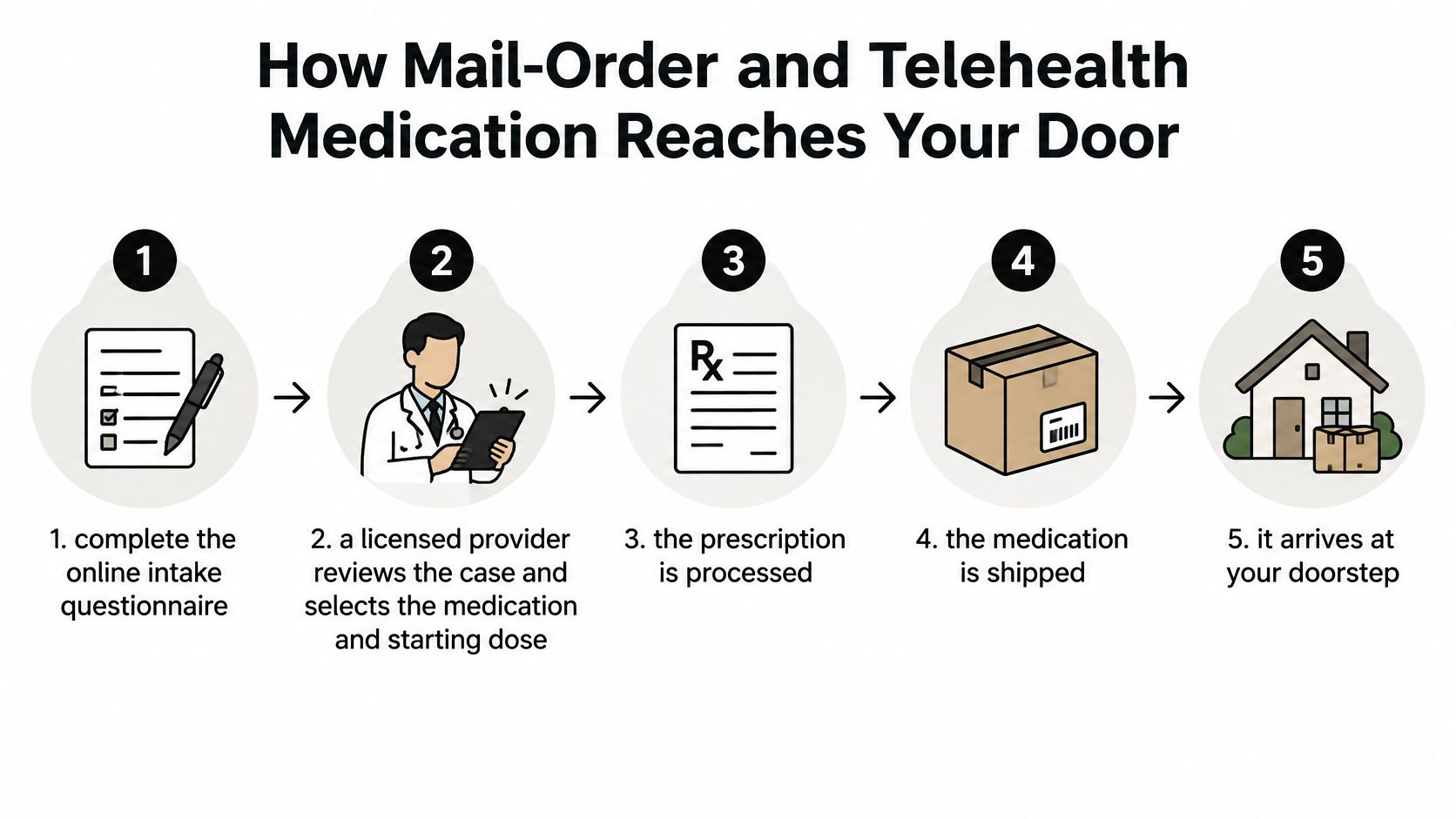
A package arriving at your door is the end of a dispensing process, not proof that the process was sound. Follow the prescription from clinical review through pharmacy preparation and transport.
Follow the handoffs
- Complete the intake. Check that your medication list, allergies, and medical history are accurate. Missing information can affect the prescribing decision.
- Confirm clinical review. A licensed provider should evaluate your case and select treatment rather than fulfill a shopping-cart request.
- Review payment and prescription details. Confirm what you're being charged for and whether approval is still pending.
- Identify the dispensing pharmacy. Keep its contact details and compare the patient name, medication, and instructions with your prescription.
- Track transport. Temperature-sensitive medicine needs product-appropriate protection. Delays require a pharmacist's assessment, not a guess based on whether the box feels cool.
- Inspect the delivery. Check the seal, label, contents, and condition before use. Keep packaging and photographs if anything is wrong.
Pro Tec Pep's explanation of protecting sensitive compounds in transit provides background on cold-chain handling, but your dispensing pharmacist must determine whether your particular shipment remains usable.
Verify the product as well as the parcel
The FDA's clarification of GLP-1 compounding policies states that the U.S. semaglutide injection shortage was resolved on February 21, 2025, while noting that localized disruptions could continue. Federal rules generally restrict compounding copies of commercially available drugs unless an applicable exception is met; compounding isn't a routine substitute for an approved product.
Our medications ship by FedEx from U.S.-licensed 503A compounding pharmacies, with delivery typically taking 3–7 business days after prescription approval. Our medication shipping guide provides shipping context.
We replace medication that's damaged, defective, unusable, lost in transit, or mismatched to the prescription at no additional charge. Verifiable delivery matters more than speed: you should know which pharmacy to contact and what happens when a shipment goes wrong.
Real-World Cases for Each Delivery System
These everyday scenarios show why the right format starts with the treatment task. They aren't individual patient histories or instructions to choose a medicine without clinical assessment.
Match the device to the moment
A child with asthma needs a usable inhaler routine. A metered-dose inhaler with an appropriate spacer can help the child administer prescribed inhaled medicine. The caregiver needs to distinguish the maintenance plan from rescue instructions and demonstrate the technique.
An adult with a severe allergy carries an epinephrine auto-injector. The device removes the need to draw medicine from a vial during an emergency. The patient and people close to them still need device-specific practice and an emergency action plan.
A person with type 1 diabetes chooses an insulin pump. Programmed background delivery and meal-related boluses can suit their treatment needs. The practical requirement is willingness to respond to alerts and maintain a backup plan for interrupted delivery.
Match ongoing treatment to everyday life
A traveler prone to motion sickness considers a scopolamine patch. Wearing a patch may fit the journey better than remembering repeated oral administration. Suitability, application timing, and adverse effects still need review before travel.
An adult using prescribed weekly weight-management treatment chooses a pen. A recurring calendar reminder and accessible follow-up can fit a busy schedule. The device doesn't replace symptom reporting or provider decisions about treatment changes.
Routine test: Choose an option you can operate correctly on a difficult day, not just during a calm demonstration.
Consider when you can reliably act, how comfortable you are with the equipment, and who can help if something fails. Different medical needs call for different systems; the most advanced device isn't automatically the most appropriate.
Verify a GLP-1 Delivery Program Before You Order
Use the checklist before paying, then compare the delivered medication with the written order. Save the prescription summary, pharmacy contact information, and replacement terms so you're not trying to reconstruct them during a problem.
GLP-1 delivery program verification checklist
| Check | Where to find it | Reassuring sign | Warning sign |
|---|---|---|---|
| Product identity | Prescription label or order summary | Brand identified, or compounded product clearly identified as not FDA-approved | Vague or missing drug name |
| Pharmacy license | Pharmacy details on label or website | Named U.S.-licensed pharmacy with verifiable credentials | No pharmacy identified or credentials unavailable |
| Provider review | Visit summary or account page | Licensed provider reviewed the case before shipping | Medication sent without clinician review |
| Dose strength | Device or vial label and prescription | Strength, prescribed amount, and instructions agree | Strength differs or instructions are unclear |
| Shipping trigger | Order confirmation | Shipment requires provider approval | Shipment proceeds without a clinical decision |
| Replacement policy | Terms of service | Written process for damaged, lost, or mismatched medication | No clear replacement procedure or response timeline |
Understand what approval does and doesn't mean
A compounded medication is not FDA-approved, even when a licensed pharmacy prepares it under a patient-specific prescription. Pharmacy licensure, provider authorization, and FDA product approval describe different safeguards; none should be used as shorthand for another.
Our compounded medications are prepared by U.S.-licensed 503A pharmacies under patient-specific prescriptions. A licensed medical provider personally reviews every case, selects the medication, and determines initial dosing. We collect payment at checkout, but medication ships only if the provider approves it.
Act on missing answers
A vague medication name, unexplained strength, or shipment without clinical review is a reason to stop and request written clarification. Don't inject a product while you're still trying to establish what it is.
If a program can't answer every checklist item in writing, don't order. Once those checks are satisfied, compare price, refill timing, cancellation terms, and follow-up access before committing. For our service, patients outside Florida may complete intake, but no prescription is issued and no medication is dispensed to them.
Weight Method connects eligible patients with licensed providers for individualized treatment decisions, ongoing monitoring, and care-team messaging, with prescribed compounded medication delivered through U.S.-licensed pharmacies. Visit Weight Method to review eligibility and begin an intake focused on a medication routine you can safely maintain.