Yes, the FDA approved a semaglutide product for chronic weight management, Wegovy (semaglutide 2.4 mg), on June 4, 2021. That approval covers the branded product and its labeled population only, not compounded semaglutide.
If semaglutide is the same molecule in every pen, vial, and pill, why doesn't one approval cover them all? That question reveals the gap in how discussions about semaglutide weight loss FDA approval often occur. People say the drug is approved, as if approval applies to an ingredient. It doesn't. It applies to a specific product, at a specific strength, for a specific use, in a specific population.
That distinction explains most of the confusion you'll hear. Ozempic and Wegovy aren't interchangeable labels, a compounded preparation isn't an approved brand, and a headline trial result isn't a promise for any one person. Once you read approval as product-specific, the timeline, the trial evidence, and the practical checks before starting treatment all become much easier to follow.
Semaglutide's FDA Approvals, Year by Year
Semaglutide has no single FDA approval. Each brand and each labeled use was approved separately, starting with Ozempic for type 2 diabetes. Reading those actions in order shows why the weight-management approval belongs to Wegovy, and why later Wegovy approvals changed the label without changing Ozempic's.
FDA semaglutide approvals by date, product and labeled use
| Date | Product | Approved use | Population or note |
|---|---|---|---|
| December 5, 2017 | Ozempic (semaglutide injection) | Glycemic control in type 2 diabetes | Not a weight-management indication |
| June 4, 2021 | Wegovy (semaglutide 2.4 mg injection) | Chronic weight management with diet and physical activity | BMI 30 or higher, or 27 or higher with a weight-related condition |
| 2024 | Wegovy | Reduce risk of major adverse cardiovascular events | Adults with established cardiovascular disease and obesity or overweight |
| 2025 | Wegovy | Moderate-to-advanced fibrosis from metabolic-associated steatohepatitis | Adults with MASH fibrosis |
| December 2025 | Wegovy pill (oral semaglutide) | Chronic weight management | Oral tablet, separate from the injectable Wegovy label |
How to read this timeline
Read each row as three separate answers. The date tells you when that labeled use existed, the product name tells you which label applies, and the population tells you who the approval covers. If any one of those three doesn't match the product in your hand, you're looking at a different approval, or at no approval at all.
People searching this topic need the weight-management rows. The other rows still matter because they change what the label says about risk and purpose. A cardiovascular or liver indication isn't a cosmetic claim, and it doesn't widen the weight-management population. It adds a separate use, for a separate group, under the Wegovy name.
Reading rule: Name the product first, then the use, then the population. If a claim skips any of those three, it is not precise enough to act on.
Why Ozempic and Wegovy Carry Different Approvals
Think of semaglutide as one engine sold in two car models. Each model is certified for different roads, and the certification for one doesn't transfer to the other just because the engine matches.
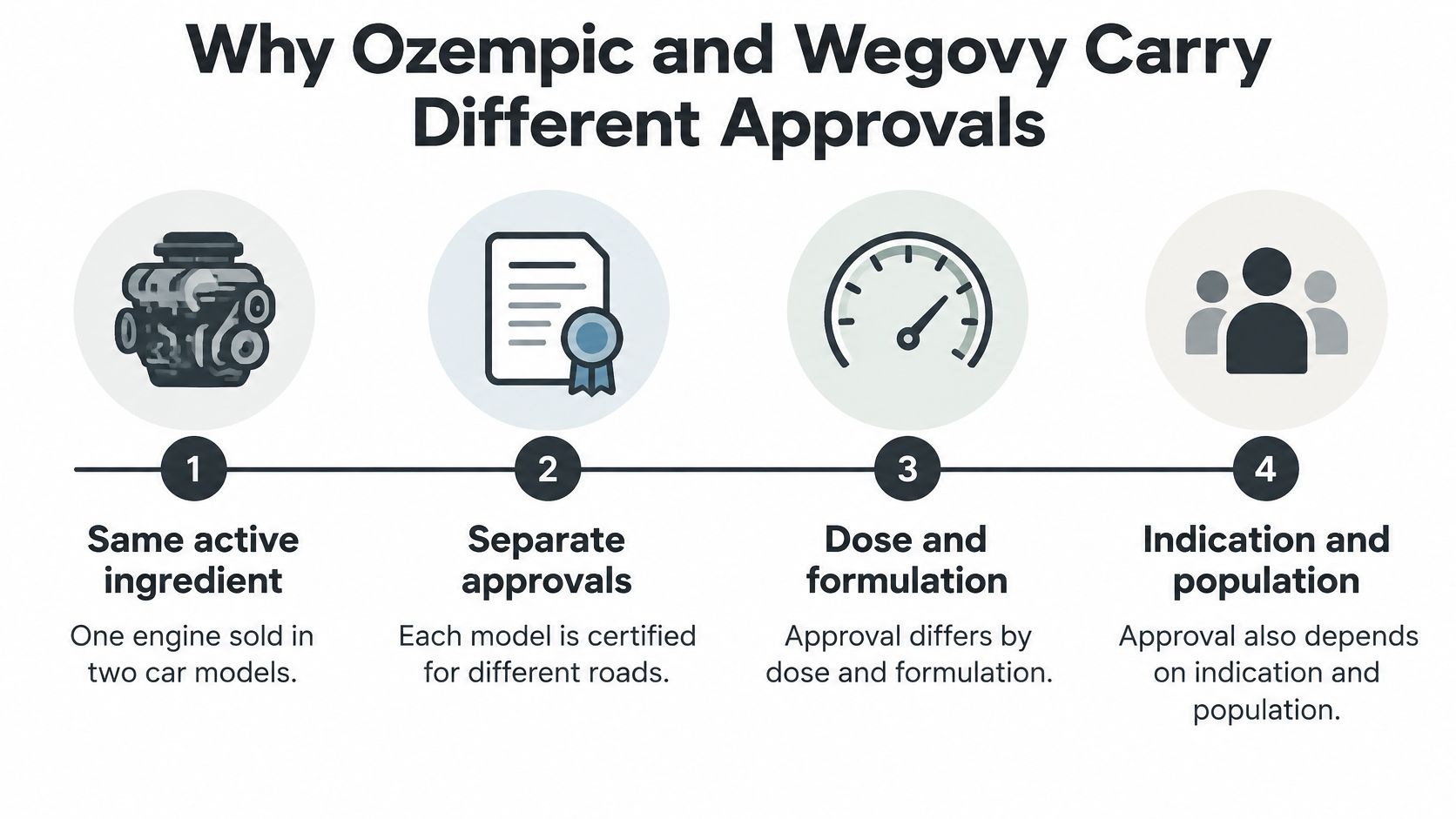
The FDA approval document for these semaglutide products records Ozempic's first approval on December 5, 2017, as an adjunct to diet and exercise for improving glycemic control in adults with type 2 diabetes, and Wegovy's approval on June 4, 2021, for chronic weight management alongside a reduced-calorie diet and increased physical activity. Wegovy is the higher-dose 2.4 mg formulation, and its initial population was adults with a BMI of at least 30 kg/m², or at least 27 kg/m² with a weight-related condition such as hypertension, type 2 diabetes, or dyslipidemia.
That separation is easy to miss when health topics overlap. Weight, blood sugar, blood pressure, and lipids often travel together, which is why readers comparing metabolic topics may also explore testosterone's effects on cholesterol. Overlapping risk factors still don't merge separate drug labels.
For any box, make three checks. Confirm the brand name, the strength, and the labeled indication. Those three items decide what the approval covers.
What the STEP 1 Trial Showed and What It Could Not
Approval needs evidence, and for Wegovy's weight indication the central evidence came from STEP 1. The STEP 1 trial report in The New England Journal of Medicine describes 1,961 adults with overweight or obesity who received once-weekly semaglutide 2.4 mg or placebo for 68 weeks, with both groups receiving lifestyle counseling. Mean body weight fell 14.9% with semaglutide versus 2.4% with placebo.
That design matters as much as the headline number. Participants didn't take a drug in isolation. They followed a structured program, escalated the dose gradually, and stayed in a controlled study long enough for slower, progressive change to show up.
The results at 68 weeks
STEP 1 weight outcomes at 68 weeks
| Outcome at 68 weeks | Semaglutide 2.4 mg | Placebo |
|---|---|---|
| Mean body weight change | minus 14.9% | minus 2.4% |
| Participants losing at least 5% of body weight | 86.4% | 31.5% |
| Placebo-adjusted difference | 12.4 percentage points | Reference group |
| Statistical significance of between-group difference | P below 0.001 | Reference group |
The 12.4 percentage point gap is the clearest way to understand the drug's contribution. It's the difference between the semaglutide group's average loss and the placebo group's average loss, not a second result added on top. The threshold result tells a related story in plainer terms. Most semaglutide participants crossed the 5% weight loss mark, while a minority of placebo participants did.
Why the placebo group matters
Picture two runners who both get coaching, training plans, and regular check-ins. One also gets the medication. If you only report how far the medicated runner traveled, you can't tell how much came from coaching and how much came from the drug. The gap between the runners is the useful comparison.
STEP 1 works the same way. Both arms received lifestyle counseling, so the placebo group shows what counseling, study contact, and expectation could do without semaglutide. Semaglutide is a GLP-1 receptor agonist that supports appetite reduction and lower energy intake, but the trial result reflects medication plus behavior support together. That's not a weakness in the design. It's exactly how the approved treatment is meant to be used.
The drug-attributable effect is the gap between groups, not the total loss in the treatment group.
What 68 weeks should do to your expectations
A 68-week endpoint is a long horizon, roughly sixteen months. Dose escalation takes time, tolerability has to be managed, and weight change accumulates over many months. A first-month result, good or disappointing, isn't the benchmark the trial used.
Readers often get confused. They see an average near fifteen percent and mentally convert it into a short timeline or a personal guarantee. The trial supports neither move. It reports group averages at a distant endpoint under controlled conditions.
The limits you shouldn't skip
STEP 1 excluded people with type 2 diabetes, so its average doesn't automatically describe that population. It was also a controlled trial, with selected participants, scheduled follow-up, and lifestyle support built in. Real-world routines are messier, and individual responses vary around any average.
What the trial does support is specific and still substantial. In adults matching its population, once-weekly semaglutide 2.4 mg with lifestyle counseling produced significantly greater weight loss than placebo with the same counseling over 68 weeks. That supports a chronic-treatment claim, including long-term reducing and maintaining weight, rather than a promise of rapid or uniform results.
Who Qualifies Under the Wegovy Weight Label
Eligibility starts with BMI, but it doesn't end there. The FDA-approved Wegovy prescribing information covers adults with an initial BMI of at least 30 kg/m², or at least 27 kg/m² when accompanied by a weight-related condition such as hypertension, type 2 diabetes, or dyslipidemia. It also specifies use alongside a reduced-calorie diet and increased physical activity.
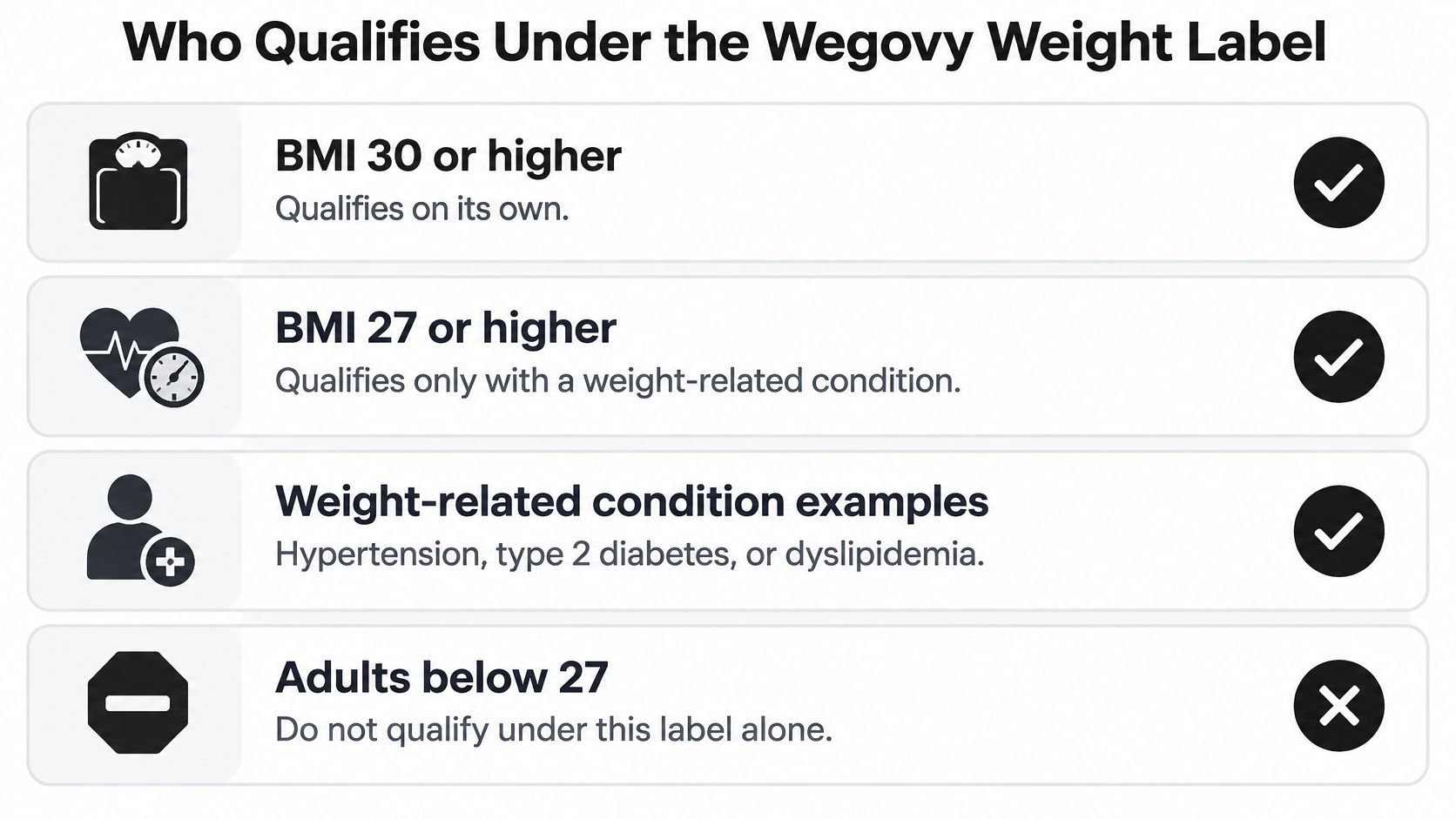
Wegovy weight-management eligibility at a glance
| Situation | Label status | Who this describes |
|---|---|---|
| BMI 30 or higher | Qualifies on BMI alone | Adults with obesity |
| BMI 27 to 29.9 | Qualifies only with hypertension, type 2 diabetes or dyslipidemia | Adults with overweight and a weight-related condition |
| BMI below 27 | Outside the weight-management label | Not indicated for weight management |
| Personal or family history of medullary thyroid carcinoma or MEN 2 | Contraindicated | Do not use |
The edge case that causes confusion
Say an adult has a BMI of 28 and no hypertension, type 2 diabetes, dyslipidemia, or other qualifying weight-related condition. That person is outside the Wegovy weight-management label, even though they may strongly want treatment. Wanting to lose a certain amount of weight isn't itself an eligibility criterion.
Adults below 27 are also outside this indication. A prescriber may discuss other approaches, but they shouldn't present Wegovy's weight approval as if it covers every adult who wants to be lighter.
Titration, side effects, and screening
The approved regimen is titrated over about 16 weeks to reduce treatment-limiting gastrointestinal effects, followed by maintenance dosing. Gastrointestinal events were the most common adverse effects, including symptoms such as nausea, diarrhea, and constipation during escalation. Rushing that schedule undermines the reason it exists.
The label carries a boxed warning concerning thyroid C-cell tumors observed in rodents. It contraindicates use in patients with a personal or family history of medullary thyroid carcinoma or MEN 2. Those aren't fine-print details to discover after the first dose. They belong in intake screening.
In our process, semaglutide or tirzepatide is selected based on BMI, medical history, and expected response, with gradual escalation dosing. Readers who want the broader screening logic can review the GLP-1 eligibility guide, and those comparing care models can also look at semaglutide treatment at ProMD Health. Either way, the prescriber's job is to match product, dose, and monitoring to the person, not to approve everyone who asks.
Check Any Product's Label Yourself
You don't have to take a marketing claim at face value. You can verify a product against its FDA label in a few minutes, using the exact name and strength on your prescription.
A step-by-step label check
-
Start with the exact product. Find the brand name, dosage form, and strength on the carton, pharmacy label, or prescription. Write down whether it's an injection or a tablet, because form is part of the approval.
-
Find it in Drugs@FDA. Search FDA's Drugs@FDA database for that exact brand name and open its current prescribing information. Don't substitute a different semaglutide brand's label because the ingredient matches.
-
Read Indications and Usage first. Confirm the approved use and population in that section. If weight management isn't listed there, the product doesn't carry a weight-management approval under that label.
-
Check Dosage and Administration. Compare the titration schedule and maintenance dose with your prescription. A strength or escalation plan that doesn't resemble the label deserves a direct question to the prescriber.
-
Read the Boxed Warning and Contraindications. Do this before starting, not after symptoms appear. Pay particular attention to any personal or family history items the label names.
-
Compare every detail side by side. Brand, strength, form, indication, and population should all line up. If the brand or population doesn't match, the product is outside that label even though the molecule is the same.
If there's no brand label to open, you've already learned something important about the product's regulatory status.
Compounded preparations don't carry an FDA-approved brand label, so this check reveals the gap quickly. You may still receive prescriber instructions and pharmacy information, and you should read them carefully. They aren't the same document as FDA-approved prescribing information.
Keep a copy of what you checked. Note the product name, strength, pharmacy, and the date you reviewed the label. If a refill arrives in different packaging or with a different concentration, repeat the comparison before using it and ask the dispensing pharmacy to explain the change. Small packaging differences can be harmless, but you shouldn't have to guess which ones matter.
Why Approval Does Not Guarantee Your Results
An FDA approval is like a driver's license. It authorizes a particular driver to use particular roads under particular rules. It doesn't guarantee an arrival time.

The 2025 Wegovy prescribing information reflects labeling that includes chronic weight management and cardiovascular-risk reduction for adults with established cardiovascular disease plus overweight or obesity, and FDA separately approved Wegovy in 2025 for adults with moderate-to-advanced fibrosis associated with metabolic-associated steatohepatitis. Approval still isn't a guarantee that every patient will lose a particular percentage of body weight, avoid regain, or receive insurance coverage.
Two different paths on the same approval
Example one follows the labeled path. An adult completes gradual titration, reports gastrointestinal symptoms early, and adjusts meals while the dose rises. After reaching a target weight, they don't treat the prescription as finished. They and the prescriber discuss maintenance dosing, follow-up intervals, and what change would trigger a new plan.
Example two starts with the same approved product but a different pattern. The adult escalates faster than scheduled because early loss feels slow, then misses doses for several weeks during travel. Faster escalation can raise gastrointestinal side-effect risk, missed doses can slow progress, and restarting may require re-titration rather than jumping back to the prior dose.
The approval didn't change between those examples. Eligibility, titration, tolerability, duration, and maintenance planning did, and those factors matter more to an individual's outcome than a headline percentage.
Stopping is part of the plan, not an afterthought
Weight regain is expected after discontinuing any semaglutide formulation, including oral Wegovy. That means a planned stop date changes the treatment conversation from the beginning. A prescriber should explain whether the goal is ongoing maintenance, a taper discussion, transition to another therapy, or structured monitoring after stopping.
Timeline expectations need the same honesty. Our overview of how much weight you can lose on semaglutide can help you prepare better questions about how personal results are usually framed, and the Medical Aesthetics And Lasers weight-loss guide offers another patient-facing discussion of timing. Neither replaces the central point. A first-month result isn't the trial's endpoint.
Before starting, ask one planning question and insist on a concrete answer. What happens after I reach the target weight, and how will maintenance be managed? If the answer is only that you'll decide later, the plan isn't complete yet.
Verify the Product and Eligibility Before You Start
A lower price doesn't make a product FDA-approved. Easier access doesn't either.
The FDA statement clarifying policies for GLP-1 compounders explains that FDA determined on February 21, 2025, that the national semaglutide injection shortage had been resolved, while localized supply disruptions could continue. It provided limited transition periods generally until April 22, 2025, for 503A pharmacies and May 22, 2025, for 503B outsourcing facilities.
FDA-approved brand versus compounded semaglutide
| Factor | FDA-approved brand | Compounded semaglutide |
|---|---|---|
| FDA approval status | Approved for specific branded products and labeled uses | Not FDA-approved as a product |
| Dose strengths | Fixed labeled strengths, up to 2.4 mg for Wegovy | Set by the prescriber; confirm concentration against the prescription |
| Manufacturing controls | Manufacturer's approved process | Compounding pharmacy under 503A or 503B rules |
| Labeling | Full FDA-approved prescribing information | No brand label; the prescriber's instructions apply |
| Packaging | Manufacturer's original packaging | Varies by pharmacy |
| Adverse-event reporting responsibility | Defined by the brand's labeling and manufacturer | Often unclear to patients; ask the prescriber or dispensing pharmacy |
| Shortage-period transition | Not applicable to the approved product | 503A transition ended April 22, 2025; 503B transition ended May 22, 2025 |
Semaglutide and tirzepatide are prescription medications, and the dose is selected and managed by a licensed provider. A product listing shouldn't choose your dose. If you're researching that distinction further, our guide to whether compounded GLP-1 medications are FDA-approved explains the terminology in more detail.
Five checks before the first dose
-
Name the exact product. Ask whether you'll receive an FDA-approved brand or a compounded preparation, and get the strength and form in writing.
-
Check your eligibility. Eligibility for GLP-1 treatment requires a BMI of 30 or higher, or a BMI of 27 or higher with qualifying comorbidities. If you're between 27 and 29.9, confirm the specific qualifying condition.
-
Ask about the full course. How will the dose escalate, how long is treatment planned, and what's the maintenance approach after the target weight?
-
Identify the pharmacy and packaging. Confirm who dispenses the medication and whether it arrives in the manufacturer's original packaging.
-
Clarify safety responsibility. Ask who handles adverse-event reporting and which symptoms should prompt an urgent call rather than waiting for the next check-in.
Telehealth programs can run screening, prescribing, and follow-up, but the same checklist applies to any prescriber. Convenience doesn't lower the standard for product identity, storage, shipping, or accountability.
At your next appointment, start with one question. Which exact product are you prescribing, and is it FDA-approved under that name and strength? A precise answer tells you the clinician understands the distinction. A vague answer tells you to keep asking.
If you're considering GLP-1 treatment and want that product, eligibility, and dosing conversation handled clearly from the start, Weight Method connects you with licensed providers who evaluate your history, explain your options, and manage gradual dose escalation with ongoing support. Take the brief assessment, meet your provider by video, and get a plan built around monitored, long-term weight management rather than a headline promise.