No universal number of days applies after surgery, and restarting depends on returning to your usual diet without significant nausea or vomiting. That answer can feel frustrating if you're looking at a calendar with your next weekly injection due.
What if the calendar is the wrong tool for this decision? Many people ask when can you resume Mounjaro after surgery expecting a fixed interval, the same way they expect a date for removing stitches. Recovery doesn't work that neatly. Two patients can have surgery on the same day and be ready on very different days because one is eating normally and the other is still nauseated and barely sipping fluids.
Think of restart readiness as a check you pass, not a date you reach. You're checking stability, food and fluid tolerance, bowel function, and glucose control. The sections below walk through how surgery type changes that check, the exact steps to work through with your team, and what to do if a dose was missed or your break stretched longer than planned.
When Mounjaro Can Restart After Common Surgeries
There's no safe shortcut here. The perioperative guidance on restarting tirzepatide states there's no universal postoperative hour or day at which Mounjaro should automatically be resumed, and it emphasizes clinical recovery instead. Restarting may be reasonable once you're hemodynamically stable, you've resumed and tolerated your usual diet, and you don't have significant nausea, vomiting, abdominal distension, ileus, or inability to take oral fluids and food.
That definition matters because it replaces guessing with observable signs. Can you eat a normal meal and keep it down? Are you drinking without vomiting? Is your abdomen comfortable rather than distended? If the answer to any of those is no, the restart waits, even if your injection day has arrived.
Restart when recovery signs are met, not when the weekly schedule turns over.
Finding your own case in the table
For uncomplicated surgery outside the gastrointestinal tract, restarting often means taking the next scheduled weekly dose only after those recovery conditions are met. It doesn't mean injecting as soon as you leave the operating room. Procedures vary within that category, too. Recovery planning after a tummy tuck without muscle repair is different from recovery after joint surgery, so your surgeon's instructions about diet progression still control the timeline.
If surgery involved the gastrointestinal tract, bariatric anatomy, or a substantially altered diet, your surgeon and prescribing clinician should coordinate the decision together. Your usual diet may be months away or permanently changed, which makes the standard ready sign harder to apply. You need an agreed definition of what tolerated intake looks like for your new anatomy.
| Surgery situation | When restarting is reasonable | Who confirms |
|---|---|---|
| Uncomplicated surgery outside the GI tract | Next scheduled weekly dose once usual diet is tolerated with no significant GI symptoms | Surgeon and prescribing clinician |
| Gastrointestinal, bariatric or substantially altered-diet surgery | Only after recovery is confirmed; timing is individualized and may be delayed | Surgeon and prescribing clinician together |
| Mounjaro used for diabetes | Restart only with a documented plan listing last dose, restart date, dose and glucose monitoring | Prescribing clinician with the surgical team |
If you use Mounjaro for diabetes, get that plan in writing. The document should specify your last dose, restart date, restart dose, and glucose monitoring instructions. Verbal reassurance at discharge is easy to misremember when you're tired, in pain, and managing new wound care.
If you're still building your understanding of the drug itself, start with what tirzepatide is and how it works before you map your restart. Then use the table above to identify which row fits you, and confirm it by name with your team. A prolonged interruption can also change the dose question, because returning straight to your previous dose isn't always appropriate. That's handled later in this guide, along with the warning signs that should stop a restart.
Why Surgery Type and Anesthesia Shape Timing
Mounjaro does not leave your system the day you skip a dose. The FDA prescribing information for tirzepatide describes a once-weekly injection with an approximate half-life of 5 days, so clinically relevant exposure can continue for many days after the last injection. The same label states that tirzepatide delays gastric emptying.
Think of the stomach as a sink with a partly closed drain. Food and liquid can still be there after the usual fasting window, even when you followed the instructions exactly. That leftover volume is the anesthesia concern. The FDA label describes rare postmarketing reports of pulmonary aspiration in patients taking GLP-1 medicines who had general anesthesia or deep sedation despite standard fasting.

Why older hold instructions have changed
Older advice often told every patient to stop these medicines before surgery. Newer guidance is more selective. The 2024 multi-society guidance summary recommends continuing GLP-1 receptor agonists for most elective-procedure patients and using a 24-hour clear-liquid diet for patients with higher-risk features.
The FDA label also says available data are insufficient to show that a temporary stop, or a change in fasting rules, lowers aspiration risk. A fixed number of hold days does not prove the stomach is empty. It can worsen glucose control in people who use the medicine for diabetes. Your surgeon and the clinician who prescribes Mounjaro decide whether a pause is warranted. You should not invent one from a calendar.
Where a planned pause still makes sense
Continuing for most patients does not mean continuing for every patient. A planned pause is more likely if you are in active dose escalation, you have severe nausea or vomiting, or your team suspects markedly delayed gastric emptying. Those same features also make an early restart harder to tolerate, because the gut is still recovering while the medicine is still slowing it.
Procedure type changes the clock more than a single hold rule does. Stomach or bowel surgery alters diet and bowel recovery in a way that a knee or skin procedure usually does not. General anesthesia and deep sedation raise aspiration concern that local numbing alone does not. A recent dose increase makes gastrointestinal symptoms more likely. Active nausea, vomiting, or poor intake is a reason to wait until recovery is clearer, not a reason to match someone else's restart day.
You are often the only person who can connect teams that do not share records. Tell every surgical, anesthesia, and procedural professional that you use Mounjaro, including dentistry teams using sedation, and review practical resources such as dental monitoring guidance from Grand Parkway Smiles if you are preparing questions about monitoring during sedation. Disclosure lets them adjust fasting, anesthesia planning, or timing instead of learning about the drug on the day of the procedure.
Restart Steps and Warning Signs
Use a sequence, not a single gut check on injection morning. The 2025 SPAQI multidisciplinary consensus on postoperative restarting states restarting may be desirable in selected patients who can resume their usual diet and have no GI symptoms, because an unnecessarily long interruption can make reintroduction-related symptoms more likely, particularly at higher doses. The goal is neither rushing nor drifting. It's restarting promptly once recovery supports it.
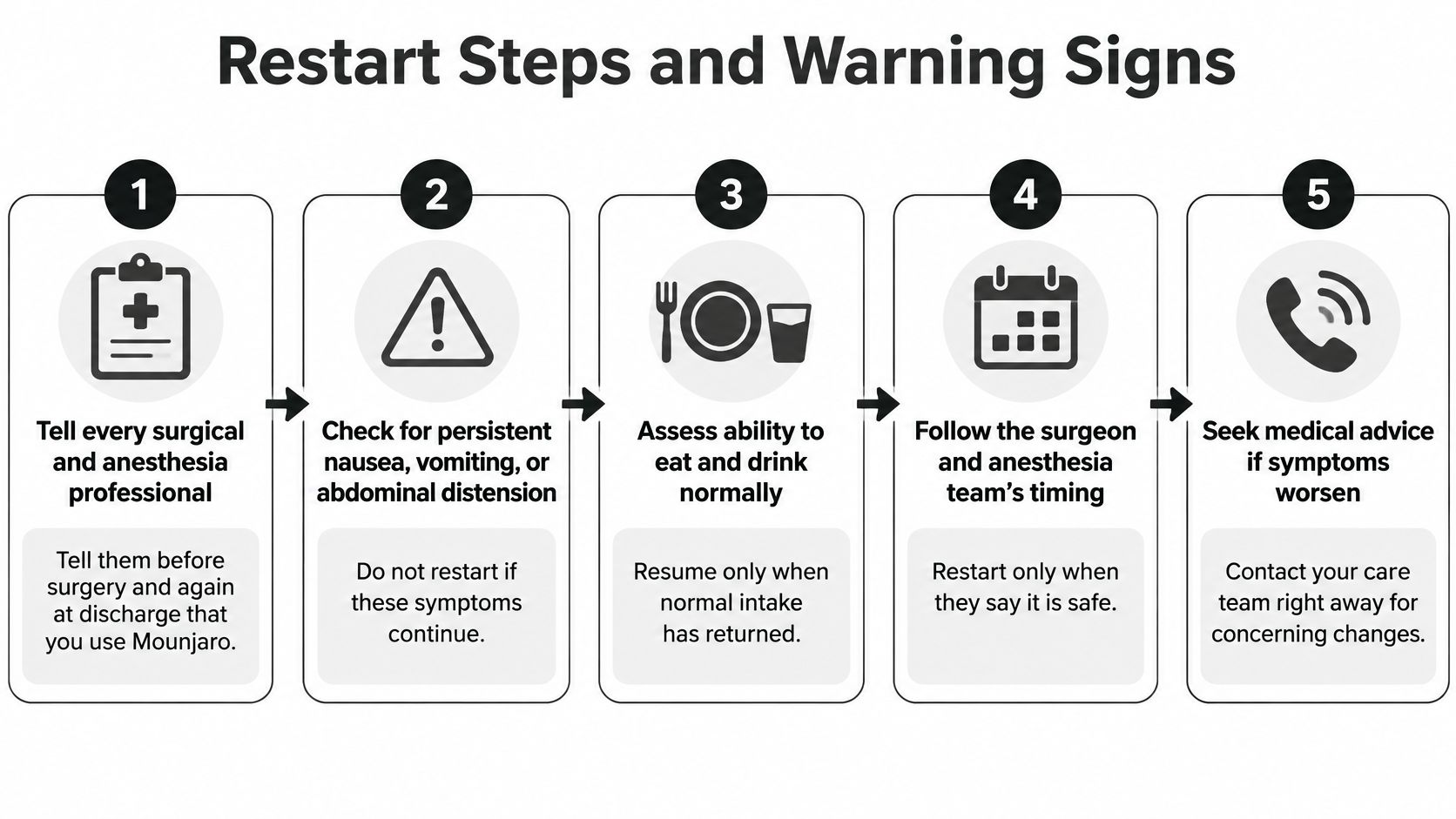
Six steps before your first post-surgery dose
- Tell every team twice: Inform surgical and anesthesia professionals before surgery that you use Mounjaro, then raise it again at discharge so restart instructions get written down.
- Screen for blocking symptoms: Check for persistent nausea, vomiting, abdominal distension, ileus, severe pain, or inability to tolerate oral intake. Don't restart while these persist.
- Confirm your usual diet: Eat your normal foods in normal amounts without significant gastrointestinal symptoms. Tolerating sips of clear fluid isn't the same green light.
- Confirm the dose: Ask your prescriber whether you resume the previously scheduled dose or step down. A prolonged interruption can require re-escalation because side effects are more common during initiation and escalation.
- Confirm the glucose plan: If you have diabetes, agree how often you'll check glucose around the restart and what readings trigger a call.
- Write it down: Record the restart date and dose on your medication list so every clinician sees the same plan.
Step 4 deserves extra attention if your break wasn't brief. At Weight Method, our patients can expect gradual dose escalation over 8-16 weeks and regular provider check-ins. That same gradual principle applies when tolerance may have faded. Jumping back to a higher dose can reproduce initiation phase nausea and vomiting at the exact moment you need nutrition for healing.
For a fuller picture of what reintroduction can feel like, review Mounjaro side effects to monitor during a restart before your first dose back. Knowing which symptoms are expected and which need a call prevents both panic and dangerous waiting.
Matching each warning sign to one action
The SPAQI guidance on symptom-based restarting recommends restarting a GLP-1 or dual GLP-1/GIP medicine after the patient has resumed their usual diet, while also considering postoperative nausea or vomiting, ileus risk, procedure type, glycemic status, interruption length, and administration requirements. That leads to a better question than when can you resume Mounjaro after surgery. Ask, have I returned to normal eating and bowel function, and am I free of significant nausea or vomiting?
| Symptom | Why it matters | What to do |
|---|---|---|
| Persistent vomiting | Blocks reliable absorption and can cause dehydration | Hold the dose and contact the prescriber the same day |
| Abdominal distension or reduced bowel function | May signal ileus after surgery | Do not restart; seek medical review |
| Unable to drink fluids or eat | Risk of dehydration and poor recovery | Seek prompt medical review |
| Hypoglycemia | Medication effect may be stronger when intake is low | Follow the glucose plan and seek urgent care if severe |
| Persistent hyperglycemia | Glucose control may be lost during recovery | Contact the prescriber for review before restarting |
Dehydration is the thread connecting several rows. Vomiting and poor intake can reduce fluid volume, affect kidney function, and destabilize glucose. Restarting a drug that can worsen nausea during escalation adds strain to a system that's already struggling, which is why hydration and renal risk shape the decision alongside diet.
Screen once, then act: If a symptom in the table is present, you don't need to debate the calendar. Hold the dose and contact the team.
You need individualized instructions if you had abdominal or gastrointestinal surgery, a prolonged hospital stay, or complications affecting oral intake. Success looks unspectacular, and that's the point. You've had a day or more of normal eating with no significant nausea, your bowels are working, you're hydrated, and you take the agreed dose on the agreed day.
Restarting After a Missed Dose or Long Break
The missed-dose rule is simple. Applying it after surgery is where people go wrong. The FDA label missed-dose instructions for Mounjaro permit taking a missed weekly dose within 4 days (96 hours). After more than 4 days, you skip that dose and take the next one on your normal weekly schedule. You don't double-dose to catch up.
That rule answers a scheduling question only. It doesn't grant surgical clearance. The same label provides no surgery-specific restart timetable, and ongoing vomiting, ileus, severe abdominal symptoms, or inability to eat and drink require clinician evaluation before resumption.
Use the lookup, then run the recovery check
| Time since scheduled dose | Action | Clearance check |
|---|---|---|
| Within 4 days (96 hours) | Take the missed dose only if eating normally with no GI symptoms | Confirm with the care team if unsure |
| More than 4 days | Skip the missed dose; take the next dose on the normal weekly day | Never double up |
| Ongoing vomiting, ileus, or cannot eat or drink | Do not take any dose yet | Seek clinician evaluation first |
Say you're on 7.5 mg and your injection fell due on the day of surgery. You're discharged six days later and you're still vomiting. The lookup gives you two reasons to wait. More than 4 days have passed, so the missed dose is skipped, and your vomiting blocks any dose until you've had clinical review. Once you're eating normally and your team agrees, you take the next scheduled dose on your usual day.
Contrast that with a simpler case. Your dose was due two days ago, your minor non-GI surgery went smoothly, and you're eating normally with no nausea. The 4-day window still applies, so your prescriber may confirm taking the missed dose now rather than waiting for the next weekly day. The difference isn't willpower or eagerness. It's recovery status.
When the break gets long
Longer interruptions change the dose, not just the date. Gastrointestinal side effects can return during re-escalation, so your prescriber may restart you at a lower step than your previous dose and build back up. At Weight Method, patients who have been off GLP-1 medication for more than three months begin two steps below their reported dose.
Before your next injection, ask two specific questions. What's my exact restart dose? How many weeks will I stay at each step before increasing? Write both answers down, because a vague instruction to restart lower invites guessing. You can compare the agreed plan against standard Mounjaro dosing steps so the numbers on your pen match the numbers in your plan.
One final caution closes this out. Mounjaro isn't recommended in severe gastroparesis, and significant GI symptoms warrant holding treatment and contacting your prescriber. Don't restart solely because the calendar says an injection is due without verifying bowel recovery and oral tolerance first.
Confirm Your Restart Plan With Your Care Team
A discharge packet works like a relay baton. The surgeon holds the wound plan, the anesthesiologist holds the sedation notes, and your prescriber holds the Mounjaro dose. If nobody writes the handoff down, the next injection gets decided from memory.
Ask for the answers in your discharge paperwork before you leave. A short written plan is easier to check later than a conversation you half remember between pain medicine and the ride home.
What to ask and what to record
- Last dose date: Confirm the exact day and dose of your final pre-surgery injection.
- Restart date and dose: Get both named explicitly, not left as resume when ready.
- Re-escalation plan: Ask whether you will step back up, and over how many weeks. A larger operation with a slow return to usual meals often means a lower restart step than a minor procedure where you are already eating normally.
- Glucose monitoring: If you have diabetes, confirm checking frequency and what to do if readings drift.
- Call triggers: Ask which symptoms need a same-day call, which need urgent care, and who to contact after hours.
Readiness is a recovery check. Usual diet, with no significant nausea, vomiting, or other GI symptoms, is the practical signal your surgeon and prescriber look for before they clear the next dose. Surgery type changes that timeline. Abdominal or GI procedures delay oral tolerance longer than a minor non-GI case, so the same pen strength is not automatically the right restart.
Preparation starts before discharge day. If surgery is still ahead of you, reviewing lifestyle changes before your procedure alongside your medication questions helps you arrive with one complete list rather than scattered concerns. Bring the written restart plan to your next appointment so your prescriber can check it against your current dose and recovery.
Follow-up tightens after a restart. Weight Method typically schedules follow-up check-ins monthly, and the provider may recommend more frequent visits during the initial weeks of treatment. Ongoing monitoring includes progress tracking, dosing adjustments, and continuous support throughout the program, so early nausea or a glucose change has a scheduled place to be caught.
Tell every future surgical team that you use Mounjaro, including teams doing minor procedures with sedation. The surgeon and the prescriber make the final call. You leave with the written dose, the step-up schedule, and the recovery signs they want to see first.
If you're planning surgery or working through a restart and want a prescriber who will map your dose, re-escalation steps, and check-in schedule with you, visit Weight Method to start with an online assessment reviewed by a licensed provider. You'll get a documented plan and ongoing support, so you're not deciding your next injection date on your own.