You've lost insurance after changing jobs, your doctor agrees that tirzepatide may be appropriate, and the pharmacy counter gives you a choice between a large cash bill and walking away from treatment. That's the reality behind many searches for a tirzepatide prescription without insurance.
The useful question isn't whether you can obtain the medication. You can often access it through a retail pharmacy, a manufacturer self-pay program, or a telehealth service. The better question is which option remains affordable after dose increases, maintenance treatment, clinical follow-ups, and refill rules. The cheapest starting price can become a poor deal when the dose rises or a program's refill window expires.
Why Uninsured Patients End Up Searching for Tirzepatide
A working adult changes jobs, loses access to a previous health plan, and discovers that the new plan excludes weight-management medication. Their clinician still considers treatment medically appropriate, but the prescription now lands outside the insured channel. A high deductible, a prior-authorization denial, or a formulary exclusion can create the same result, even when the patient technically has insurance.
That situation is common among gig workers, people employed by small businesses, and adults whose plans cover diabetes treatment but not obesity treatment. Some patients also face a deductible that resets each January, making the cost unpredictable even after they've started therapy. For a practical overview of how medical expenses can affect household planning, see these covered medical costs explained by Gerald Technologies, Inc.
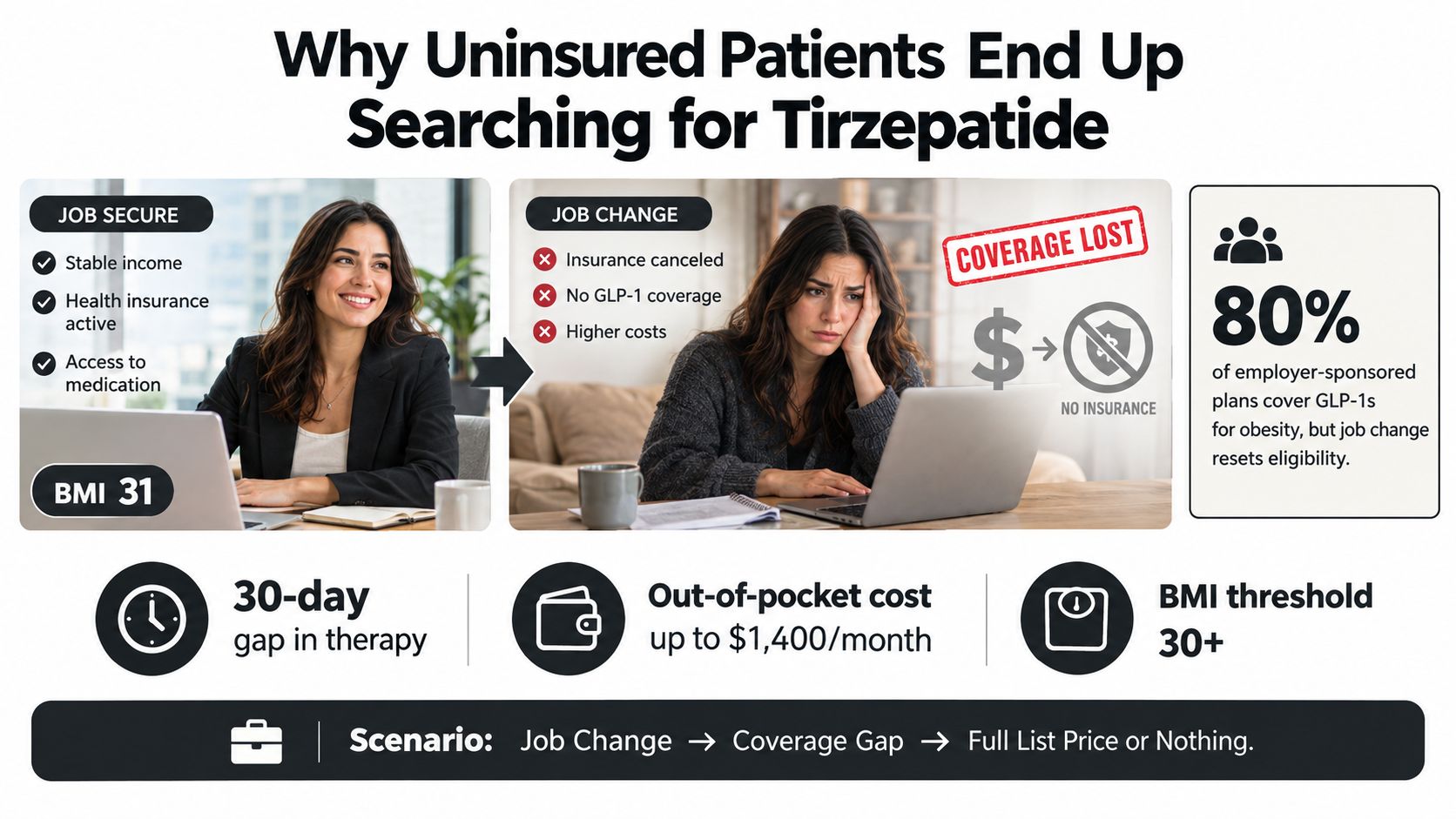
Tirzepatide's demand expanded sharply after the FDA approved it for chronic weight management on November 8, 2023, beyond its earlier type 2 diabetes use approved in 2022. CNBC's report on the FDA approval and launch pricing describes how Eli Lilly launched Zepbound with both a list-price channel and a cash-pay savings strategy. That widened access for some people, but it also exposed the limits of insurance designs that never included anti-obesity medication.
Coverage is improving, but it hasn't become dependable. A 2025 analysis found injectable tirzepatide coverage rose from 26.5% in 2022 Q3 to 92.9% in 2024 Q3, while the AMA reported in 2026 that only 39.4% of people with private insurance had obesity-medication coverage under their plan. The same coverage analysis found that only 56% of people with sponsored health insurance had obesity-medication coverage, as detailed in this coverage analysis published by the National Library of Medicine.
Practical rule: Treat insurance as a variable, not a foundation. Price the medication as if coverage could disappear before you commit to a long-term plan.
The first thing I tell cash-pay patients is to compare their full treatment pathway, not just the first invoice. Start with the dose you'll use now, estimate what happens after titration, add the clinical fee, and ask how the provider handles refills. A low introductory price means little if the next dose costs substantially more or the program ships only when supply is available. This guide to GLP-1 cost without insurance is useful for putting the medication bill into a broader cash-pay budget.
How Tirzepatide Is Priced and Why Cash-Pay Exists
If you are paying out of pocket, the first quote can be misleading. Brand-name tirzepatide costs more because patients are buying a patented, manufacturer-produced medicine without a generic equivalent. Eli Lilly sells tirzepatide under two labels, Mounjaro for type 2 diabetes and Zepbound for chronic weight management. The same active ingredient can therefore face different indications, payer rules, and commercial pricing.
Eli Lilly listed Zepbound at $1,059.87 per month at launch. That equals more than $12,700 per year at list price. An eligible uninsured patient using the launch savings-card cash price as low as $550 for a one-month or three-month prescription could still spend more than $6,600 annually at that monthly rate. The launch pricing is documented in Eli Lilly's announcement.
The purchase route changes the bill. A retail pharmacy dispenses a branded product through manufacturer, wholesaler, and pharmacy channels. A direct self-pay vial can use a different presentation and distribution model, so it may cost much less than a standard retail pen. Compare the total pathway, not only the first prescription.
The cost rises when the dose rises
Tirzepatide usually starts at a lower dose and may increase gradually under clinician supervision. Budget for the maintenance dose and recurring refills before choosing a provider. A low starting price has limited value if the next dose costs substantially more or the program ships only when supply is available.
| Price component | Typical value | Why it matters |
|---|---|---|
| Brand-name Zepbound at retail | About $1,086 to $1,094 per month | Standard retail pricing can make sustained cash payment difficult. See GoodRx's Zepbound cost comparison. |
| LillyDirect self-pay vial | Roughly $299 to $449 per month, depending on dose and refill timing | Direct pricing may be materially lower than retail, but eligibility and refill rules matter. |
| Launch list price | $1,059.87 per month | The original launch price shows why uninsured access became a major concern. |
| Annual retail exposure | More than $12,700 per year at launch list pricing | A monthly quote can hide the long-term commitment. |
| Reduced cash-pay exposure | More than $6,600 per year at the launch savings-card cash price | Even a discount may not make treatment affordable for every household. |
Payers still shape what patients pay. Employer plan design, pharmacy-benefit negotiations, prior authorization, and exclusions for obesity treatment can determine whether you pay a copay or the entire cash price. If you are reviewing broader medication coverage options, this resource on prescription insurance for Florida residents explains how plan structure affects prescription costs. For cash-pay planning, compare the highest expected dose, clinical fees, refill timing, and pharmacy route before starting.
Getting a Tirzepatide Prescription Through Telehealth
Telehealth should shorten the trip to appropriate care, not eliminate the clinical evaluation. A legitimate provider starts with an intake form that asks about your current weight, BMI, medical history, related conditions, prior weight-loss attempts, medications, allergies, and previous GLP-1 use.
The screening should also identify situations that require caution or may rule out treatment. Tell the clinician about a personal or family history of medullary thyroid carcinoma or Multiple Endocrine Neoplasia syndrome type 2. Pregnancy, breastfeeding, gastrointestinal conditions, pancreatitis history, diabetes treatment, and other medications also belong in the discussion.
The consultation should answer clinical and financial questions
A video or phone visit with a physician, nurse practitioner, or physician assistant gives the provider a chance to verify that treatment fits your health profile. The clinician may review recent lab work or request testing such as A1c, lipids, or thyroid testing, depending on your history and the treatment plan.
You should leave the visit knowing the starting dose, the conditions for increasing it, the expected follow-up timing, and the pharmacy destination. The prescriber should also explain what happens if nausea, vomiting, constipation, abdominal pain, or other side effects interfere with treatment.
Pharmacy routing changes the experience
Your prescription may go to a local retail pharmacy, a cash-pay mail-order pharmacy, or a patient-specific compounding pharmacy where legally and clinically appropriate. Ask who dispenses the medication, whether the pharmacy is licensed in your state, how shipping is handled, and whether you'll receive branded packaging or a compounded preparation.
Self-injection training matters too. A lower medication price doesn't compensate for unclear instructions, poor storage guidance, or no way to reach the prescriber. Patients comparing programs can use this guide to compare telehealth GLP-1 providers and then ask each service for its complete medication, consultation, shipping, and follow-up price.
Monthly monitoring doesn't always mean a new lengthy visit. It does mean someone should review your response, side effects, weight trend, medication use, and readiness for any dose adjustment. Before choosing a provider, review how to get tirzepatide online with a focus on the clinical process, not just the sign-up speed.
Comparing the Main Cash-Pay Paths Side by Side
You can find an attractive starter price, then face a very different bill after dose increases and monthly refills. Compare the full treatment path, not the first payment. Cash-pay patients generally choose among branded retail Zepbound, LillyDirect self-pay vials, compounded telehealth programs, or discount and international channels.
Branded retail is the most familiar route and provides a manufacturer-labeled product, but it can create the highest recurring cash expense. LillyDirect self-pay vials may lower the branded cost, while dose tiers, availability, and refill timing determine whether the listed amount applies.
Compounded telehealth programs may combine clinical care, medication, and fulfillment in one fee. That structure can suit patients who want predictable support, but the product is not FDA-approved in the same way as Zepbound, and pharmacy supply or legal conditions may change. Discount cards may offer little help with brand-only medication. International purchasing adds prescription, shipping, and regulatory concerns.
| Path | Approx. monthly cost | Refill stability | Key trade-off |
|---|---|---|---|
| Branded retail Zepbound | About $1,086 to $1,094 | Usually straightforward when the pharmacy has stock | Highest routine cash exposure, especially at retail pricing. |
| LillyDirect self-pay vials | Roughly $299 to $449, depending on dose and refill timing | Depends on program rules and timely refills | Lower branded cash price, but the refill calendar can change the amount due. |
| Compounded telehealth | Varies by provider and dose | Can be affected by pharmacy supply and changing rules | Potentially lower cost with more regulatory and product-quality questions. |
| Discount-card or international channel | Varies widely | Less predictable | Discount cards may do little for brand-only medication, and overseas sources carry added risk. |
The listed price is only the starting point. Ask what the next dose costs, whether shipping is included, whether the provider charges a membership fee, and whether a missed refill window changes the bill. Confirm that the dispensing pharmacy is licensed to serve your state.
My recommendation: If you want branded medication and qualify for the manufacturer's self-pay route, compare it with retail pricing before considering a compounded option. Base the comparison on the dose you expect to maintain, not only the starter dose.
Build a twelve-month worksheet before choosing. Separate provider fees, medication, shipping, supplies, laboratory work, and follow-up charges. Review current tirzepatide injection prices and enter the amount for each expected dose, then check whether the total changes after escalation or a late refill.
If a company will not disclose these terms before payment, exclude its introductory price from your comparison. The cheapest route is the one that remains affordable when the dose and refill schedule change.
Savings Cards, Direct Programs, and Other Ways to Lower the Bill
Savings programs sound interchangeable, but they aren't. A manufacturer savings card often targets commercially insured patients, and eligibility may depend on the exact plan, residency, product, and enrollment terms. Uninsured patients frequently fail the eligibility check because the card is designed to reduce an insured patient's cost share, not replace coverage entirely.
Eli Lilly's direct self-pay pathway is more relevant to many uninsured adults. Its value comes from changing the dispensing route, particularly when a self-pay vial costs less than the standard retail presentation. The exact amount still depends on the dose, refill timing, and program terms, so save the pricing page and confirm the amount before each major dose change.
Read the eligibility conditions before relying on a discount
Check these details before entering payment information:
- Coverage status: Determine whether the offer accepts people without commercial coverage or requires an eligible commercial plan.
- Government coverage: Confirm whether Medicare, Medicaid, Veterans Affairs, or TRICARE status affects eligibility.
- Residency: Verify that the program serves your state and that the dispensing pharmacy can legally ship there.
- Refill timing: Ask whether a missed window moves you into a higher price tier.
- Renewal terms: Find out whether you must re-enroll annually or reconfirm eligibility.
- Total bill: Add consultation, membership, shipping, labs, supplies, and medication rather than comparing the drug line alone.
A telehealth membership may bundle the evaluation, messaging, prescription management, and medication fulfillment. That can simplify budgeting, but only if the membership remains clear when the dose changes. Third-party discount platforms can still help you compare retail pharmacies, yet they shouldn't be treated as a guaranteed solution for a brand-only medicine.
Treat compounded pricing as a separate decision
A 503A pharmacy generally compounds for an identified patient under a prescription, while a 503B outsourcing facility operates under a different regulatory framework for certain bulk compounding activities. Neither label means you should skip verification. Ask for the pharmacy's name, state license, dispensing process, labeling, storage instructions, and the clinician's reason for choosing a compounded product.
Don't pay a non-branded invoice until you know exactly what you're receiving, who prescribed it, where it was made, and how adverse events are reported. A low price is not useful if the provider can't explain the formulation or the pharmacy can't verify its license.
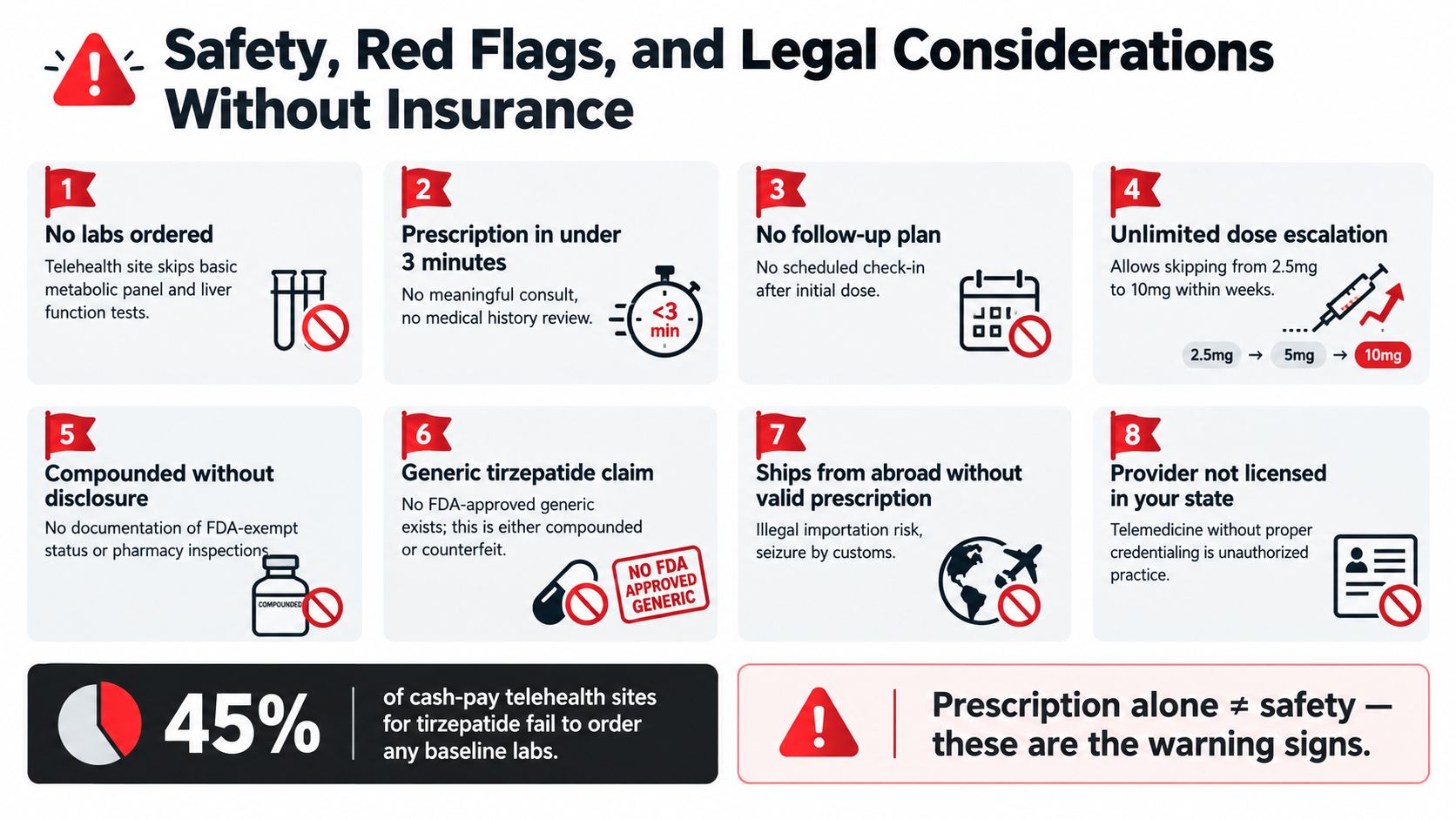
Safety, Red Flags, and Legal Considerations Without Insurance
A prescription doesn't automatically make a cash-pay pathway safe. Some telehealth sites make treatment look like a checkout process, with little medical history, no meaningful consultation, no lab discussion, and automatic refills that continue without a clinician actively reviewing the patient.
Be especially cautious when a provider promises rapid escalation or treats every patient the same. Tirzepatide dosing should be individualized, and a clinician should ask about symptoms before increasing the dose. A pharmacy should also identify the product clearly instead of using vague labels such as “research peptide” or “generic tirzepatide.”
What a responsible provider should document
Before treatment, expect a review of your weight, medical history, medications, and relevant metabolic information. Depending on your circumstances, the provider may request baseline A1c or fasting glucose testing and other labs. The clinician should discuss pancreatitis symptoms, gastrointestinal effects, pregnancy considerations, and the thyroid-cancer contraindication.
Before each dose increase, you should have a way to report side effects and receive a clinical decision. If the program never asks how you tolerated the previous dose, it isn't providing the level of oversight that cash-pay treatment requires.
Ask hard questions about compounded medication
Compounded tirzepatide hasn't been reviewed by the FDA for safety, effectiveness, or quality in the same way as an FDA-approved product. It should be prescribed only when a licensed provider determines that an approved alternative isn't suitable for the specific patient, and availability can change as shortage and enforcement conditions evolve.
Use a state-licensed pharmacy and request the lot number, expiration information, storage instructions, and a clear route for reporting an adverse event. Keep access to the original telehealth portal, verify that the provider is licensed in your state, and avoid any source that ships medication internationally without a valid prescription.
Walk away if: The site won't identify the prescriber or pharmacy, won't explain the formulation, won't schedule follow-up, or lets you increase the dose without a clinical review.
Choosing Your Path and What to Watch Next
Make the choice based on your maintenance budget, not your first-month budget.
- Choose a branded self-pay vial if product identity and manufacturer supply matter most, and the program's dose-tier pricing fits your expected maintenance dose.
- Choose a reputable compounded telehealth pathway only after confirming patient-specific prescribing, pharmacy licensure, formulation details, clinical follow-up, and the reason an approved product isn't suitable.
- Use a discount card stack when it produces a verified retail price reduction, but don't assume it will materially lower a brand-only prescription.
- Wait for coverage or appeal if the cash price would force you to stop treatment, especially when a prior-authorization appeal or employer-plan change is realistic.
Coverage is moving, but the figures show an uneven market rather than universal access. Track your plan's obesity-drug language, prior-authorization rules, and formulary updates. Also watch FDA communications about compounded medication, because a change in shortage status or enforcement policy can affect availability and legal dispensing conditions.
Within the next 48 hours, download your plan's pharmacy formulary, record your current weight and BMI, gather recent lab results, and book a consultation with a licensed prescriber who will disclose the medication source and complete monthly cost before prescribing. Ask for the price at your likely maintenance dose in writing.
If you're comparing cash-pay options, Weight Method offers online intake, licensed-provider consultations, prescription management, home delivery, and ongoing messaging for eligible patients. Visit the program to review its current pricing and determine whether its supervised tirzepatide pathway fits your budget and clinical needs.