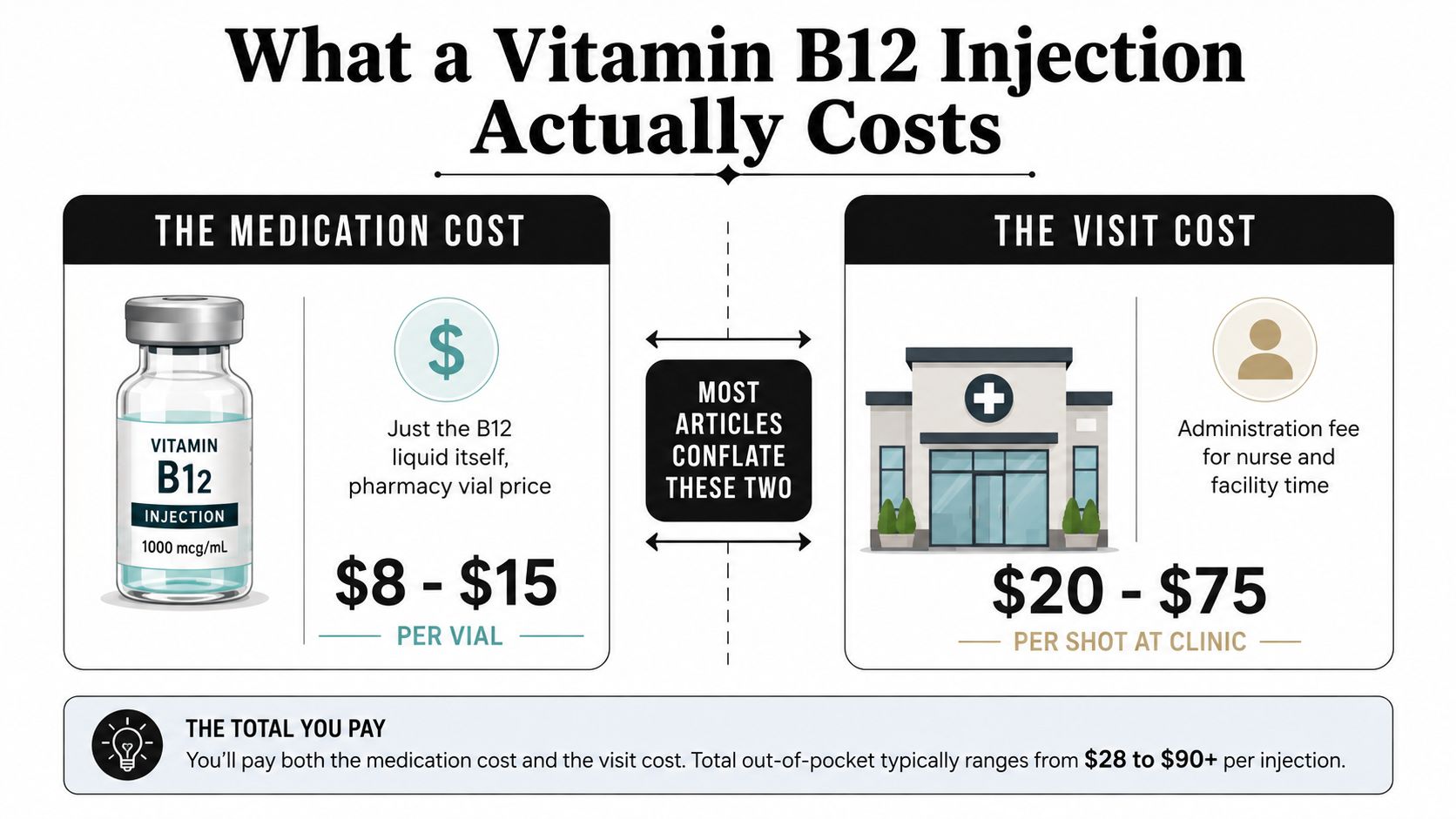
A vitamin B12 injection costs $20 to $75 per shot at a clinic, but only $8 to $12 per dose when self-administered from a pharmacy vial. Telehealth bundles typically run $30 to $150 per month.
The popular advice is to compare one clinic's “B12 shot price” with another clinic's price. That's the wrong comparison. Most of what you pay isn't the vitamin. It's the appointment, administration, supplies, clinical oversight, and facility overhead wrapped around a small amount of inexpensive medication.
If you're asking “How much does a vitamin B12 injection cost?”, start by asking a better question: Am I buying the drug, or am I buying a service? That distinction can turn a recurring clinic bill into a much cheaper prescription-vial arrangement, provided a qualified clinician confirms that injections are appropriate and teaches you how to use them safely.
What a Vitamin B12 Injection Actually Costs
Two prices get blurred together in most online guides. The first is the medication price, meaning the B12 liquid in a pharmacy-dispensed vial. The second is the visit price, which covers the person and facility delivering the injection.
Published U.S. pricing examples place a clinic-administered shot at roughly $20 to $75 per injection, while an at-home dose from pharmacy-dispensed supplies can cost about $8 to $12. Telehealth-style plans sit in a different category, with bundled pricing around $30 to $150 per month because the fee may include medication, supplies, prescribing, monitoring, and shipping. Biology Insights' B12 cost breakdown outlines how those service models produce very different totals.
A quoted “per shot” price usually refers to one administration, often involving 1,000 mcg of cyanocobalamin given intramuscularly, although the exact formulation, dose, route, and schedule must come from your prescriber. Don't assume that a monthly clinic price applies to you if your treatment plan uses a different interval or formulation.
Read every quote as a bundle
A posted price may exclude:
- The consultation, especially if a clinician must assess symptoms or review laboratory results.
- Administration, which pays a nurse, medical assistant, or other qualified professional.
- Supplies, including a syringe, needle, alcohol swab, and disposal materials.
- Clinical oversight, such as prescribing, follow-up messages, or treatment monitoring.
- Facility charges, particularly in urgent care or specialized wellness settings.
That's why a medication priced in single digits can become a clinic charge in the tens of dollars or more. Before scheduling a vitamin B12 appointment, ask whether the advertised amount includes the consultation, injection, supplies, and any follow-up.
Use this framework whenever someone gives you a price: separate the drug, supplies, clinician time, and facility overhead. Once those four layers are visible, the vitamin B12 injection cost stops looking random.
The Four Cost Layers Behind Your Bill
The medication itself is usually the least expensive part of the transaction. One retail listing shows injectable vitamin B12 at an average insurance price of $2.00 and a retail price of $6.99, while another listing prices a 25 mL vial at $90.35, or $3.61 per 1 mL unit. Amazon Pharmacy's injectable vitamin B12 listing illustrates why pharmacy prices can look completely different from clinic prices.
| Cost Layer | Typical Range | Most Negotiable? |
|---|---|---|
| Medication | About $2 to $15 in cited pharmacy-price examples | Yes, by comparing pharmacies and package sizes |
| Supplies | Varies by kit and reuse period | Sometimes, especially for home supplies |
| Clinician time | Included in or added to the service price | Sometimes, through cash-rate requests |
| Facility overhead | Varies sharply by setting | Often, by avoiding urgent care or premium clinics |
The first layer is the B12 product. Drugs.com's cyanocobalamin price guide lists a U.S. retail example of about $26.98 for 25 mL, with larger packages lowering the unit cost. The important point isn't one exact shelf price. It's that package format materially affects the cost per dose, while the administered service can add far more than the liquid itself.
Supplies form the second layer. A home user may need syringes, needles, alcohol swabs, and a sharps container. Those items don't always appear in a clinic's headline price, but they're part of the self-administration budget.
Clinician time is the third layer. A nurse or medical assistant must verify the order, prepare the dose, administer it, document the service, and respond to immediate concerns. A physician-led visit may include broader evaluation and oversight, which increases the bill even when the injection itself takes only moments.
Facility overhead is the fourth layer. A primary care office, urgent care center, med spa, and telehealth platform have different staffing, rent, technology, and billing structures. The final price reflects that environment.
Practical rule: Ask for the medication price and administration price separately. A provider that won't explain the components clearly isn't giving you a useful quote.
For broader budgeting, compare the injection with other recurring medical expenses in your out-of-pocket healthcare cost planning. The most negotiable layer is usually the service model, not the vitamin. Switching from an in-office shot to a prescription vial can remove repeated administration and facility charges, but only after your clinician confirms that home use is suitable.
Comparing Prices Across Provider Types
The cheapest option depends less on the B12 molecule than on who supplies it and who gives it to you. A primary care office may fold the injection into a broader appointment, while urgent care may charge for a quick standalone service. Telehealth plans package access differently, and a pharmacy vial separates the prescription from the administration entirely.
| Provider Type | Total Cost | Includes | Best For |
|---|---|---|---|
| Primary care office | Depends on visit and insurance terms | Evaluation, clinical record, possible injection administration | Patients with a diagnosed deficiency and an established clinician |
| Urgent care clinic | Often a standalone cash service | Walk-in access and administration | People who need convenience and lack a scheduled appointment |
| Telehealth subscription | About $30 to $150 per month | Remote evaluation, prescription management, and sometimes supplies or medication | Patients who prefer recurring home delivery and virtual oversight |
| Pharmacy pickup with self-administration | Medication cost plus supplies and training | Prescription vial and home materials | Stable users who want to avoid repeated visit fees |
The primary care route makes sense when you already have coverage, an established diagnosis, or a need for laboratory review. Its weakness is friction. You may need to book an appointment even when you only need a scheduled dose, and the office may bill the encounter rather than the injection as a simple standalone purchase.
Urgent care is convenient but usually gives you the least control over the bill. The clinic may apply a walk-in charge, require an evaluation, or order services that aren't necessary for a routine, documented treatment plan. Ask for the cash price before arriving and confirm whether a clinician visit is mandatory.
Telehealth bundles are easier to compare because the recurring charge may include several elements. The tradeoff is that monthly renewal charges can continue even when you don't need a new visit, and the package may be priced for convenience rather than the lowest possible medication cost.
Pharmacy pickup with self-administration usually wins for someone with a stable prescription, regular travel, or a long-term need for injections. It isn't automatically appropriate for a new user. You still need a diagnosis, a prescription, clear instructions, and a way to contact your clinician if symptoms change.
The lowest sticker price isn't always the lowest total cost. Count the appointments, renewals, supplies, travel, and time required to receive each dose.
My recommendation is straightforward. Use primary care when insurance and medical complexity make oversight valuable. Use telehealth when convenience and remote support matter more than buying the drug alone. Use a pharmacy vial only after proper training, and avoid paying an urgent care premium for a routine injection whenever another safe option is available.
Getting a Prescription Vial and Self-Administering
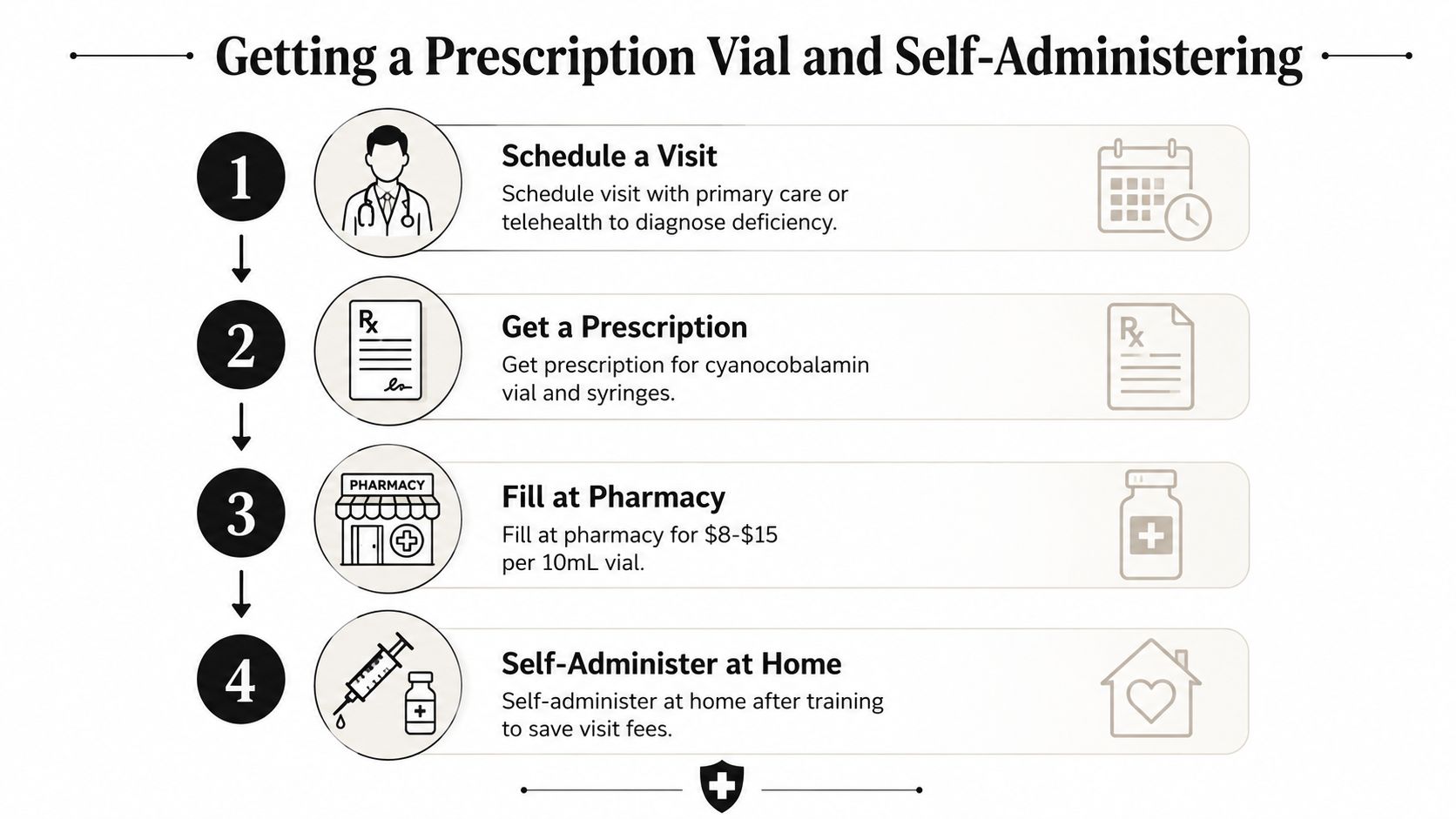
A prescription vial can be the most practical cost-saving route for a patient who needs ongoing treatment and is comfortable with home administration. The process should start with diagnosis, not with buying a vial online.
Start with a legitimate prescription
Book an assessment with a primary care clinician, telehealth provider, or nurse practitioner. The prescriber can determine whether you need cyanocobalamin or another formulation, decide on the dose and schedule, and write the prescription for the medication and any required supplies.
Ask the pharmacy to quote the exact product, package size, concentration, and cash price. A generic cyanocobalamin product may be inexpensive, but the price can change with dispensing format, pharmacy, and insurance status. Compare recognized pharmacy channels rather than relying on an unverified marketplace seller.
Buy the complete home setup
You'll need more than the vial. Confirm that you have:
- Sterile syringes and needles: Use the size and route your clinician prescribes.
- Alcohol swabs: Prepare the vial top and injection site as instructed.
- A sharps container: Dispose of every used needle and syringe safely.
- Storage guidance: Follow the product label and your pharmacist's instructions.
Your clinician should demonstrate the technique in person or through an appropriate clinical training process. Don't improvise the injection site, needle size, route, or schedule. Some clinicians may prescribe intramuscular administration, while others may choose subcutaneous use when clinically appropriate. The route is a medical decision, not just a cost preference.
Treat safety as part of the savings
Store the vial exactly as the label directs, inspect it before use, and never share a vial, syringe, or needle. Place used sharps directly into an appropriate container and follow local disposal rules. If you're learning the process, use a clinician-approved guide such as this resource on how to take a shot safely, but follow your own prescriber's instructions if they differ.
Avoid “research-grade” products and sellers who won't provide pharmacy labeling, prescription verification, lot information, and appropriate storage details. A lower price is not a bargain if the product isn't intended for human use or the supply chain can't be verified.
Pharmacist prescribing rules vary by jurisdiction. Ask your local pharmacist whether they can assess and prescribe B12 under applicable rules, but don't assume that option exists where you live. The legal, safe path is a licensed clinician, a valid prescription, pharmacy-dispensed medication, and proper training.
Insurance Coverage and FSA/HSA Strategies
Insurance coverage depends on why you need B12, where it's administered, and how the claim is coded. A medically documented deficiency is easier to justify than a wellness injection requested by someone with normal levels.
In U.S. billing, J3420 is associated with a cyanocobalamin injection, while J3424 is associated with hydroxocobalamin. These codes help a clinic submit the medication component, but they don't guarantee payment. Your plan may still apply a deductible, copay, coinsurance, office-visit rule, or separate administration charge.
| Payer / Account | Covers B12 Injection? | Typical Patient Cost | Key Requirement |
|---|---|---|---|
| Commercial insurance | Often possible for documented deficiency | Depends on plan terms | Medical necessity, eligible provider, correct claim |
| Medicare | May cover a medically appropriate clinical administration | Depends on Part B cost sharing | Covered indication and documentation |
| Medicaid | Rules vary by state | Depends on state program | Eligible diagnosis, provider, and program rules |
| FSA or HSA | Potentially eligible when medically necessary | Depends on account and receipt | Itemized documentation and account rules |
| Preventive wellness purchase | Often limited or excluded | Usually cash pay | No covered medical indication |
Your insurer may ask for laboratory evidence or clinical documentation. Don't assume that a clinic's use of a J-code means your plan will pay. Call the member-services number and ask about the medication code, the administration code, the provider type, prior authorization, and whether the service is subject to your deductible.
Medicare and commercial plans can treat a medically necessary injection differently from an elective wellness shot. Medicaid policies vary by state. For every payer, the practical move is the same: obtain a written estimate and request an itemized receipt.
Use tax-advantaged accounts carefully
FSA and HSA eligibility usually depends on medical necessity and documentation. Keep the prescription, itemized receipt, and any supporting statement your plan administrator requests. A provider's wellness branding doesn't automatically make an injection an eligible medical expense.
For a useful checklist on smart ways to use your FSA, review the account rules before paying. Don't purchase a bundled plan assuming the entire monthly charge qualifies. Separate eligible medical services from nonmedical coaching, convenience fees, or unrelated products.
The simplest money-saving move is often paying for a medically necessary prescription at a regular pharmacy with your account card, rather than buying a heavily marked-up specialty bundle. Confirm eligibility first, then keep the documentation.
How Formulation and Injection Method Affect Price
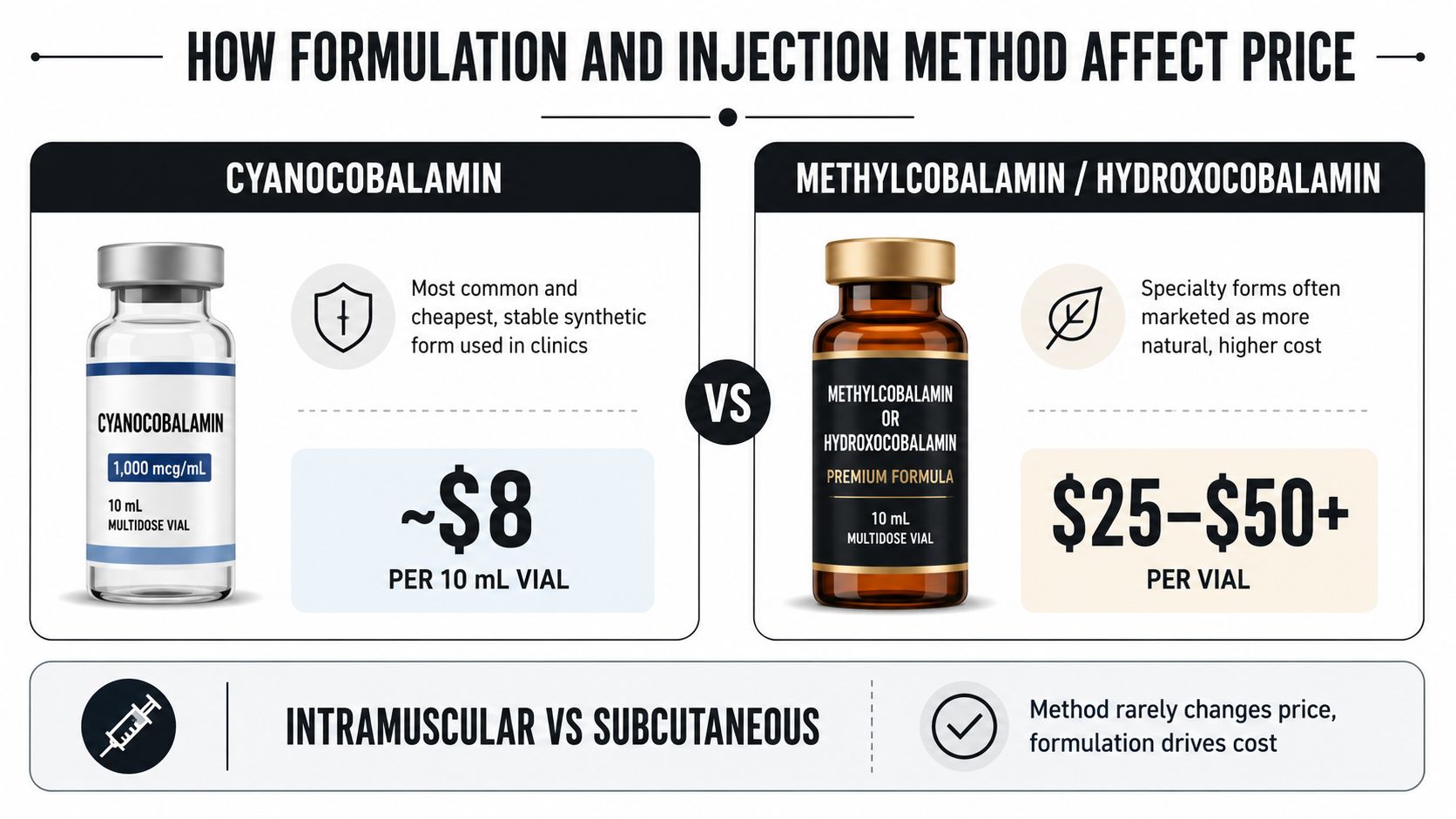
Formulation can change the quote, but the expensive part is often the service model. Cyanocobalamin is commonly available as a generic injectable product, while methylcobalamin and hydroxocobalamin may be less consistently stocked or marketed as specialty choices.
Neutral international pricing makes the point. Malaysia's government medicines guide lists cyanocobalamin 1,000 mcg/mL injection at 15.00 MYR per vial in 2026, while U.S. pharmacy-price examples place generic injectable B12 in the low single-digit to high single-digit dollar range per vial. Malaysia's government drug-price guide shows why country and formulation matter before you compare a U.S. clinic quote with an overseas medication price.
Methylcobalamin may cost more through certain pharmacies or compounding channels, but a higher price doesn't establish superior results for every patient. Hydroxocobalamin is common in some healthcare systems yet may be harder to find in U.S. retail pharmacies. Ask your prescriber why a particular formulation is medically appropriate rather than paying a premium for marketing language such as “active” or “natural.”
Method affects convenience more than the drug price
Intramuscular and subcutaneous administration use different techniques and may involve different needle choices. Some patients find subcutaneous administration easier to perform at home, but your clinician must decide whether that route fits your diagnosis, product labeling, and treatment plan.
The injection method usually matters less to the total price than whether a clinician administers each dose. A pharmacy vial can reduce repeated facility charges, while a clinic visit preserves hands-on oversight. Choose based on medical suitability and training, not needle preference alone.
Compounded products deserve separate scrutiny. If you're considering a compounded methylcobalamin product, read about why compounding pharmacy medications aren't FDA approved and ask the pharmacy what quality controls and labeling apply. “Compounded” and “FDA-approved” aren't interchangeable descriptions.
For a discussion of combined formulations, review MIC and B12 injections as a separate question from basic B12 replacement. A combination product may add ingredients and cost without addressing the reason you need B12 in the first place.
Choosing the Right Option and Cutting Your Costs
Start with the medical situation, then choose the payment channel. A stable, diagnosed deficiency with insurance usually favors an established primary care relationship. Someone who travels frequently and has a long-term prescription may benefit from trained self-administration. Someone pursuing a general energy boost without confirmed deficiency should pause before spending money on injections.
Use this decision path:
- Do you have a documented deficiency or a clinician-determined need? If not, ask for an appropriate evaluation before committing to recurring treatment.
- Do you need ongoing monitoring or help with injection technique? If yes, keep a clinical administration option available.
- Are you paying cash for repeated visits? Ask whether a prescription vial and supervised training are appropriate.
- Does your plan cover the service? Verify the medication, administration, provider, and deductible rules separately.
- Are you comparing total annual cost? Include visits, supplies, shipping, renewals, travel, and missed work.
Make the quote easier to compare
Ask for the product's NDC, the administration fee, the consultation fee, the supply charge, and the expected refill schedule. Compare cash prices at multiple pharmacies, ask whether a larger package is available, and request a longer prescription supply when your clinician agrees. A larger vial or multi-dose format may reduce the unit cost, but it also creates storage, handling, and expiration considerations.
Avoid clinics that refuse to disclose what the fee includes. Be cautious with subscriptions that renew automatically, med spas that charge a premium for a cosmetic “shot,” and providers that sell a formulation without explaining why it fits your needs.
My recommendation: If you need regular injections, ask your prescriber directly whether pharmacy-dispensed home administration is safe and appropriate. If you don't have a confirmed need, spend the money on evaluation before spending it on injections.
Weight Method offers telehealth consultations, ongoing support, and home delivery for its medically supervised weight-management plans, which is a different service from standalone B12 replacement. If you're comparing virtual-care models, distinguish the medication you need from the broader clinical program you're considering.
Review your treatment and spending plan periodically with your clinician. If the diagnosis, formulation, route, or frequency changes, recalculate the total instead of assuming last year's price still applies.
If you're comparing recurring healthcare expenses, Weight Method provides virtual consultations, licensed-provider support, and home delivery for medically supervised weight-management treatment. Visit the site to review the program, pricing, and eligibility before deciding whether its broader telehealth model fits your needs.